Get Full Government Meeting Transcripts, Videos, & Alerts Forever!
Get email alerts on the Foreign Adversary Investments topic
No spam. Unsubscribe anytime.
Committee hears bill to bar state and local approvals of development deals with foreign adversaries
Summary
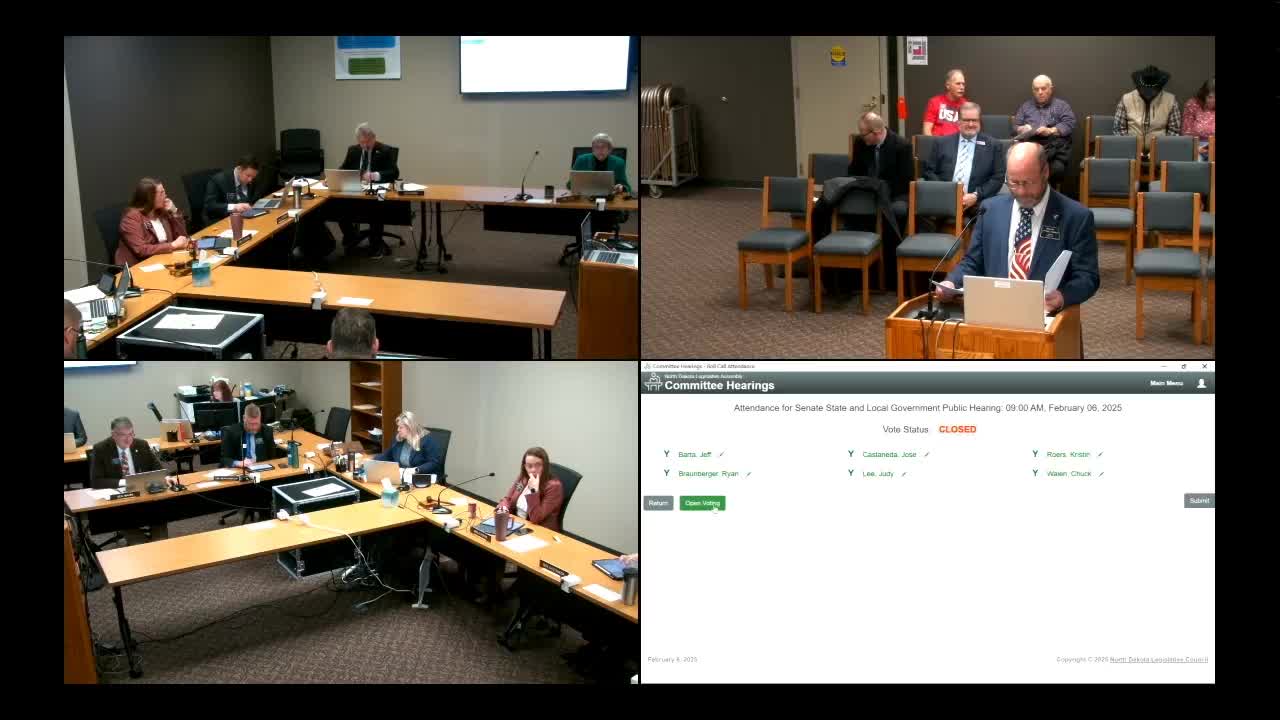
Sen. Jeff Magram introduced Senate Bill 23-14 at a hearing to prohibit local and state approvals of development agreements with persons or governments identified as foreign adversaries.
Sen. Jeff Magram introduced Senate Bill 23-14 at a State and Local Government Committee hearing on a measure that would prohibit county, city and state entities from procuring, authorizing or approving development agreements with individuals or governments identified as foreign adversaries in federal law.
The bill, Magram told the committee, “The goal of 23 14 is to create a path to protect our state and nation from foreign adversaries.” Supporters said the measure would create an investigatory path — starting with a complaint to a county sheriff or state's attorney and then referral to the state and local intelligence center (SLIC) and the FBI — and would include criminal penalties and disqualification from holding state office for violators.
Proponents framed the bill as a response to perceived national-security risks from foreign investment. Ross Kennedy, a geopolitics consultant who testified in favor, said the proposal reflects a broader national effort to identify and manage complex ownership structures and “tap into the federal pipeline of resources” to protect state assets and military installations. Local speakers who testified in support, including Lanny Kenner and Gerald Gorek, referred to prior controversies such as the Fu Feng proposal near Grand Forks Air Force Base as justification for tighter local safeguards.
Committee members pressed the sponsor on several procedural and constitutional questions. Senator Castaneda and others asked what qualifies as a “complaint,” how a county sheriff would screen potentially frivolous filings, and whether the statute as written criminalizes accidental or unknowingly entering into an agreement with an entity later named a foreign adversary. Magram said the reporting and investigatory pathway mirrors existing criminal complaint processes and that a judge would ultimately determine criminal intent in any prosecution.
Lawmakers also raised constitutionality and enforcement concerns. Multiple members cited testimony from legal experts and a member of the state’s security community who warned that state-level restrictions on foreign investment could face federal preemption or court challenges. Magram and witnesses said the bill was meant to complement existing federal tools (including review by the Committee on Foreign Investment in the United States) and to provide a local “path to justice” in cases where state or local officials learn of a foreign-adversary connection after an agreement is already in place.
The committee closed the hearing after receiving public testimony; no committee vote on final action was taken at that meeting.
Ending: The bill drew sustained public testimony and questions about scope, complaint standards and constitutional risk. Committee members asked staff and the sponsor for follow-up on legal review and procedural detail before any vote.