Get Full Government Meeting Transcripts, Videos, & Alerts Forever!
Get email alerts on the Environmental Regulation topic
No spam. Unsubscribe anytime.
Bill to ban certain atmospheric interventions draws local supporters and state agencies' objections
Summary
Rep. Desiree Morton asked lawmakers to ban ‘‘polluting atmospheric activity,’’ citing concerns about aerial aerosol injections and other geoengineering; state regulators and cloud‑seeding professionals told the committee the bill is too broad and would criminalize permitted programs.
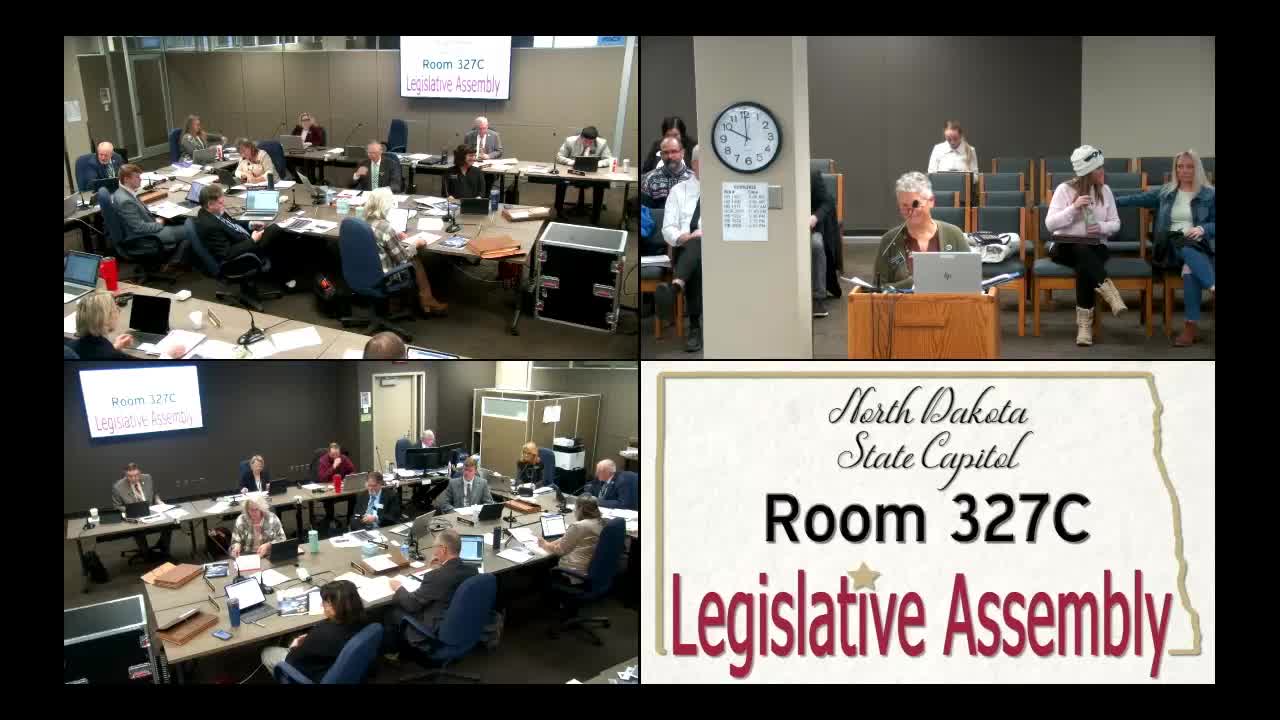
Representative Desiree Morton introduced House Bill 1514 to the House Agriculture Committee, proposing a prohibition on "polluting atmospheric activity" and authorizing investigation and penalties for those who release xenobiotic agents, conduct stratospheric aerosol injection, or otherwise emit harmful atmospheric pollutants.
Morton told the committee she sought to stop what she described as harmful atmospheric interventions and said federal research and documents — including NOAA-funded monitoring and open‑source material she distributed — raised alarms about aerosol injections and related activities. "We cannot continue to ignore what they are doing to the sky, the earth, the animals, the birds, the insects and the vegetation that's slowly and methodically being destroyed," Morton testified, urging the committee to pass the bill.
The committee heard multiple witnesses opposed to broad criminalization. Danny Quistel of the North Dakota Weather Modification Association asked the committee to give the bill a do‑not‑pass recommendation, noting North Dakota’s long history of locally driven, permitted cloud‑seeding programs dating to the 1950s and stressing that permitted programs use tracked aircraft, licensed pilots, and small amounts of silver iodide. Quistel said permitted cloud‑seeding operations are transparent and that local governments decide whether to opt in or out.
Dave Glatt, director of the Department of Environmental Quality, and Darren Langard of the Department of Water Resources testified the bill’s language is overly broad and would require technical capabilities the state does not possess. Glatt told members the bill as written would require measurement and enforcement for a wide range of electromagnetic frequencies and foreign substances ("xenobiotics") for which the DEQ lacks both instrumentation and statutory standards. He said quick response timeframes in the draft (e.g., two‑hour emergency measurements) are unrealistic given staffing and travel distances.
Langard, who oversees cloud‑seeding regulation in the Department of Water Resources, said permitted cloud‑seeding operations are licensed, tracked in real time, and carefully recorded. He noted silver iodide used in cloud seeding is insoluble, used in trace amounts, and that published literature has not demonstrated environmental harms at operational seeding rates; he urged a do‑not‑pass recommendation because the bill would criminalize legally permitted programs and impede research.
Several public witnesses supported the bill and urged action; they raised concerns about aerial sprays, long‑lasting contrails and health impacts. Committee members asked technical questions about radiofrequency measurements, federal jurisdiction over airspace, and whether the proposed language could conflict with aviation and FCC authority.
Committee staff and agency witnesses recommended substantial redrafting and legal/technical review before the legislature could implement the enforcement and monitoring the bill proposes. The committee closed the hearing without a vote.