Get Full Government Meeting Transcripts, Videos, & Alerts Forever!
Get email alerts on the State Legislation topic
No spam. Unsubscribe anytime.
Senate confirms gaming commissioner nominee, adopts multiple amendments and rejects several bills including carbon-pipeline tax change
Summary
The North Dakota Senate on Feb. 6 confirmed a gaming commission nominee, approved floor amendments across several health, IT and caregiving bills, and defeated measures on long-term care, statewide education funding and a carbon dioxide pipeline tax exemption.
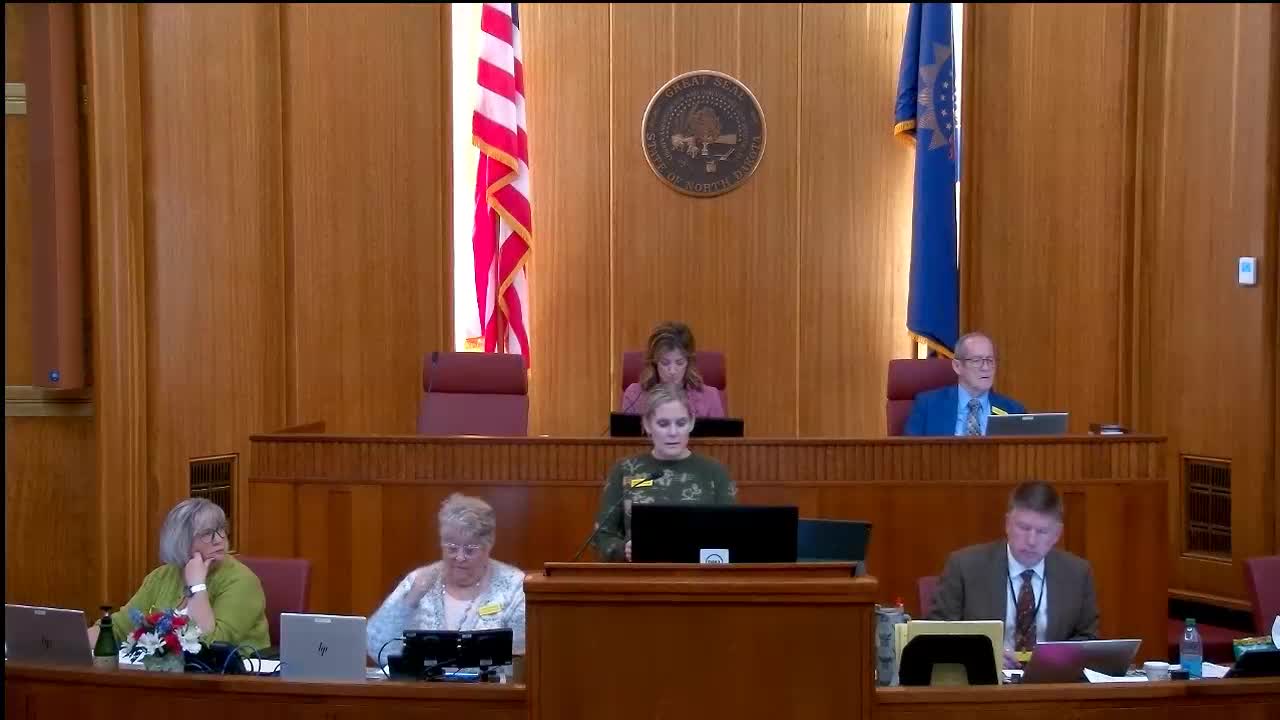
BISMARCK — The North Dakota Senate confirmed Michael Seminary to the North Dakota Gaming Commission and approved a string of floor amendments Tuesday while voting down several high-profile bills, lawmakers said on the floor.
The chamber voted 46-0 with one absent to advise and consent to the nomination of Michael Seminary to the Gaming Commission after the Senate’s select committee, chaired by Senator Gearhart, reported a 5-0 committee recommendation. Senator Castaneda, speaking for the committee on the floor, said the committee “had a very good conversation” with Seminary and added, “we hope that everyone votes green for Mister Seminary.” The nomination passed on a roll-call vote of 46 ayes, 0 nays, 1 absent, the secretary reported.
Why it matters: Confirmation fills a current vacancy on a regulatory body the Legislature has discussed changing; the vote concludes the committee review and places Seminary on the commission pending any further statutory or executive changes to the commission’s role.
In addition to the confirmation, senators approved amendments to multiple bills on the floor, including measures dealing with fuel-testing fees, survivors' services, caregiver pilot programs, IT project governance, correctional health oversight, psychiatric residential treatment reimbursement, and adult residential care facility rules. Several of those amended bills were re-referred to the Appropriations Committee for funding review.
Key floor outcomes and context
- Confirmation: Michael Seminary, nominee to the North Dakota Gaming Commission — Passed, 46 ayes, 0 nays, 1 absent. The select committee reported a unanimous 5-0 advisory recommendation. Senator Castaneda said Seminary has served on the commission since 2019 and signaled he would push to expand the commission’s role if given additional authority.
- Final passage: Senate Bill 22-82 (income tax credit for employer childcare contributions) — Passed, 46 ayes, 0 nays, 1 absent. The fiscal note on the bill indicated no fiscal impact, the secretary reported.
- Final passage: Senate Bill 23-16 (long-term care services for ventilator or psychiatric needs) — Failed, 5 ayes, 41 nays, 1 absent. Sponsors and committee members debated operational difficulties, staffing shortages and whether combining ventilator and psychiatric services into one mandate was feasible. The Human Services Committee recommended a do-not-pass vote. Senator Roers and others noted concerns about staffing and the practicality of requiring regional centers.
- Final passage: Senate Bill 22-95 (state education funding and related levy changes) — Failed, 4 ayes, 42 nays, 1 absent. The bill drew objections over scale and cost; the committee recommended a do-not-pass vote, citing an estimated increased cost of about $2,200,000 in the fiscal note.
- Final passage: Senate Bill 23-20 (remove CO2 pipeline property tax exemption) — Failed, 10 ayes, 36 nays, 1 absent. Senator Patton, the bill carrier, told the Senate the measure would remove a 10-year property tax exemption that now applies to certain CO2 interstate pipelines and related equipment; Patton argued the revenue could help reduce property taxes for state residents. Opponents, including members of the Finance and Tax Committee, recommended voting against the bill. The committee’s report on the floor (4-2) recommended a do-not-pass.
Amendments and committee referrals
Several proposed amendments were adopted by voice vote or unanimous consent and, where noted, were re-referred to the Appropriations Committee for fiscal review:
- Senate Bill 21-79: Amendment adopted. The bill, as described on the floor, would authorize the Department of Environmental Quality to collect retail fuel samples and impose a charge of 1/40 of 1% per gallon on retail fuel facilities to fund testing; an amendment places a sunset on that charge. The carrier reported the amendment would direct roughly $561,000 (described on the floor as about that amount) away from the general fund into DEQ testing operations.
- Senate Bill 23-87: Amendment adopted. The amendment added child advocacy language and clarified distribution of victim resources; the bill relates to rights for survivors of domestic violence and had been worked on with three advocacy groups, the carrier said.
- Senate Bill 23-05 (family caregiver pilot project): Amendment adopted; the measure extending or reviewing last session’s family caregiver pilot project was approved by amendment and re-referred to the Appropriations Committee. The carrier reported all program slots filled within a month last session and said the pilot allowed family members to be paid for extraordinary caregiving tasks; committee recommended continuation as a pilot until a cross-disabilities waiver is implemented.
- Senate Bill 20-49 (major IT project governance): Amendment adopted. The amendment raised the financial threshold that defines a “major IT project” (from $500,000 to $5,000,000) while adding non-cost criteria (duration longer than one year, significant public visibility or risk) and changing an executive steering committee model into an oversight committee with revised membership and advisory authority.
- Senate Bill 21-91: Amendment adopted; the bill was substituted for study language to examine standards and regulation for health care in city and county jails, the chamber heard.
- Senate Bill 23-99 (psychiatric residential treatment facilities): Amendment adopted; the amendment specified reimbursement elements for PRTFs (clinical supervisors, medical directors, family engagement, therapeutic leave days, administrative costs) and required a study/report after new rules are developed.
- Senate Bill 20-271 (adult residential care facilities): Amendment adopted and re-referred to Appropriations. The amendment updated definitions, removed a mandatory rate review and asked the department to include payment rates and asset limits in an ongoing basic care study.
What senators said and key details
- On staffing and operational feasibility: Senators on the Human Services Committee, including Senator Hogan, repeatedly cited staffing shortages as the central reason for recommending a do-not-pass on Senate Bill 23-16. Hogan said existing payment mechanisms allow higher reimbursement for higher-acuity patients, but the access to trained service providers is the limiting factor.
- On carbon-pipeline taxation: Senator Patton said the exemption targeted by his bill was never intended for geologic storage pipelines and argued removing the property tax exemption for interstate pipelines would generate revenue that could help lower property taxes statewide. Patton noted past committee work dating to 1991 and cited state research (EERC) and permit structures (an EPA Class 6 permit and related mitigation fee) in floor remarks.
- On the gaming commission nomination: Senator Castaneda emphasized Seminary’s prior service on the commission since 2019 and told senators Seminary wanted a larger role for the commission where appropriate.
Ending note
The Senate concluded its floor session by agreeing to stand adjourned and reconvene at 12:30 p.m. Friday, Feb. 7, 2025. Several committees announced afternoon and next-day hearings; multiple amended bills were sent to Appropriations for fiscal review before further consideration.