Get Full Government Meeting Transcripts, Videos, & Alerts Forever!
Get email alerts on the Municipal Budget Warrant Language topic
No spam. Unsubscribe anytime.
Budget committee reviews multiple warrant-language edits ahead of deliberative session
Summary
The Milford Budget Advisory Committee discussed edits made after DRA review to several warrant articles ahead of the town's deliberative session, including the removal of a $1 million water-park request, clarifications to library restroom wording, and changes to capital-reserve and revolving-fund language affecting who may expend funds.
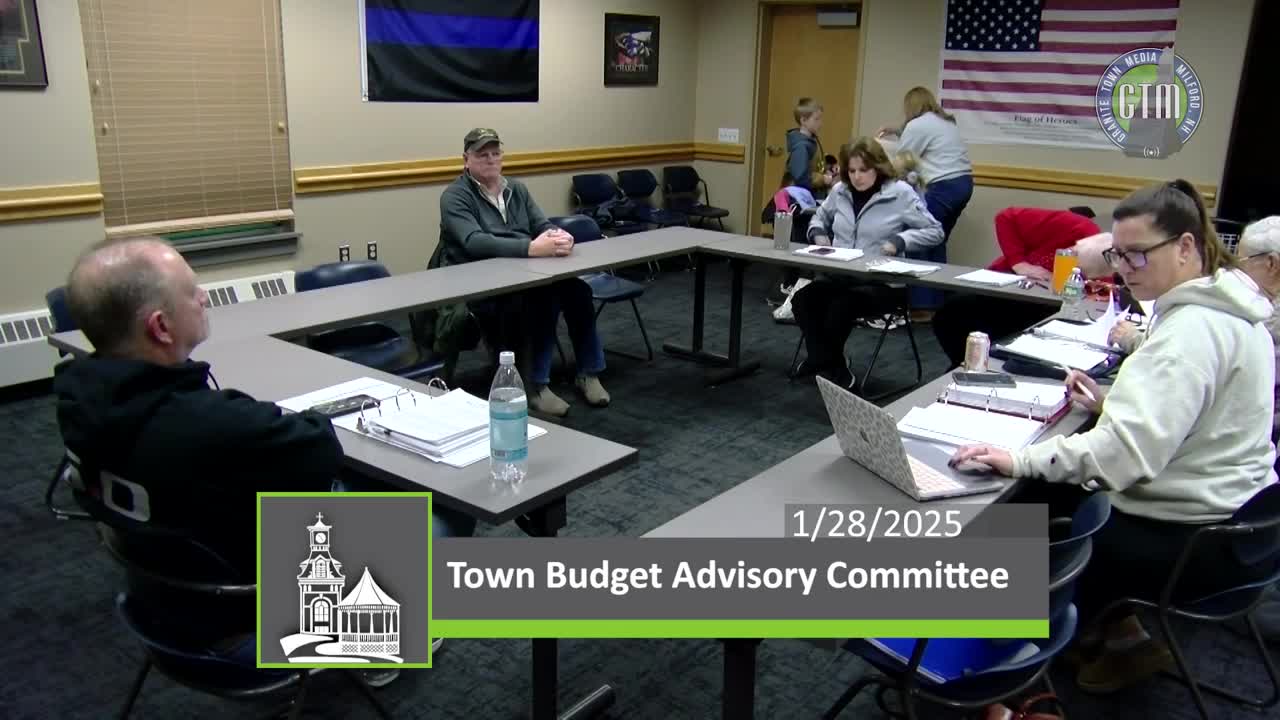
The Milford Budget Advisory Committee spent substantial time on Jan. 28 reviewing post‑DRA changes to the town warrant before the deliberative session, clarifying language on several articles and noting procedural next steps for deliberative and final votes.
Town Administrator Lincoln Daley said a review with the Department of Revenue Administration (DRA) led to revisions and the withdrawal of one large item: "the first article dealing with the request, for the million dollar amount to for reimbursement, for matching, grants for the water, the water park" was pulled because of language problems and timing constraints, Daley said. Committee members discussed whether the item might be reformulated as a capital reserve fund article instead.
Committee members flagged other specific edits returned from DRA. Library trustee Lynn Coakley had requested clearer language for the library lower‑level restroom article; the warrant text now uses the plural “restrooms” but does not specify a number, and the committee discussed adding explicit language that two restrooms would be constructed. Daley said a final amendment could be made at deliberative or during later steps.
The committee discussed changes to an ambulance replacement and equipment revolving fund article: language referencing a $75,000 agent‑to‑expend limit was removed to eliminate confusion about the board’s role and residents’ ability to vote on larger expenditures. Committee members noted that removing that line leaves a question about who will have authority to expend funds; Deliberative amendments will need to clarify whether the governing body or the legislative body (town meeting) will retain expenditure authority.
Language around governing authority for certain revolving funds and capital reserve accounts was also examined. Committee members referenced RSA 31:95‑h during the meeting and discussed whether the statute requires the governing body or allows the legislative body to designate the body that authorizes expenditures; Daley said he will consult town counsel and provide guidance before deliberative session.
Other administrative changes included marking long‑running articles as special and non‑lapsing, adding $2,000–$8,000 adjustments to recurring civic events (the Labor Day parade increase from $6,000 to $8,000 was discussed as support for an 80th‑anniversary event) and reconciling petition warrant articles that have tax impact so the advisory committee can issue recommendations after deliberative session.
Committee members asked for a clean, final warrant version before Saturday’s deliberative session and discussed logistics for the meeting, including timing, parking, and how remote participation will affect voting. Daley and staff agreed to post any remote‑participation links in compliance with public‑meeting notice rules and to provide instructions so members participating remotely can be identified and votes roll‑called.
The committee will also prepare the advisory committee’s recommendations and assignment of speakers for each warrant article at the deliberative session; members said they will circulate and edit recommended language in advance. No binding town votes on the underlying warrant items occurred at the committee meeting; the session focused on wording, statutory compliance and logistics ahead of deliberative and final town actions.