Get Full Government Meeting Transcripts, Videos, & Alerts Forever!
Get email alerts on the Education Savings Accounts topic
No spam. Unsubscribe anytime.
Senate committee debates education savings account bill as supporters tout choice and critics warn of funding and accountability risks
Summary
Senate Bill 2400 would create tiered education savings accounts administered by DPI, allowing public, nonpublic and homeschool students to spend state‑approved funds in an online marketplace. Supporters emphasized rural access and therapeutic options; opponents warned diversion of public funds and urged accountability and constitutional review.
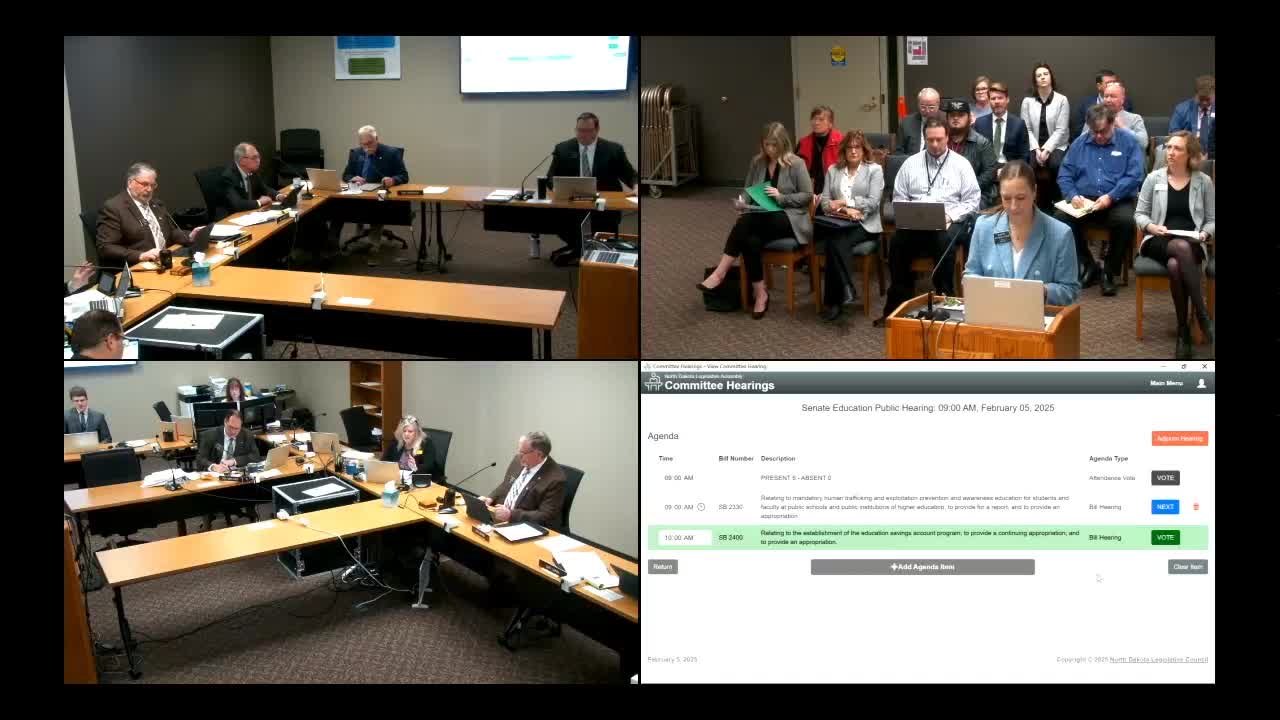
Bismarck — The Senate Education Committee spent several hours hearing testimony on Senate Bill 2400, a bill to establish education savings accounts (ESAs) in North Dakota that would let families direct state‑authorized funds to approved educational goods and services via an online “marketplace.”
Senator Michelle Axeman, sponsor of SB 2400, told the committee the bill creates a three‑tiered program administered by the Department of Public Instruction (DPI). “The first year of the program would apply to all public school students. They would receive $1,000 to be used to select services tailored from an online marketplace to meet their individual needs or interests,” Axeman said. The second tier would apply to students who enroll in a participating nonpublic school and uses a means‑tested schedule: households at or below 200% of the federal poverty level would receive $4,000; households at or below 400% would receive $2,500; families above 400% would receive $1,000. A third tier for home‑educated students would provide $1,000 and link to existing homeschool statute requirements.
Axeman and supporters highlighted two unusual inclusions in the bill’s list of qualifying expenses: mental‑health services and school meals. Axeman said allowing mental‑health assistance to be an educational expense “acknowledges that mental and behavioral health is closely tied to a child’s learning environment.” She also described a $3,000,000 appropriation in the bill to DPI to contract a vendor to build and audit the digital marketplace. Senator Axeman said she has sought feedback nationally on marketplace vendors; she told the committee the bill’s fiscal note had not yet been posted.
The governor’s office provided supportive testimony: Maria Nesen, chief of staff to Lieutenant Governor Strinden and senior advisor to Governor Armstrong, said the executive branch views ESAs as a tool to expand options, especially for rural families who lack local access to specialized services. The governor’s budget proposal, Nesen said, would back the policy with about $44,250,000.
Several witnesses testified about students with special needs. Britney Buckmeyer, co‑founder of a private therapeutic school and pediatric therapy clinic, and Brenda Weisner, who described enrolling her daughter at Full Circle Academy (a nonprofit private school for students with complex special needs), urged the committee to consider how ESAs can improve access to therapeutic placements that are otherwise cost‑prohibitive. “The cost of educating one of our students is substantially higher than that of a typical student,” Buckmeyer said, and families often cannot afford private therapeutic tuition without additional funding.
Opponents included unions, district superintendents and some rural leaders who warned ESAs could divert public funds to private schools and reduce resources available to public districts. Nick Archuleta, president of North Dakota United, said his group supports funding for supplemental educational services but opposes using public dollars for private school tuition: “If this were a stand‑alone bill with a dedicated funding source and the same amount of money was provided to both private and public school parents, North Dakota United would be in strong support,” Archuleta said. Multiple superintendents and school leaders urged strong accountability if public funds are used in nonpublic settings and flagged potential constitutional questions; Valley‑Edinburg superintendent Kirsten Hurt cited North Dakota Constitution language prohibiting public funds to sectarian schools as a legal concern.
Several higher‑profile issues emerged in questioning: whether private schools accepting ESA funds must use blind admissions or accept students with disabilities; whether participating nonpublic schools must submit to the same financial reporting, open‑meeting and assessment requirements as public schools; and how to calculate the per‑student dollar amount so the program’s transfer value is meaningful. Committee members pressed for a fiscal note and asked DPI and stakeholders to clarify implementation details, auditing, and how mental‑health services would interact with private insurance.
The hearing closed without committee action; senators signaled both interest and substantial disagreement and requested more fiscal and legal analysis before any advancement.
Ending: The bill drew sharply contrasting testimony that frames the coming debate: sponsors and the governor’s office emphasized expanded parental choice and rural access to services; educators and unions warned of potential fiscal diversion, accountability gaps, and legal constraints. The committee asked for further fiscal and legal information before proceeding.