Get Full Government Meeting Transcripts, Videos, & Alerts Forever!
Get email alerts on the Employee Health Insurance topic
No spam. Unsubscribe anytime.
Committee reviews plan to shift PERS enrollees from grandfathered to non‑grandfathered coverage
Summary
Senate Bill 2160 drew data from Sanford Health showing roughly $10.8 million in 2023 member cost‑sharing would have been covered under a non‑grandfathered plan; PERS staff and senators debated offering a voluntary third plan option, possible employee premium amounts and the need for additional study before a larger policy change.
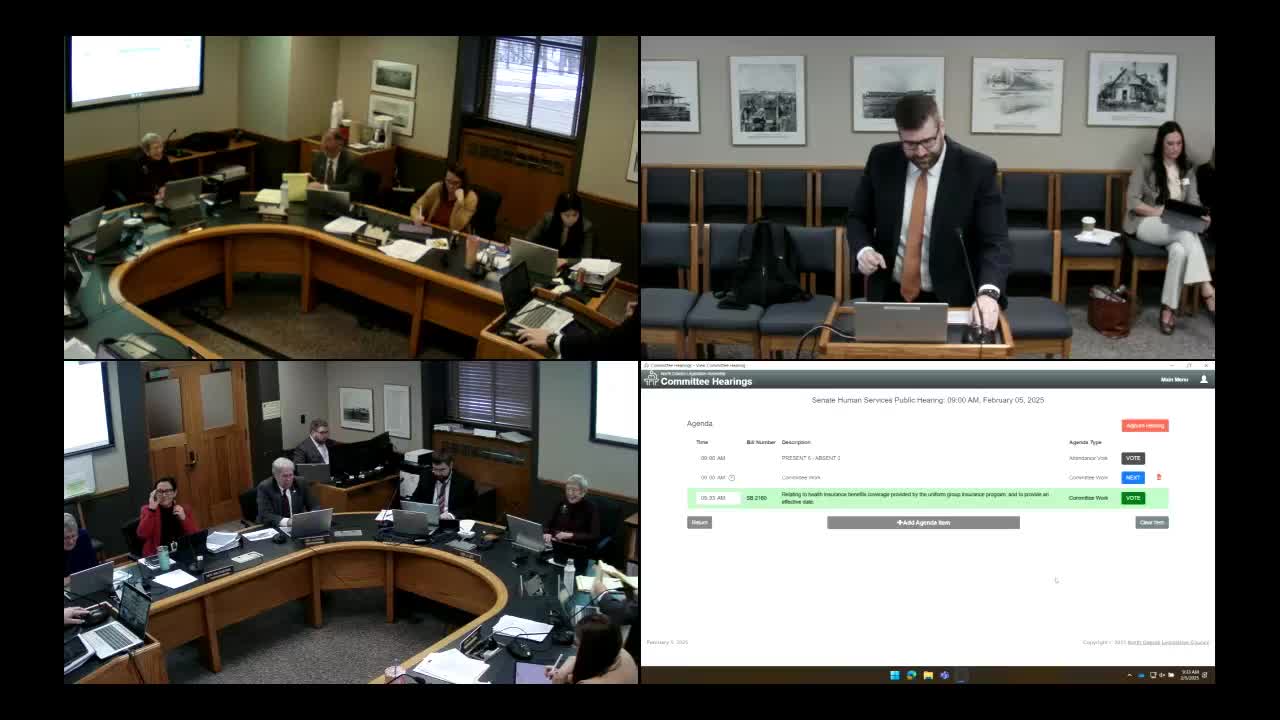
The Senate Human Services Committee discussed Senate Bill 2160 on a proposal to transition the Public Employees Retirement System (PERS) non‑Medicare pool from a grandfathered plan design to non‑grandfathered coverage.
Dylan Wheeler, government affairs with Sanford Health Plan, told the committee Sanford’s data analytics team found about 15,000 employees enrolled in a grandfathered PPO or open‑network plan in 2023. Of those, Sanford estimated 11,851 members paid about $10,846,591 in cost share during 2023 for services that would have been fully covered under a non‑grandfathered plan with the same benefit design. Wheeler said that averages to about $76.27 per employee per month and is roughly 4.6% of the monthly premium in 2023.
Wheeler cautioned the committee that the figure is a utilization average for a single plan year, not an actuarial or premium estimate. He listed several caveats: the analysis used 2023 plan data only, some claims for 2024 remain pending, certain services are not present in the non‑grandfathered benefit design (for example, breast pumps), and the data were pulled at the contract level for speed rather than at the individual member level.
Rebecca Fricke, executive director of PERS, said PERS already offers a non‑grandfathered PPO that has the same benefit design as the grandfathered PPO but with enhanced benefits; employers who lose grandfathered status have previously shifted to the existing non‑grandfathered plan by paying a higher premium. Fricke told senators the operational lift for adding a voluntary third plan option would mostly be on PERS to program enrollment and billing systems for an anticipated January 1, 2026, effective date.
Fricke also flagged two sections of statute that would be relevant to any proposal that charges employees a portion of premium: “5452.106” and “5452.107,” which she said currently describe state payment of full family premium. She said those sections would need review if the committee chooses to require employee premium contributions.
Committee members asked detailed questions about implementation, adverse selection and communication. Senator Hogan asked whether other employers have made the shift; Wheeler said Sanford has at least one client that moved pools but that he would follow up on outcomes. Senators and PERS staff discussed the interaction with the state’s high‑deductible health plan (HDHP) and the existing practice of funding a health savings account (HSA) contribution equal to the premium differential; Fricke said the HSA contributions have been $246.16 per month for family coverage and about $101 per month for single coverage in prior practice.
Members debated three broad policy options heard in the meeting: (1) move the entire NDPRS pre‑Medicare population to non‑grandfathered status; (2) create a voluntary third plan option and leave the grandfathered plan in place for people who prefer it; or (3) delay action and study the change in a legislatively directed interim review. Several senators, including Senator Rohrs, said they do not want to “do nothing” this year and expressed interest in adding an opt‑in third plan, coupled with further study. Senators discussed a possible employee premium in the range of about $50 per month as a starting point; one senator noted that the $76 average utilization number Sanford produced is not a premium estimate and urged caution.
Committee members also asked whether communications could target employees who would have benefited from the non‑grandfathered design in the prior year. Fricke said individual‑level outreach might raise HIPAA and confidentiality concerns, but enrollment communications could be tailored to help employees identify whether the third option would likely benefit them.
No formal motion or vote on SB2160 occurred during the hearing. The chair asked staff to draft amendment language for Monday that could include a third plan option and to return with fiscal and implementation details.
The discussion focused on tradeoffs between additional covered benefits and employee cost, the administrative lift to implement a third option, statute changes that would be necessary to charge employees, and the need for clearer actuarial/pricing work before adopting a system‑wide change.