Get Full Government Meeting Transcripts, Videos, & Alerts Forever!
Get email alerts on the Criminal Justice Fees topic
No spam. Unsubscribe anytime.
Lawmakers hear bill to eliminate many criminal justice fees, sponsor cites hardship and recidivism
Summary
Representative Bernie Satrim presented House Bill 1310 to remove a broad set of court-related fees and reimbursements, arguing fees cause hardship, increase recidivism and shift burdens to families; stakeholders urged study of fiscal impacts and local revenue consequences.
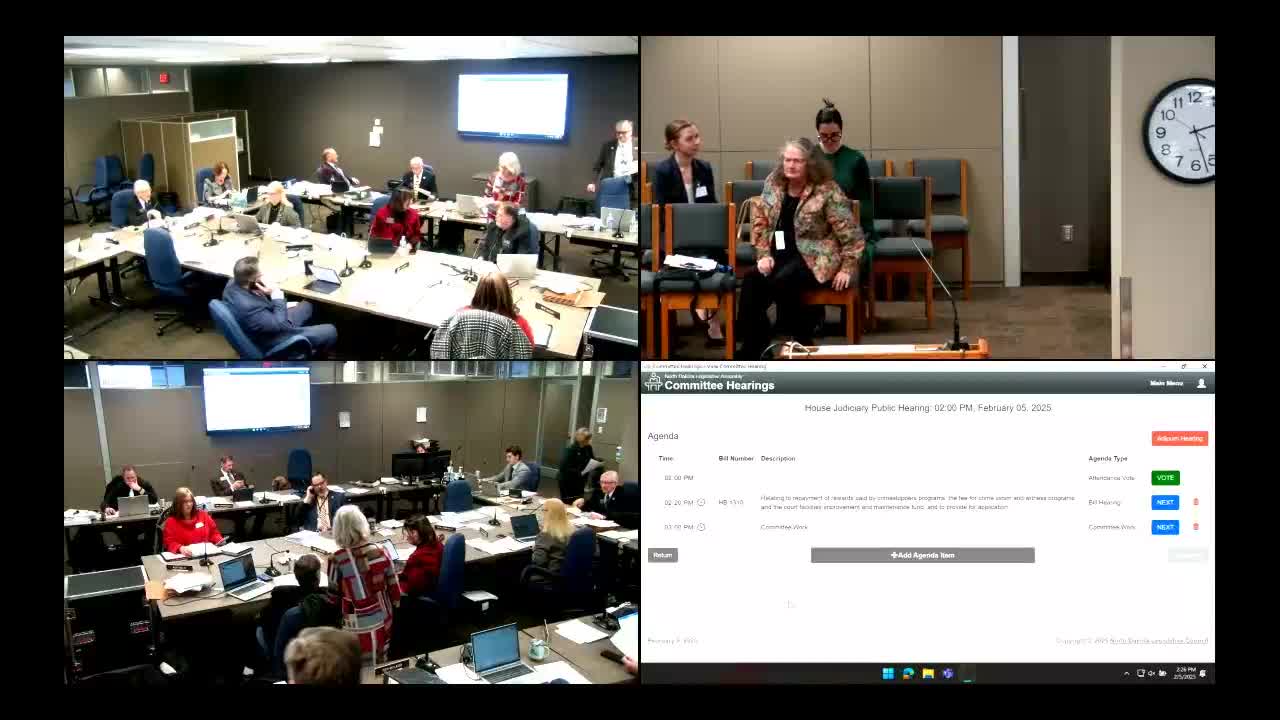
Representative Bernie Satrim, sponsor of House Bill 1310, told the House Judiciary Committee that the bill would “eliminate a wide variety of fines and fees associated with criminal justice.”
The bill would remove or change many statutorily imposed fees and the court’s ability to order repayments in numerous statutory sections cited during testimony. Satrim said research finds the financial burdens from fines and fees contribute to food and housing insecurity for families and increase the risk of reoffending, and he described fees as a barrier to reentry.
“Financial pressure and lack of access to transportation and shelter can also increase recidivism and lead to further incarceration,” Satrim said, citing national studies and earlier interim studies in other states.
Nut graf: Supporters framed HB 1310 as an equity and reentry measure and urged the committee to weigh human and systems costs against a fiscal note. Opponents and committee members pressed for guardrails and for more analysis of where fee revenue flows and what state and local budgets would lose if the fees are eliminated.
Committee discussion focused on three themes: (1) who would bear the cost if fees are waived, (2) whether judges should retain discretion to impose fees in individual cases, and (3) the size and source of fiscal impacts. Representative Carl and several other members asked whether wealthy defendants would also avoid fees; Satrim replied that the bill targets people who cannot pay and stressed discretion for judges and alternatives such as community service as possible responses.
Aaron Burst of the Association of Counties, testifying in support in principle, told the committee that some fee revenue is directed to county courthouse improvement funds and other local uses. He said a previously circulated fiscal note does not capture about $880,000 that currently flows to the court facility fund and county distributions statewide, and urged care in drafting because many fees the bill would remove are currently mandatory (“the court shall impose those fees,” he noted).
The committee pressed whether to convert statutory “shall impose” language to discretionary language (change “shall” to “may”) and whether HB 14‑17 (a separate bill heard earlier) already covers some fee changes and a study of fees. Multiple members suggested either narrowing the bill’s scope or adding an implementation study to avoid sudden budget shortfalls.
Ending: The committee closed the hearing on HB 1310 after receiving public and stakeholder testimony. No committee vote on the bill was recorded in the transcript; members asked for more time to reconcile the bill with other pending legislation and fiscal analyses before taking further action.