Get Full Government Meeting Transcripts, Videos, & Alerts Forever!
Get email alerts on the Community Supervision Fees Indigent Defense topic
No spam. Unsubscribe anytime.
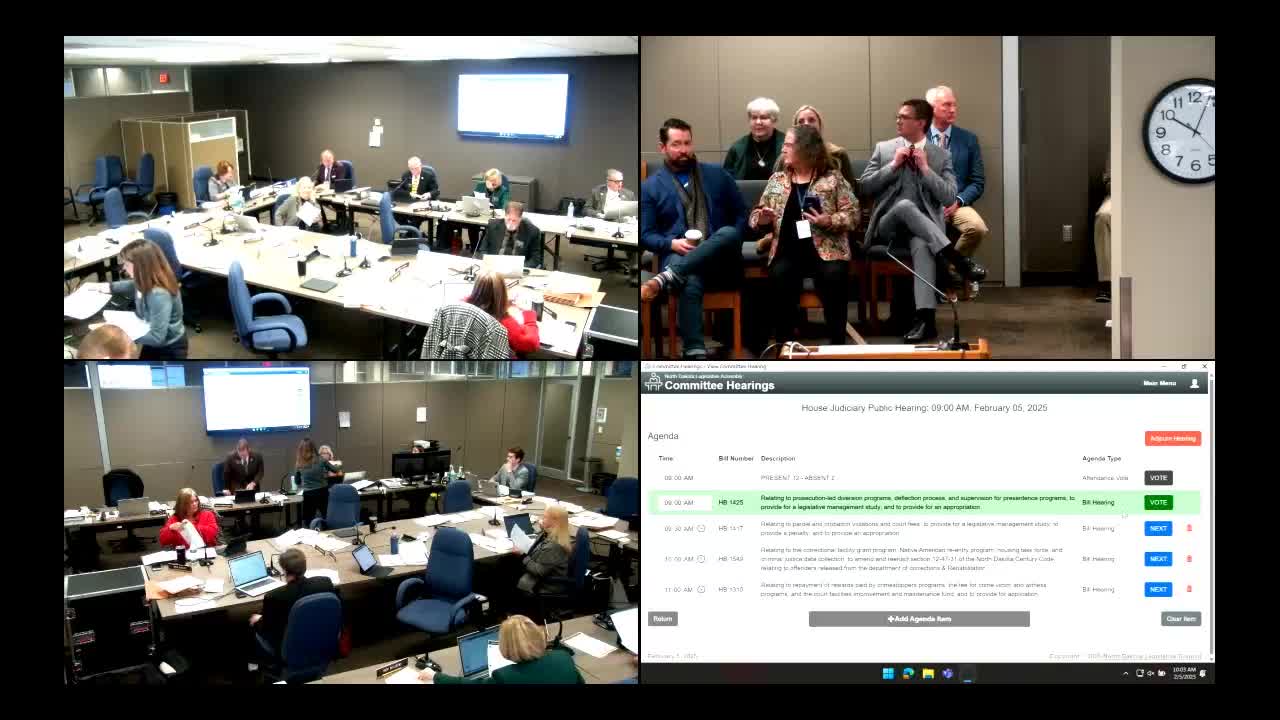
Committee hears bill to revise supervision rules, eliminate fees and study court costs
Summary
House Bill 14‑17 would define 'technical violations,' create tiered sanctions for supervision revocations, eliminate $55/month supervision fees and remove indigent defense application and recoupment fees; sponsors said the changes aim to reduce prison admissions and administrative burdens.
BISMARCK — Lawmakers and agency officials told the House Judiciary Committee that House Bill 14‑17 targets growing prison admissions tied to parole and probation revocations by clarifying definitions, encouraging graduated sanctions and eliminating several supervision‑related fees.
Representative Lawrence Clameen, sponsor of the bill, said HB 14‑17 “updates definitions and develops tiered sentencing recommendations for supervision violations due to technical violations for a more consistent response.” The bill would also eliminate the $55 per month supervision fee and remove a $35 application fee for indigent defense, aligning state practice with American Bar Association recommendations.
The bill adds statutory definitions (absconded, technical violation, responsivity factors and modernizes the risk assessment definition), and proposes that courts and the Parole Board may use tiered periods of incarceration for technical revocations (15 days for a first technical revocation, up to 30 days for a second, up to 90 days for a third, with remaining sentence imposed on a fourth and subsequent revocations). Clameen emphasized that the provisions are permissive (“may”), preserving judicial and Parole Board discretion for individual circumstances.
Proponents argued the measures would reduce admissions for supervision violations — a major driver of recent prison population growth — and relieve administrative burdens associated with collecting supervision fees that agencies rarely recover in full. Representative Clameen said DOCR spends significant resources administering and attempting to collect supervision fees; the bill eliminates roughly $1.5 million in anticipated fee revenue over two years but supporters said collections net far less and the administrative cost is substantial.
Coby Braun, DOCR director, testified that clarifying definitions will improve data collection and that eliminating supervision fees would let probation and parole officers focus on coaching and treatment rather than fee collection. Travis Fink of the Commission on Legal Counsel for Indigence and the Commission itself urged removing the $35 indigent defense application fee and recommended replacing the lost revenue with general fund appropriations to maintain agency operations.
Supporters said the bill also asks legislative management to study other court fees, their collection rates and impacts on justice‑involved people. No committee vote was recorded at the hearing.
Ending: Committee testimony closed after multiple agency and nonprofit witnesses; the bill remains in committee for further consideration.