Get Full Government Meeting Transcripts, Videos, & Alerts Forever!
Get email alerts on the Diversion Deflection Pretrial topic
No spam. Unsubscribe anytime.
House committee hears bill to expand diversion, deflection and pretrial services with $1.75 million pilot funding
Summary
Lawmakers and stakeholders told the House Judiciary Committee that House Bill 14‑25 would create a three‑county pilot for prosecution‑led diversion, fund supervision and treatment, and require a study of pretrial services; no vote was taken at the hearing.
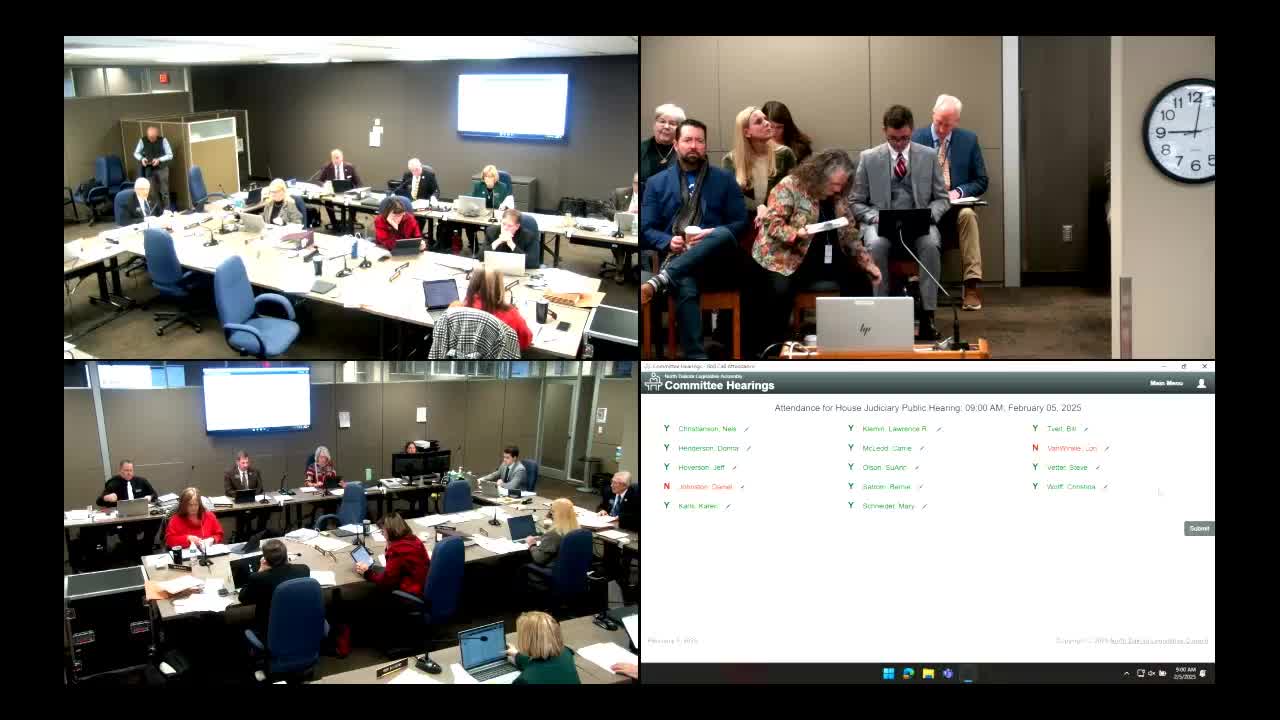
BISMARCK — The House Judiciary Committee on Thursday opened a hearing on House Bill 14‑25, a package measure that would expand prosecution‑led diversion, formalize local “deflection” protocols and fund supervision and treatment for pre‑sentencing programs.
Representative Lawrence Clameen, sponsor of the bill, said the legislation “targets the front end of reentry including strengthening deflection, diversion and pretrial services to expand pathways to alternatives to incarceration.” The hearing included testimony from Lieutenant Governor Michelle Strinden, county prosecutors, corrections officials and community providers.
The bill would: establish a prosecution‑led diversion pilot in three counties and authorize the Department of Corrections and Rehabilitation (DOCR) to provide supervision for participants; create a statutory definition and local authority to establish a deflection process that coordinates law enforcement and behavioral‑health providers; and request a formal legislative study of North Dakota’s pretrial services program. The measure requests appropriations of $1,000,000 to DOCR (to staff and contract supervision for the pilot), $750,000 to the Department of Health and Human Services (DHHS) for treatment and services, and $55,000 for a third‑party evaluation of pretrial services.
Why it matters: Proponents said the bill aims to reduce prison and jail admissions driven by drug‑ and alcohol‑related offenses and supervision revocations. Lieutenant Governor Michelle Strinden said the legislation grew out of a reentry work group and that the state needs earlier “off‑ramps” to connect people to treatment and supports before they move deeper into the criminal justice system.
Supporters described gaps the bill tries to fill. Travis Fink, executive director of the North Dakota Commission on Legal Counsel for Indigence, said prosecutors will set local eligibility but lack supervision resources. Kim Hegvick, Cass County state’s attorney, told the committee her office would implement diversion if funding were available, citing a heavy caseload in Cass County. Coby Braun, DOCR director, said counties have expressed interest in participating in a pilot and that jail capacity concerns make front‑end interventions important.
Several witnesses gave concrete examples of how diversion and deflection could be used: Sister Kathleen Atkinson of Ministry on the Margins recounted individuals for whom treatment and supports, not incarceration, opened a path to stable employment and housing. Advocates and county officials underscored that deflection protocols should be flexible to local resources; the bill does not create centralized deflection centers but allows communities to set minimum standards for training, protocols and data collection.
The sponsor described negotiated amendments filed after the bill’s introduction. The original DOCR supervision appropriation was modeled on prior pretrial pilot staffing (one immediate FTE and additional FTEs in a later year). Stakeholders proposed retaining the $1,000,000 total appropriation but using one temporary FTE at DOCR to administer the pilot and contracting with third‑party providers for supervision services so counties can start more quickly and scale services to local need.
Questions from committee members addressed which offenses are likely to be eligible (the sponsor said the programs are aimed at lower‑level offenses related to drug and alcohol addiction rather than serious violent felonies), how the pilot counties will be selected (not selected at the hearing), and how the new supervision capacity differs from existing prosecutorial authority (prosecutors can offer diversion today but lack supervision capacity to ensure compliance and treatment engagement).
No formal committee vote occurred. The hearing record shows multiple organizations and county officials in favor and a single written opposition filed by one state’s attorney; the sponsor closed the hearing and moved on to other bills in the reentry package.
Ending: Committee discussion will continue as the three‑bill package proceeds; no final action on HB 14‑25 was taken at the hearing.