Get Full Government Meeting Transcripts, Videos, & Alerts Forever!
Get email alerts on the Bioscience Grants Lifescience Council topic
No spam. Unsubscribe anytime.
Committee hears bill to move bioscience grant program to Industrial Commission and create life-science council; $12 million appropriation included
Summary
Senate Bill 2328 would repeal the existing bioscience innovation grant program under Agriculture, create a Life Science Research Council under the Industrial Commission, and include a $12 million appropriation. Committee members pressed sponsors for outcomes data and reporting; no committee vote was taken.
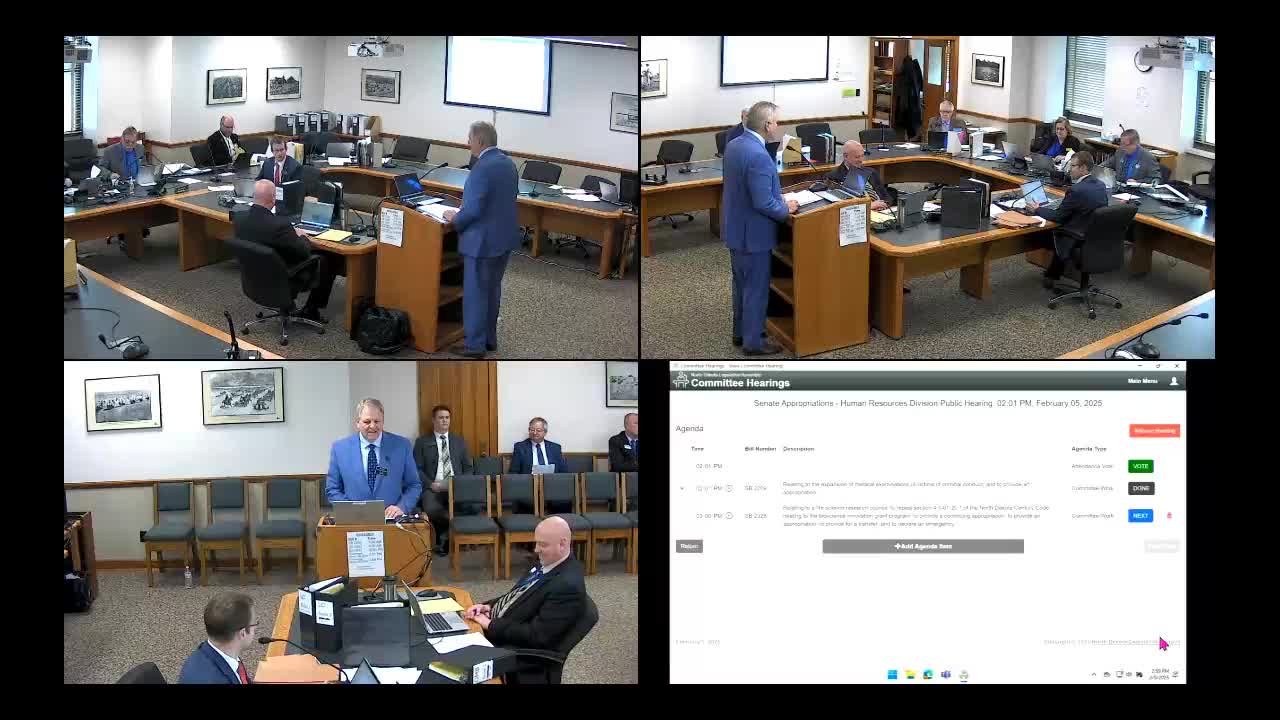
The Appropriations - Human Resources Division opened a public hearing on Senate Bill 2328, a proposal to repeal the current bioscience innovation grant program in the Department of Agriculture, establish a Life Science Research Council under the Industrial Commission and appropriate $12 million for bioscience grants.
Senator Terry Wansick, sponsor, described the change as an administrative shift intended to broaden technical review and oversight for the state’s bioscience grants. "This will open it up where they can secure more technical advice and making determinations of which grants to support," Wansick said, adding the proposal moves administration from the agriculture commissioner to the Industrial Commission and creates a council with appointments from the governor, the attorney general and the agriculture commissioner.
Randy Schneider, president of the North Dakota Bioscience Association and a member of the BioInnovation Grant committee, testified in support and said the program has attracted companies that invested in the state. Schneider cited Corvent/Corvin Medical and Lincoln Therapeutics as companies that have located operations in North Dakota and said the grants were one factor among several that attracted investment. "It is a program that I think has a huge opportunity," Schneider said.
Committee members pressed sponsors and agency staff for measurable results and stronger reporting. Senator Davison asked for outcomes rather than activity summaries; he said the written brochure presented several funded projects but lacked measurable outcome reporting linking grants to relocations or firm-level investment. Tom Bodino, deputy agriculture commissioner, acknowledged the brochure lists open grant rounds and that more detailed performance documentation exists and is maintained by the bioscience association and the department as part of grant closeout and reimbursement review.
Committee members noted the bill’s text would make application materials confidential when they meet the statutory definition of a trade secret (referencing "section 44" in the bill). Members also asked about whether the $12 million appropriation in section 4 is part of the governor’s recommendation or one-time funding. Staff said part of the funding had previously been included as one-time funding in the governor's budget and that the bill’s appropriation would be the vehicle for bioscience funding going forward, but that legislative budgeting decisions (general fund vs. State Investment Fund) remained to be resolved.
Industrial Commission representatives said the commission has experience administering similar grant and loan programs and that the office could apply its existing process (contracts with deliverables, reimbursement, and performance reporting) to bioscience grants. The commission’s representatives noted additional workload and potential staffing/resource considerations if the program’s administration shifts to the commission.
Committee members asked the sponsors and agencies to provide a fuller accounting of past grant recipients’ results — for example, jobs created, private investment leveraged, and whether recipients met required matching commitments and deliverables. The committee did not take final action on SB 2328 during this hearing and deferred further work, saying members wanted additional documentation from the agriculture department, the bioscience association and the Industrial Commission before advancing the bill.