Get Full Government Meeting Transcripts, Videos, & Alerts Forever!
Get email alerts on the Juvenile Forensic Assessments topic
No spam. Unsubscribe anytime.
Appropriators back temporary funding option for forensic competency assessments in juvenile bill
Summary
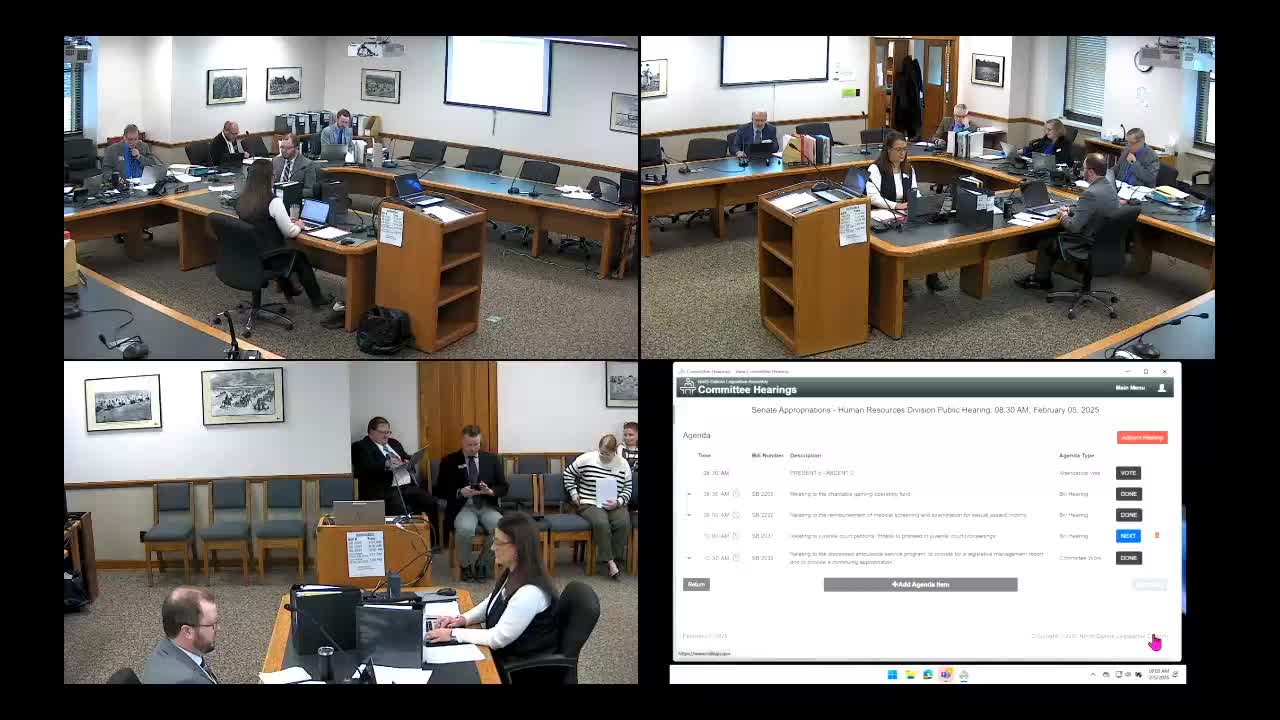
The Senate Appropriations Human Resources Division recommended a due-pass on juvenile forensic-assessment provisions in Senate Bill 2037 and approved one-time contract funding to cover forensic psychologist assessments rather than immediately adding a state FTE.
The Senate Appropriations Human Resources Division recommended a due-pass for provisions in Senate Bill 2037 related to juvenile court petitions and fitness-to-proceed and criminal-responsibility assessments. The committee discussed and directed funding to contract services rather than immediately adding state FTEs.
Shauna Eberhardt of the Department of Health and Human Services’ Behavioral Health Division told the committee that the fiscal note for the portion of SB 2037 that creates or clarifies criminal-responsibility and fitness-to-proceed assessment requirements would likely require additional psychologist capacity. DHHS estimated roughly $350,000 for an FTE psychologist with forensic training; the department currently has five psychologists at the State Hospital who perform similar assessments for adults and youth. Eberhardt said the department would be open to providing the service through contract vendors or by locating staff outside the State Hospital in the least restrictive setting.
Committee members expressed interest in a flexible approach that allows DHHS to use contractors or regional providers so juveniles can be assessed in or near their communities when appropriate. Senator Davison and others argued a one-time contract approach would let the Legislature evaluate demand before permanently adding FTEs to the base budget.
After discussion the division adopted an amendment to provide one-time contract/consulting funding (the division settled on $300,000 in a separate amendment adopted for juvenile-related provisions) to the department to cover forensic assessments during the biennium and recommended a due-pass on the bill as amended. Senators said the department could use contracts or vendor arrangements to meet assessment demand while the Legislature evaluates longer-term workforce needs.
Why it matters: The bill and appropriation language affect how juvenile competency and criminal-responsibility evaluations are handled, where they take place and who conducts them. Juvenile forensic assessments can determine a child’s fitness to proceed and the appropriate legal pathway; arranging services through contractors or regional providers can reduce out-of-area placements and promote least-restrictive care.
Outcome: Division adopted one-time contract funding and recommended a due-pass on relevant provisions of SB 2037; further budget or policy action may be taken during the full committee and conference process.