Get Full Government Meeting Transcripts, Videos, & Alerts Forever!
Get email alerts on the Emergency Medical Services topic
No spam. Unsubscribe anytime.
Committee advances distressed ambulance pilot funding; amendment limits spending to contract services
Summary
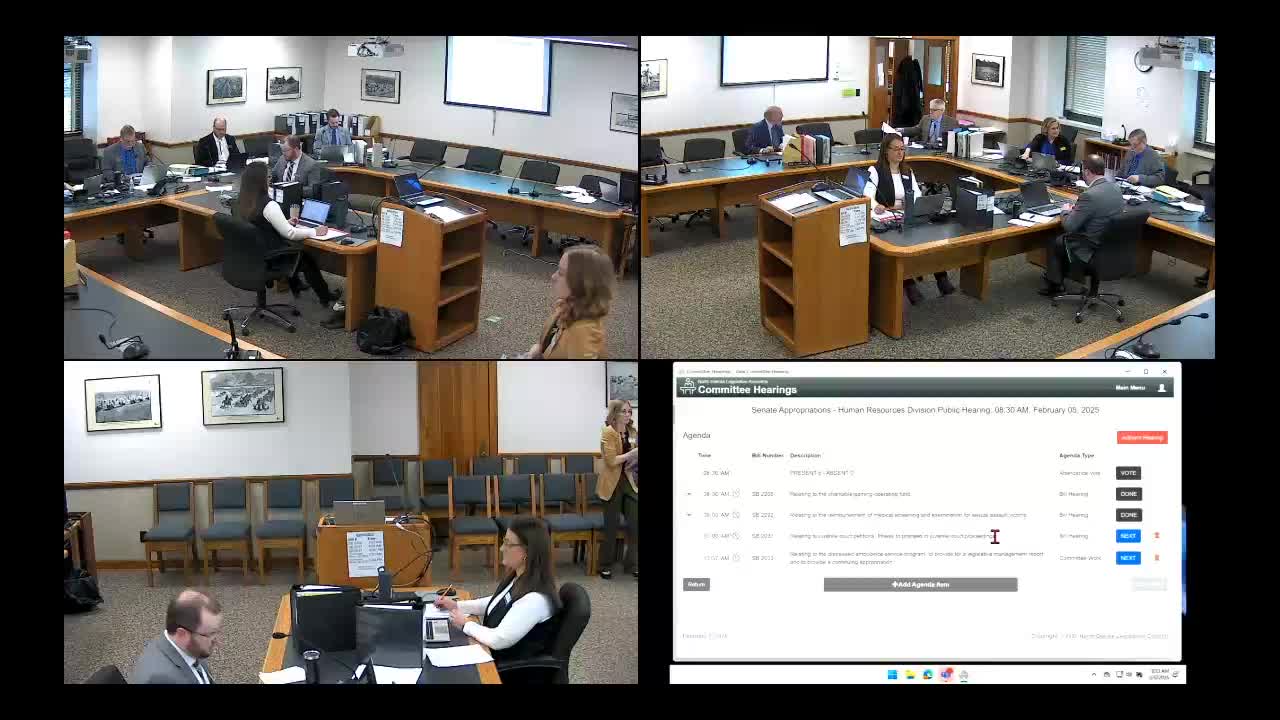
Senate Appropriations Human Resources Division approved an amendment and gave a due-pass on Senate Bill 2033 as amended, attaching a $150,000 appropriation to support a consultant and to stand up a distressed-ambulance program; sponsors said amendment avoids adding state FTEs and retains policy decisions to be refined later.
The Senate Appropriations Human Resources Division adopted an amendment and recommended a due-pass on Senate Bill 2033, which establishes a distressed ambulance services program and includes funding to support program setup.
Senator Davison moved the amendment (Amendment 25.0113.02003) that provides $150,000 for Human Services to use to hire a consultant to design and stand up a distressed-ambulance program. Sponsors explained the change removes an earlier fiscal note tied to adding FTEs and instead funds consulting/contract services to develop program design and rules; the intent is to avoid adding a state position immediately and to allow policy refinements in the next biennium if needed.
Committee discussion focused on whether the amount should create permanent positions or be one-time contract funding. Senators said contracting services would give the department flexibility to use private vendors or regional providers, and would preserve the committee’s ability to review program need next session if the project requires a full-time staff member. Sponsors noted the fiscal note had estimated $150,000 and the amendment aligns the bill with that appropriation without creating new state FTE positions.
The division adopted the amendment by voice vote and then passed the bill as amended on a recorded vote; the motion carried. Senator Davison agreed to carry the bill to the full committee and then return it to the policy committee for further work on program details.
Why it matters: Rural ambulance services nationwide have struggled with staffing and finances; this amendment funds planning and program design work rather than immediately creating state staff, enabling faster startup and more flexible, regionally tailored contracting.