Get Full Government Meeting Transcripts, Videos, & Alerts Forever!
Get email alerts on the Higher Education topic
No spam. Unsubscribe anytime.
NDSU urges continued student-success funding, seeks $35 million for new programs and facilities
Summary
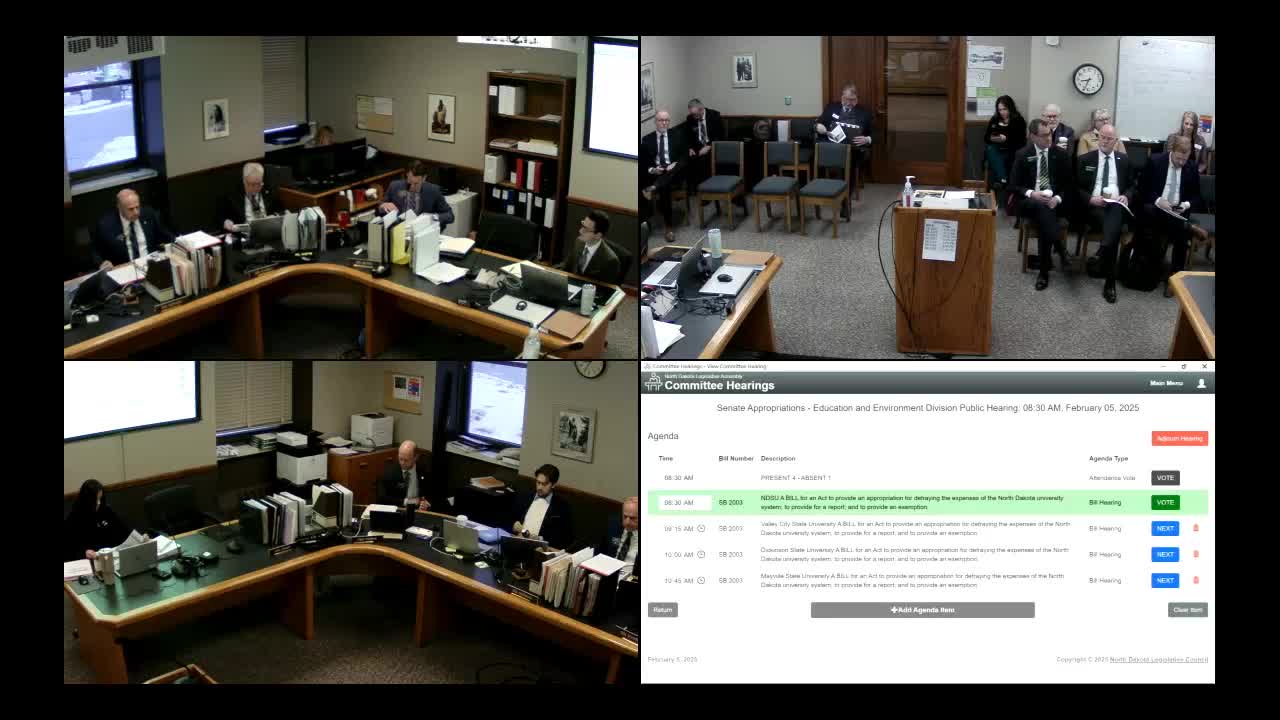
North Dakota State University President David Cook told the Appropriations — Education and Environment Division that NDSU seeks to convert a $4.8 million one-time retention investment into ongoing support and asked for additional targeted funding for engineering, agriculture technology and health workforce programs.
North Dakota State University President David Cook asked the Appropriations — Education and Environment Division on behalf of NDSU for continued state support to accelerate an institutional “turnaround,” urging the panel to convert a $4.8 million one-time retention investment into ongoing funding and to add targeted investments in engineering, agriculture technology and health programs.
Cook said NDSU is asking the legislature to “continue that funding” and characterized the current request as three buckets: a $5,000,000 base continuation of student-success supports, and two $15,000,000 investments for engineering/ag-tech and health-care workforce initiatives. “You gave us 1 time money of 4,800,000.0; very grateful for that. In a minute I'm going to ask you if you might want to consider extending that,” he said.
The request reflects NDSU’s recent cost-cutting and restructuring, Cook told the committee. He described enrollment stabilization after a decade-long drop, the launch of voluntary separation incentives and post-tenure review processes, and the university’s “NDSU Transform” plan. “We've implemented a new post-tenure and tenure review policy,” Cook said, adding that NDSU had used one-time state funds to fund retention work that he credits with recent enrollment improvements.
Alan Kallmeyer, interim dean of the College of Engineering, outlined the $15,000,000 engineering package. He proposed a new four-year Bachelor of Science in robotics and automation, certificates in energy engineering including nuclear, and K–12 and 2+2 pathway expansions to prepare graduates for automation, AI and robotics roles. “We're proposing several new academic programs and other innovative approaches to help the state meet the evolving needs,” Kallmeyer said.
Greg Lardy, vice president for agriculture, described “precision ag” as the integration of data science, engineering and biological disciplines and said a proposed four-year AgTech degree would combine those elements to meet industry demand.
Teresa Connor, dean of the College of Health and Human Sciences, outlined health-care workforce needs. She cited nursing and allied-health shortages, discussed accelerated nursing programs and proposed a $6,000,000 bioskills laboratory that would support anatomy, simulation and remote/holographic telepresence training. “All of our majors lead to jobs and our students are placed almost immediately,” Connor told the committee, and she argued the lab would expand clinical training and rural access.
Cook and the academic leads also described capital and non-state funding strategies: NDSU is not asking for state capital dollars for several projects but seeks authority to use special funds for projects such as University Village residence work; certain lab upgrades were explicitly conditional on a federal grant. Cook cited industry partnerships and the recently funded engineering and computational sciences facility (Afordel Hall) as foundations for the new programs.
On research and external grants, Cook told the committee NDSU currently holds grants from agencies including the Department of Defense, USDA, NSF and NIH and that the university had roughly “476 different grants” across federal sources. He cautioned that federal policy changes can affect cashflow because universities may front payroll while awaiting federal reimbursements.
No formal committee action or vote was recorded during the presentations. Committee members asked for further detail and for written recommendations on professional program factors (specifically pharmacy funding) by the committee’s deadline.
If appropriators move forward, Cook requested campus-specific dollar recommendations to be supplied by Monday to allow the committee to incorporate them into the work that begins the following week.
Ending: NDSU framed the appeal as a mix of sustaining recent gains in student retention and making targeted investments to supply graduates for automation- and health-related industries across North Dakota. The university left the committee with written handouts and offered follow-up data on program costs and formula factors on request.