Get Full Government Meeting Transcripts, Videos, & Alerts Forever!
Get email alerts on the Forensic Medical Exam Funding topic
No spam. Unsubscribe anytime.
Appropriators approve amendment to designate general fund as source for forensic-exam reimbursements
Summary
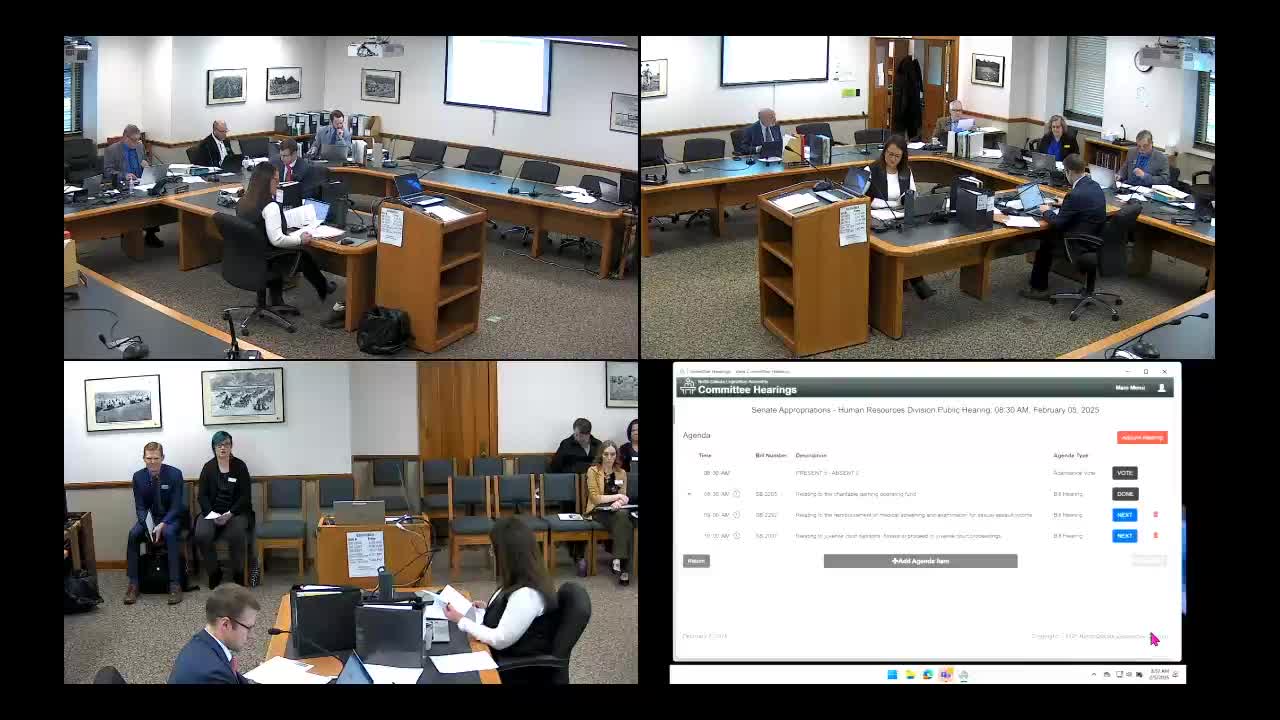
The Senate Appropriations Human Resources Division adopted an amendment clarifying that reimbursement for forensic medical examinations and forensic interviews for sexual-assault victims should come from the General Fund and recommended a due-pass for Senate Bill 2292.
The Senate Appropriations Human Resources Division voted to adopt an amendment and gave a due-pass recommendation on Senate Bill 2292, which clarifies the funding source for reimbursement of forensic medical examinations and forensic interviews provided to survivors of sexual assault and other abuse.
John Godfrey, representing the Insurance Commissioner, explained that the bill does not change the dollar amount appropriated historically for forensic medical exam reimbursements but redesignates the funding source. He said the Insurance Regulatory Trust Fund had borne the costs historically (dating back to a 2007 appropriation) but recent statutory and structural changes — including a $2.4 million-per-biennium designation to the North Dakota Firefighters Association and movement of the fire marshal’s office under the Insurance Department — have created cash-flow deficits in the trust fund. Godfrey said the Insurance Department’s position is that the general fund is a more appropriate and stable source for the forensic-exam reimbursements.
Christie Wolf, communications coordinator for Central Dakota Forensic Nurse Examiners, and Greg Kosowski, executive director of the Children’s Advocacy Centers of North Dakota, testified in support. Wolf outlined the scope of forensic medical exams (collection of physical evidence, photography, swabs and other procedures) and said state and federal law bar charging victims or their insurance for these exams; she told the committee that fully funding exams is necessary to preserve eligibility for federal STOP grants. Kosowski explained the separate reimbursement streams for forensic interviews (Medicaid first, then Crime Victims Compensation, and only then Attorney General reimbursements) and requested language clarifying that both forensic medical exams and forensic interviews be funded from the General Fund.
Becky Keller, finance director for the Attorney General’s Office, said the Attorney General’s Office is neutral on the bill’s funding-source change but noted the bill as amended does not itself include a General Fund appropriation to the Attorney General’s Office; if the bill passes the office will need an appropriation in the AG’s budget. During discussion the committee adopted an amendment (sponsored by the Insurance Commissioner in draft form) that inserts “from the General Fund” in two locations to make clear both exams and interviews are to be funded from the General Fund. The division adopted that amendment and then moved a due-pass on SB 2292 as amended.
The committee recorded a voice vote to adopt the amendment; the committee then voted on the bill and the motion passed on a roll call (recorded yesses included Senators Clary, Davidson, Deaver, Magrum, and Mather). The division agreed someone (Senator Cleary offered) would carry the bill to the full committee; Senators said it will be returned to policy committee because it had not previously passed through policy.
Why it matters: The amendment and bill do not change the statutory-level reimbursement amounts but change the funding source from a special Insurance Regulatory Trust Fund to the General Fund; proponents said the trust fund’s cash-flow and structural changes make the trust fund an unstable source. Central Dakota Forensic Nurse Examiners and Children’s Advocacy Centers said the funding clarity preserves victim protections (no charge to survivors or their insurers) and helps maintain federal grant eligibility.
Outcome: Division adopted the Insurance Commissioner’s amendment and recommended a due-pass on SB 2292 as amended; the appropriation consequences will be addressed in the Attorney General’s budget bill.