Get Full Government Meeting Transcripts, Videos, & Alerts Forever!
Get email alerts on the Problem Gambling Funding topic
No spam. Unsubscribe anytime.
Senate panel backs larger quarterly transfer to fund gambling-disorder services
Summary
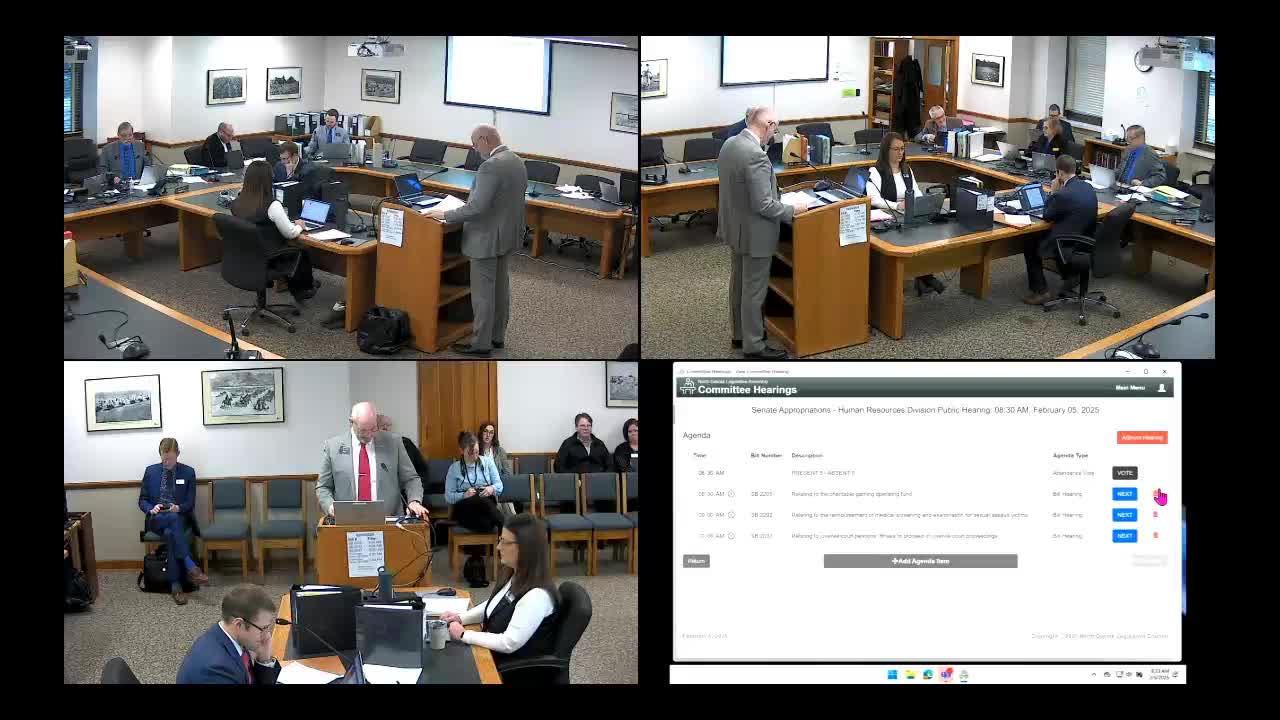
Senate Appropriations Human Resources Division recommended a due-pass for Senate Bill 2205, which would raise the quarterly transfer from the Charitable Gaming Operating Fund to the Gaming Disorder Prevention and Treatment Fund from $10,000 to $75,000.
Senate Appropriations Human Resources Division recommended a due-pass for Senate Bill 2205, which would increase the quarterly transfer from the Charitable Gaming Operating Fund to the Gaming Disorder Prevention and Treatment Fund from $10,000 to $75,000.
The bill’s sponsor, Senator Lueck, told the committee that gambling activity in North Dakota “has picked up exponentially” and that the additional transfers are intended to bolster prevention and treatment services for problem gambling. He asked the committee for a due-pass recommendation.
Department of Health and Human Services manager James Canopic said the increase largely continues funding the department received last session. He told senators the prior $500,000 appropriation from charitable gaming was used to convert temporary problem-gambling counselors into full-time, benefited positions and to provide limited clinical training for clinicians statewide. Canopic said the department currently has two counselors based in Fargo (serving the eastern side of the state, with office space in Grand Forks) and one based in Minot who travels regularly to Bismarck to meet with clients.
Becky Keller, finance director for the Attorney General’s Office, explained the mechanics of the fund. Charitable gaming tax receipts are initially held in the Attorney General’s charitable gaming fund; excess at the end of the biennium transfers to the general fund. Keller said the requested change would increase the quarterly statutory transfer amount the Attorney General’s Office makes to DHS; once the funds leave the gaming fund, DHS determines spending.
Senators asked whether DHS had specific spending plans for the larger transfer. Canopic said much of the additional money would continue to support staff (converting temporary counselors to full-time positions) and trainings; he said DHS has contracted a prevalence study (Gemini Research) and expected preliminary results in February. Committee members also discussed whether problem gambling services should be more broadly integrated with behavioral-health addiction services; Canopic and others said problem-gambling treatment requires specialized interventions (for example, financial-account planning and relapse prevention tailored to gambling disorder).
Senator Davison moved a due-pass recommendation; Senator Cleary seconded. The roll call recorded several aye votes by name during the committee’s recorded vote (Senator Clary — Yes; Senator Davidson — Aye; Chairman Deaver — Aye; Senator Grama — Yes; Senator Mathern — Aye). The motion carried and the committee agreed to send the bill to the full committee the following day.
The committee closed the public hearing on SB 2205 after a brief public comment exchange urging more robust attention to gambling addiction and the flow of gaming revenue.
Why it matters: The bill shifts predictable quarterly resources into a statutory fund dedicated to prevention and treatment of gambling disorder; sponsors and DHS framed it as continuing funding from the last session that established several full-time counselor positions. The change affects how gaming tax revenue is allocated and may reduce the amount that otherwise transfers to the general fund at the end of the biennium.
Votes at a glance: The division adopted a due-pass recommendation on SB 2205; the committee vote included recorded ‘aye’ votes by Senators Clary, Davidson, Deaver, Grama and Mathern; the motion carried and the bill will proceed to the full committee.