Get Full Government Meeting Transcripts, Videos, & Alerts Forever!
Get email alerts on the Legislation Introductions topic
No spam. Unsubscribe anytime.
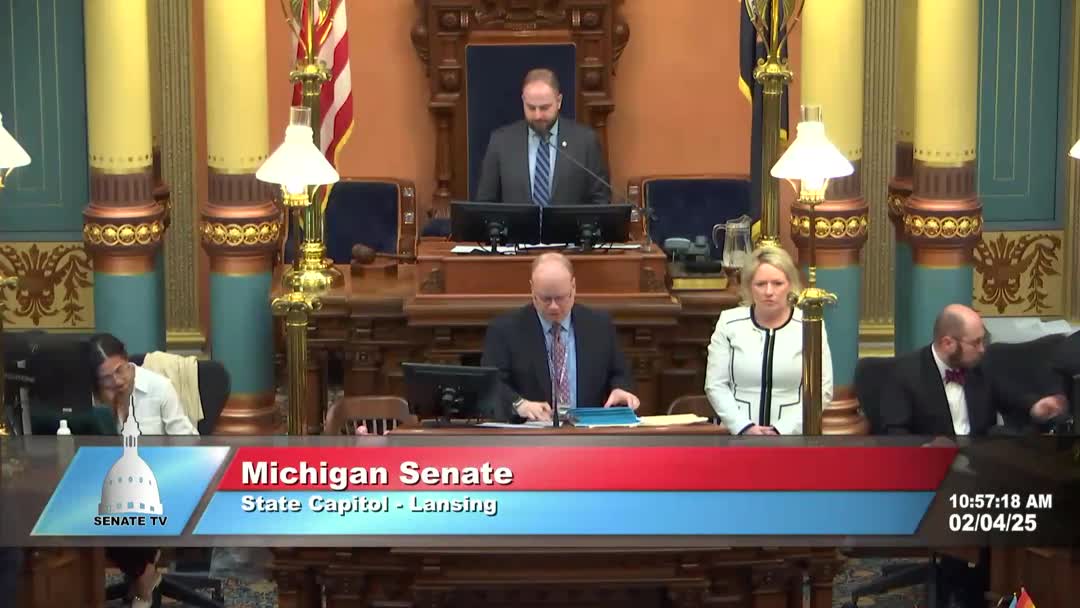
Michigan Senate introduces dozens of bills; most referred to committee
Summary
Senators read dozens of bills and a joint resolution into the record and referred them to standing committees for review; items ranged from amendments to the Public Health Code to changes in the State School Aid Act.
The Michigan Senate read into the record a broad slate of proposed legislation and a joint resolution and referred most items to standing committees for review.
The measures introduced on the floor included Senate Joint Resolution A, a proposal to amend section 13 of Article 4 of the Michigan Constitution to limit the legislative session; bills to amend the Animal Industry Act and various provisions of the Public Health Code; proposals to amend the Insurance Code of 1956; bills addressing the Estates and Protected Individuals Code; changes to the Elliott-Larsen Civil Rights Act; and multiple measures to amend the Social Welfare Act and the State School Aid Act of 1979. The chamber also received house bills transmitted from the House of Representatives, including House Bill 4001 (workforce opportunity wage act) and House Bill 4002 (earned sick time act), which were referred to regulatory affairs.
Most bills were offered by individual senators and, after first reading, were referred to the committees named on the floor. Examples recorded in the session: Senate Bill 28 (Animal Industry Act) was referred to the Committee on Regulatory Affairs; a package of bills addressing the Public Health Code and social welfare were referred to the Committee on Housing and Human Services; bills to amend the Insurance Code were referred to Housing and Human Services; bills affecting transportation and infrastructure were sent to the Committee on Transportation and Infrastructure; and budget and appropriations-related measures were referred to the Committee on Appropriations.
No floor debate on merits or final votes on these measures are recorded in the transcript. Each bill was entered on first reading and then assigned to the committee identified by the presiding officer.
The list of introduced measures is extensive and was read into the record in sequence. Because the session recorded only introductions and referrals, further committee action or floor debate will determine whether any of the bills advance.