
Littlestown Area SD committee reviews softball reorientation to protect future track expansion
Get AI-powered insights, summaries, and transcripts
Subscribe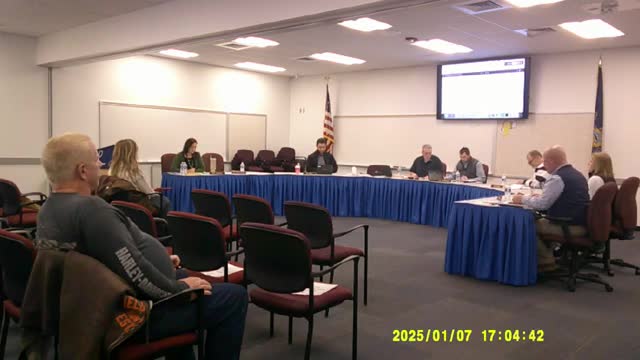
Summary
At a Finance, Property and Supply Committee meeting, district staff and a design consultant presented three options for the softball field and track, including reorienting the softball field inside an expanded track; the board was asked to pick a design to carry into detailed cost estimates.
At a meeting of the Littlestown Area School District Finance, Property and Supply Committee, district staff and a design consultant reviewed three design options for the district’s softball field and track and asked the board to select which option should move forward to detailed design and costing.
The committee heard a recommendation to reorient the softball field and expand the infield area inside a rebuilt track. The presenter said the reorientation would “improve player safety,” reduce sun glare and foul-ball risk, correct drainage and uneven ground and “optimize space utilization” so the complex could host soccer, lacrosse and field hockey in addition to softball and track events. The presenter also told members the redesign could create additional parking and improve spectator access and restrooms.
The presentation matter-of-factly framed the issue as a near-term chance to address a track resurfacing that will require rebuilding the base layer, not just a top-layer overlay. The presenter said the track will likely need full reconstruction when resurfaced again and that “you can’t just do the top layer resurface again. They’re gonna have to dig down to the … stones at the bottom.” That deeper work, the presenter said, presents an opportunity to expand the track footprint if the district plans for it now.
Shelly, the presenter from the design firm (materials labeled from the design company Turf Traffic Court), told the committee: “The proposal that I would suggest is the reorientation of the softball field and field expansion inside the track.” The handout shown to the board listed three broad options: keep the softball “as is” and design around an unchanged track; keep the softball position but design track expansion for a later date; or reorient the softball now to accommodate a future larger track (the reorientation options included 6- and 8-lane track layouts in the presented concept drawings).
Staff noted the difference in construction cost between keeping the softball as-is and reorienting it could be substantial. One presenter said the cost difference between the two approaches had been estimated “anywhere from almost a hundred thousand dollars” in earlier design-phase ranges; the group emphasized those figures are design estimates that will be refined only after the board selects a specific option to develop. Board members were told that many line items—dugout placement, size of scoreboards, fencing type, batting cages and parking layout—would be defined in the next design stage and would change final pricing.
The committee discussed timing and trade-offs. Staff said the district previously decided to retain the softball in its current orientation during an earlier feasibility discussion but that the resurfacing timeline and the need to reconstruct the track base now make reconsidering orientation prudent. The presenter said the track has already been resurfaced once and that a full reconstruction would likely be required when the district resurfaces again (presenter estimated the existing surface life measured in decades). The presenter asked the board whether it wanted staff to proceed with detailed design and cost estimates for the reorientation option or to limit design work to the “as-is” layout.
Board members asked clarifying questions about which elements of the site would change under each option and what design costs would be wasted if the board later selected a different alternative. Staff answered that some components—fencing and the scoreboard—would remain in most designs, while dugouts, batting cages and additional parking would be the primary added costs for a reorientation. A handout shown during the presentation listed a potential increase in parking capacity; the presenter described the figure as part of the concept materials and said exact counts would be determined in design.
No formal motion or vote was recorded at the meeting. The discussion closed with staff requesting direction from the board on which of the three concept options the district should take into the next, detailed design phase so accurate cost estimates can be produced.
Next steps: staff will return with detailed design and cost estimates for whichever option the board directs; no timeline or funding source for construction was set during the committee discussion.