Get Full Government Meeting Transcripts, Videos, & Alerts Forever!
Get email alerts on the Tax Foreclosure Covenants topic
No spam. Unsubscribe anytime.
Marathon County committee advances resolution to require build-out and short‑term‑rental limits on tax‑foreclosed parcels
Summary
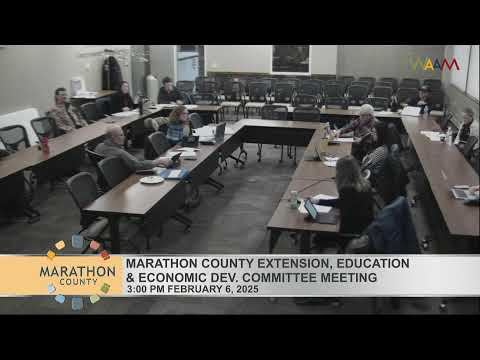
Marathon County's Extension Education and Economic Development Committee on Feb. 6 voted unanimously to forward two related measures to the Human Resources, Finance and Property Committee that would attach restrictive covenants to properties acquired through the county's tax‑delinquency process.
Marathon County's Extension Education and Economic Development Committee on Feb. 6 voted unanimously to forward two related measures to the Human Resources, Finance and Property Committee that would attach restrictive covenants to properties acquired through the county's tax‑delinquency process.
The measures, presented by County Administrator Mike, would (1) condition future sales of unimproved, buildable tax parcels on construction and occupancy within 24 months of purchase and (2) record covenants prohibiting short‑term rentals for 10 years on parcels sold by the county. The packet also included a draft ordinance amendment to Marathon County Code section 3.2 to reflect recent state law and U.S. Supreme Court guidance on disposition of tax‑delinquent property.
Committee members debated legal risk, enforcement and practical implementation. Administrator Mike said recent court and statutory developments require counties to return any sale proceeds exceeding unpaid taxes and costs to former owners, and Wisconsin law shortens the window for county sale of acquired parcels from 240 days toward 180 days by 2026. He suggested adding the new timelines to county code so future staff and boards see the requirement in writing.
Supervisor Rosenberg asked whether the covenants would reduce property values and create liability. Mike and other staff acknowledged such claims are possible but said recent local practice — using statewide surplus property listings and appraisals — has produced quick sales and could help show the county obtained fair market value. A county official said one practical protection is to obtain a certified appraisal assuming no covenants, and to document sales that equal or exceed that appraisal as evidence the covenant did not depress the sale price.
Committee members also discussed enforcement options if a buyer fails to build within 24 months. Staff described prior practice in which sale contracts included a repurchase right for the county and said recorded deed restrictions would follow a parcel to later owners, creating a recorded notice for subsequent buyers. Short‑term rental prohibition enforcement was described as more straightforward because short‑term rental licensing is already overseen by a county department; properties with covenants would be flagged so they could not receive a short‑term rental license.
Supervisor Lemmer raised whether the proposed changes are a temporary response to current market conditions or a long‑term policy; staff said they included both a standalone resolution and an ordinance change in the packet and recommended sending both to HR, Finance and Property for detailed review. Supervisor Rosenberg moved to advance both documents; Supervisor Lemmer seconded. The motion carried unanimously.
Votes at a glance • Motion to advance two related items on restrictive covenants (conditions of sale language; and conditions of sale plus proposed ordinance amendments to revise Code section 3.2) to HR, Finance and Property — Mover: Supervisor Rosenberg; Second: Supervisor Lemmer; Outcome: approved unanimously. • Approval of prior meeting minutes (Jan. 9, 2025 Extension Education and Economic Development Committee) — Mover: Supervisor Rosenberg; Second: Supervisor Lemmer; Outcome: approved.
What happens next: Staff said either measure could proceed piecemeal or together; if the ordinance is amended staff intends to return detailed operational procedures to HR, Finance and Property, including appraisal practices, recording language for deed restrictions and enforcement options. The committee did not set a countywide enforcement protocol at the meeting; staff said they will draft recommended procedures and bring them to the next committee for review.