Get Full Government Meeting Transcripts, Videos, & Alerts Forever!
Get email alerts on the Rezoning Goodby Hs1 topic
No spam. Unsubscribe anytime.
Planning commission denies two rezoning requests for large Goodby-area parcels after flooding and traffic concerns
Summary
The St. Tammany Parish Planning Commission voted to deny two related rezoning requests from HS1 Associates/Marietta Trust that would have rezoned roughly 344 acres near Goodby from rural residential and neighborhood commercial to S-2 suburban residential, following extensive public comment citing flooding and traffic problems.
The St. Tammany Parish Planning Commission denied two related rezoning requests that would have rezoned roughly 344 acres near the Goodby area of Covington from rural and neighborhood residential designations to S-2 (suburban residential) after hours of public comment and commissioner debate.
Supporters including the petitioner’s attorney Paul Marone argued the parcels front major corridors and are consistent with nearby subdivisions. “S-2 zoning has a specific purpose … providing single family residential dwellings in a setting of moderate urban density with central utilities,” Marone told the commission, and he said the developer’s preliminary engineering estimated “probably in excess of 50 acres of ponds on this site to meet those requirements” and pledged to “not only meet the drainage requirements … we’ll exceed them.”
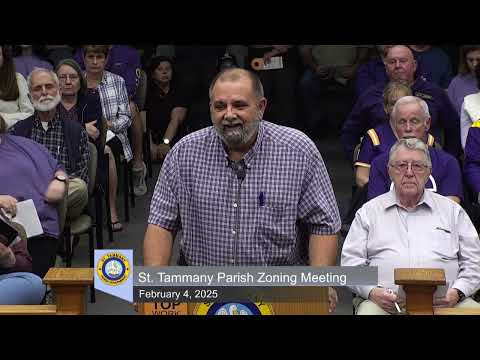
Opponents — dozens of residents, civic advocates and local groups — said the tract is a known storage basin and headwaters for downstream creeks, floods frequently, and that Highway 1077 and U.S. 190 cannot absorb the traffic a large subdivision would generate. “This whole property floods,” said Matthew Allen, executive director of North Shore River Watch, during public comment.
Why it matters: the two petitions covered adjacent parcels the developer said would be phased over many years but neighbors said would increase flood risk and worsen congestion at the already-congested Goodby intersection. Commissioners who voted to deny cited public-safety and infrastructure concerns and the volume of opposition from nearby residents.
What the petitions proposed: Case 2024-4097-ZC described a 305.5-acre tract with mixed R-1/R-2/NC-2 zoning petitioned to S-2; Case 2024-4098-ZC was a separate 38.7-acre parcel adjacent to the first. Petitioners said the 2040 comprehensive plan designates much of the area as medium-density residential and that nearby subdivisions contain lots equal to or smaller than S-2 minimums. Opponents presented repeated accounts of flooding in Spring Hill Lakes and surrounding neighborhoods and said Highway 1077 at U.S. 190 is regularly congested.
Commission action and procedure: Commissioner Arceneaux moved to deny the rezoning for Case 2024-4097-ZC; Commissioner Trucillo seconded. The motion to deny carried. After that vote the commission moved on to Case 2024-4098-ZC; Commissioner Robert moved to deny and Commissioner Narcisse seconded, and the motion to deny for the smaller parcel also carried. The chair reminded the public they retain the right to appeal the commission’s denial to the Parish Council.
Public comment and technical concerns: speakers focused on three recurring points: (1) chronic flooding and the parcels’ role as stormwater storage and headwaters to East Biedeco Creek; (2) traffic congestion on LA 1077 and U.S. 190 at the Goodby intersection; and (3) lack of immediate infrastructure (schools, roads, homeowners’ association capacity for pond maintenance). Petitioners repeatedly said rezoning alone does not authorize construction and promised to meet parish drainage and traffic mitigation rules at later planning stages.
What is next: the petitioner may appeal the commission’s denials to the Parish Council. The commission’s vote does not itself change land use but is the dispositive recommendation on the submitted rezoning applications.