Get Full Government Meeting Transcripts, Videos, & Alerts Forever!
Get email alerts on the Preapproved Design Catalog topic
No spam. Unsubscribe anytime.
Committee explores preapproved residential design catalog and pattern zoning to speed housing supply
Summary
Staff described a plan, funded by a $1 million pro-housing grant, to develop preapproved building plans (a pattern-zoning/catalog approach) to expand missing-middle housing and accessory dwelling units (ADUs). Staff recommended stakeholder outreach, an RFP for consultants emphasizing community buy-in, and a possible pilot focused on ADUs.
The City Council Business and Community Affairs Committee on Feb. 6 discussed creating a preapproved design catalog of residential building plans and pattern zoning to help increase housing supply, with a staff presentation led by Anya/Anais and moderated by planning staff.
Anya explained the concept: “preapproved plans are, building plans that have been prereviewed for building code and for fire kind of issues, but they would still require, a site plan and a foundation plan.” She said such plans are typically designated by zone, available to any resident, and can lower design friction though they do not in themselves make housing "affordable." “They are a supply tool, not an affordability tool,” staff said, summarizing lessons from peer cities.
Staff outlined case studies: Claremore, Okla., which has used typologies successfully in certain neighborhoods (including post-disaster rebuilds); Bridal, Texas, which has a program but low take-up; Fayetteville, Ark., which plans a three-year pilot and has a wait list for plans; and Spokane, Wash., which ultimately adjusted zoning to enable missing-middle housing after design/code problems with outside-prepared plans.
The committee discussed practical program design: stakeholder engagement (neighborhoods, local architects and local bankers), whether to seek an open call for plans or to hire a consultant via RFP, and whether to prioritize accessory dwelling units for a rapid pilot that could produce near-term results. Staff said the city was awarded a $1,000,000 pro-housing grant and indicated the preapproved-plans project has a budget allocation at the staff-planning stage (staff used the phrasing "slated for ... 50 ish of that," which left the precise amount unclear).
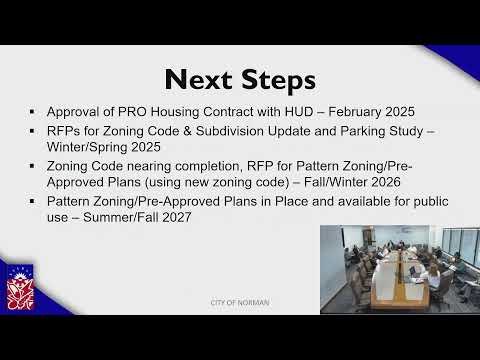
Council members and staff emphasized required safeguards: ensure plans meet local building code (including climate/structural requirements), preserve opportunities for local architects, include foundation/site-plan considerations, and design the RFP to score community outreach methodology highly. Staff projected the preapproved plans and any associated zoning updates could be ready for council consideration in early to mid 2027 if schedules hold.
Ending: Staff will include a strong community-engagement requirement in the consultant RFP, consider an ADU pilot to accelerate near-term impact and return with RFP language and a timeline as other work on zoning and the comprehensive plan proceeds. No formal vote occurred at the meeting.