Get Full Government Meeting Transcripts, Videos, & Alerts Forever!
Get email alerts on the Utility Safety Culture topic
No spam. Unsubscribe anytime.
CPUC staff says SoCalGas safety-culture revision shows progress but urges broader metrics, public-safety focus
Summary
At a CPUC workshop, Safety Policy Division staff and external experts said SoCalGas’s revised safety-culture improvement plan reflects a more self-critical approach and better linkage between findings and initiatives, but recommended stronger metrics, clearer baselines, wider scope beyond occupational safety, and formalized iteration processes.
Carolina, Safety Policy Division staff at the California Public Utilities Commission, told participants the workshop was focused on the Safety Policy Division’s evaluation of SoCalGas’s revised safety-culture improvement plan and the staff report that accompanies it. Commissioner Hauck opened by saying the proceeding “is 1 of 3 proceedings before the Commission that were open due to significant safety incidents involving SoCalGas.”
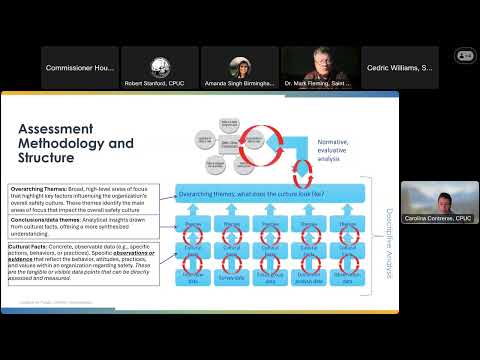
The workshop reviewed the Phase 1 safety-culture assessment (the 2EC report), the CPUC decision that directed SoCalGas to revise its plan (Decision D23-12034), and SoCalGas’s revised plan filed after extensive organizational dialogues. Dr. Mark Fleming, a subject-matter expert who worked with the assessment team, emphasized that the assessment sought to identify “overarching themes” beneath visible practices — the underlying assumptions that drive culture — and said improvement work must target those deeper drivers. “We need to specify those indicators before we go to the next level,” Fleming told the workshop, describing why pre‑defined cultural indicators are essential to judge whether initiatives move the organization in the intended direction.
Safety Policy Division (SPD) staff said their evaluation found meaningful changes in SoCalGas’s revised plan compared with an earlier submission the Commission had rejected. SPD’s high‑level finding: the revised plan reflects a shift from a defensive tone to a more self-critical one and shows clearer links between assessment findings, dialogue outputs and proposed initiatives. Carolina summarized SPD’s view that the utility used organizational dialogues to surface drivers behind the assessment conclusions and to design measures intended to address them.
SPD identified specific areas that need strengthening. First, SPD flagged a risk that many proposed activities remain rooted in occupational safety practice and thus may not advance a “speak up” culture for public and infrastructure safety. SPD requested that SoCalGas demonstrate how activities traditionally associated with employee safety (for example, tailgate or toolbox talks and work observations) will explicitly incorporate public- and infrastructure-safety considerations and how those changes will be measured.
Second, SPD recommended expanding the scope and throughput of the corrective action program so it captures a broader set of issues across the company — including contractor‑raised concerns — and supports systemwide learning. Third, SPD asked SoCalGas to strengthen the design of its “learning teams” (used to probe resource allocation and systemic issues) by applying saturation testing or similar steps to ensure the teams collect enough evidence to support organizationwide conclusions.
SPD also recommended more concrete baselines and more detailed metric descriptions in the quarterly reports so regulators and stakeholders can make apples‑to‑apples comparisons over time. Carolina noted SPD’s review did not initially include SoCalGas’s December quarterly filing and encouraged the utility to use existing company data where practical to populate baselines rather than relying solely on the 2EC assessment as a default benchmark.
SoCalGas Chief Safety Officer Cedric Williams and Jason Egan, Director of Safety Strategy and Culture, told the workshop the company has broadened its definition of safety beyond personnel injury to include hazard recognition, mitigation, public safety and infrastructure protection. Williams said the revised plan “reflects our change in thinking” and described concrete examples from recent wildfire response where the company aligned senior leaders to shut off service to about 30,000 customers, expanded personal protective equipment protocols, and stepped up public communications during restoration.
Egan said SoCalGas intends to “change the way work is done, rather than add new activities on top of existing” practices, by embedding considerations of public and infrastructure safety into existing worksite conversations and processes. He and Williams acknowledged SPD’s recommendations and described steps the company plans to take: (1) expand and make more explicit how work observations and tailgate discussions consider non‑occupational risks; (2) iterate and phase enhancements to the corrective-action tracking system rather than attempt a single, large overhaul; (3) perform saturation analyses for learning teams to confirm whether their outputs are representative; and (4) add more detailed measure definitions and baseline descriptions in future quarterly reports.
Participants asked clarifying questions. Rachel Sweetnam of the Center for Accessible Technology asked whether communications and comprehensive-safety definitions would explicitly include “vulnerable populations.” Egan responded that SoCalGas’s plan definitions include “the safety of vulnerable populations” among public-safety considerations. A commenter identified in the record as Mina and representatives of Cal Advocates asked how ongoing SPD‑utility engagement should be structured and what approval timeline should apply to plan iterations filed in quarterly reports. SPD staff said the division favors an approval process that balances prompt review (a 30‑day target was discussed) with the ability to take additional time when a filing appears to require deeper review.
No formal Commission votes or regulatory orders were issued at the workshop. The CPUC docket will continue with written comments: initial comments on the SPD report and filings are due February 19 and reply comments are due March 5, and SPD noted a proposed decision is expected within 90 days after the record is closed.
The parties and staff signaled continued collaboration: SPD and Dr. Fleming described frequent check‑ins with SoCalGas during plan development; SoCalGas said it will continue engagement with SPD, Sempra, and interested parties during implementation and reporting.
Why it matters: the proceeding evaluates how the largest gas investor‑owned utility in Southern California will address systemic cultural drivers that the independent assessment found are affecting safety decisions. SPD and the external experts pressed SoCalGas to move beyond discrete, occupational-safety activities toward interventions, metrics and governance that demonstrate measurable change in how the company identifies and mitigates risks to employees, the public and infrastructure.