
Residents propose 18-hole disc-golf course in Mileslip Forest; conservation commission raises questions on access, impact and long-term maintenance
Get AI-powered insights, summaries, and transcripts
Subscribe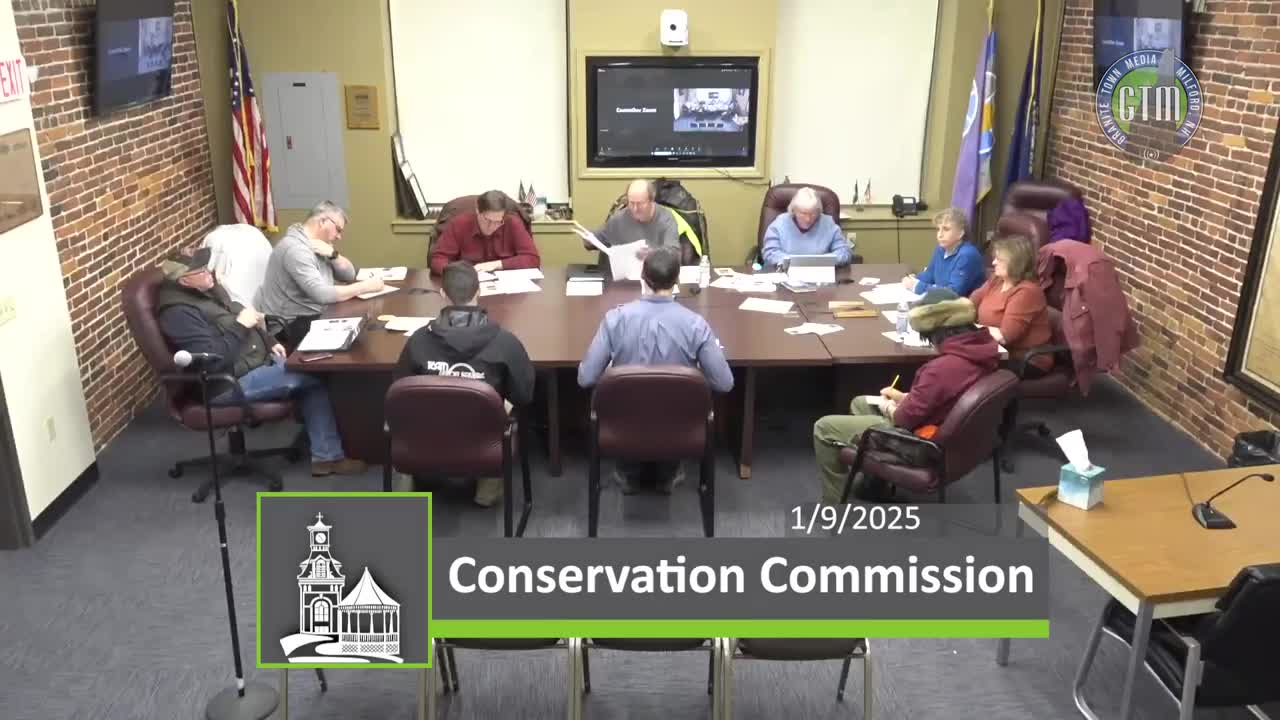
Summary
Local residents proposed adding an 18-hole disc-golf course to a portion of Mileslip Forest. Presenters outlined environmental safeguards, trail reuse, funding via sponsors and volunteer maintenance; commission members requested more detailed sketches, management plans and confirmation of easement and permitting constraints.
A community group proposed installing an 18-hole disc-golf course on a small portion of the town-owned Mileslip Forest at the Jan. 9 meeting of Milford Boards & Committees of Selectmen. The presenters asked the conservation commission to allow continued study of the idea and to avoid an immediate “no.”
Mike Solo, a Milford resident who described his background in environmental science and experience with course development, and Ryan Pernice, a local business owner, outlined a plan that would use roughly 20–25 acres for a full 18-hole course while preserving the rest of the 423-acre forest for other uses. Solo said construction would be limited to installing tees (typically 5-by-12-foot pads with gravel or pavers), signage and anchored baskets: “For the tees themselves, generally, you want to install 2 tee boxes. It's a 5 foot by 12 foot section that you generally put a poor service on, so gravel, paved stones, concrete,” he said.
The presenters said few trees would need removal, trimming would be limited and the course could use existing trails to minimize new clearing. They proposed hiring a professional course designer and coordinating with Bay State Forestry and the town’s forest-management process; Solo said he had discussed the idea with Eric Radliff of Bay State Forestry and that Radliff was “net neutral” based on his experience, noting courses can be built poorly or well.
Environmental protections described included avoiding significant new clearing, using temporary baskets or natural markers to trial layouts, and coordinating any timber harvests as part of managed, selective cuts rather than large clear-cuts. Solo said Fish and Game and DES grant-type pots and snowmobile-trail grants might be sources of funding if the course could be tied to multiuse trail maintenance; he also said private sponsorships and tournament “greens fees” could cover capital and maintenance costs.
Board and commission members raised several concerns the presenters said they would address if the commission allowed further study: confirmation that course use fits the Mileslip Forest easement and town-forest designation; plans for long-term maintenance and governance (the presenters proposed forming an association to take donations and handle upkeep); parking and trail-user conflicts, including walkers, hunters and wildlife; potential exclusionary effects if organized leagues monopolize access; the course’s effect on habitat and the town’s stated desire to keep some forest areas undisturbed; and permitting and accessibility constraints. Anita, a commission member, emphasized habitat protection and cautioned that Mileslip already has many trails and high trail impact.
Commission members asked the presenters to produce a preliminary, gross sketch of proposed hole locations, coordinate site walks and work with town forestry staff so the course design could be incorporated into the forthcoming Mileslip Forest management-plan update. The board indicated it would not issue an immediate prohibition and asked the presenters to return with more detailed plans and documentation, including any easement or permitting clarifications. No formal vote or permit decision was made at the meeting.