
Milford Planning Board opens first of two public hearings on zoning ordinance revisions
Get AI-powered insights, summaries, and transcripts
Subscribe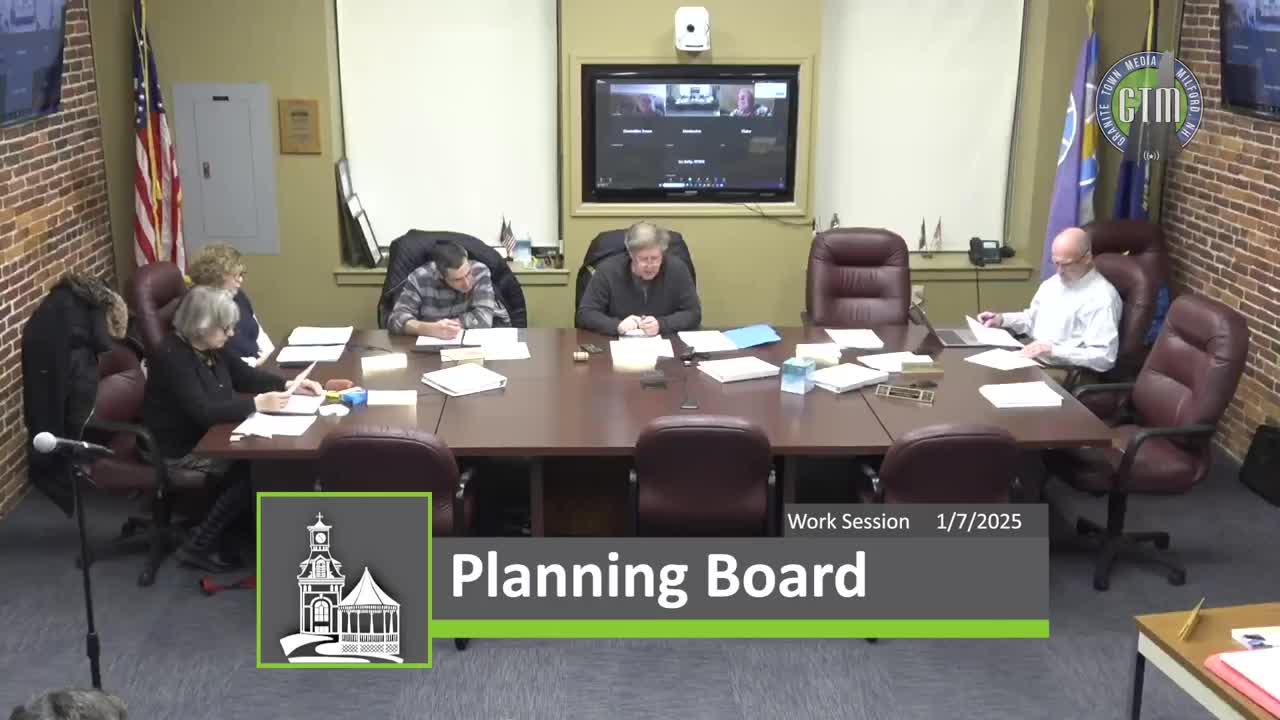
Summary
This is the first of two required public hearings for a proposed Town of Milford zoning ordinance revisions, Planning Board Chairman Doug Knott told the meeting on Jan. 7.
This is the first of two required public hearings for a proposed Town of Milford zoning ordinance revisions, Planning Board Chairman Doug Knott told the meeting on Jan. 7.
The hearing reviewed five separate proposed changes to the town zoning ordinance that staff say are mostly intended to bring the ordinance into compliance with recent state statutes and to clarify ambiguous wording. The board did not vote; members asked staff to prepare clearer, plain-language materials, maps and draft code language for the second hearing and for the voters’ information materials.
Town Planner Terry Dolan described the first change as implementing a state mandate for family day care homes. "The state is mandating and you cannot require a local site plan review," he said, explaining the proposal would convert many small family day cares (typically six or fewer children) into an allowable use in areas where single-family residential uses are permitted. Vice Chair Janet Langdell also reminded the public that such day cares still must meet state licensing and life-safety rules: "The family home day cares and all the day cares will need to comply with any kind of state regulation and state licensing for that use," she said.
Dolan presented a second proposal to revert the rural-residential (R) district's minimum lot size and frontage to earlier criteria. He said the draft language would return to a 40,000-square-foot minimum lot (roughly under one acre) and restore a frontage standard; speakers and staff used different frontage figures during discussion. Dolan initially described a 150-foot frontage on a classified road, while other comments noted "50 feet" in later remarks. Dolan also noted current ordinance language that reads as a two-acre minimum and suggested the change would be put to voters after the required hearings.
Other proposed edits reviewed during the hearing include: - Junkyard definition: staff proposed replacing ambiguous wording to make clear junkyards are regulated on "any lot," removing a prior reading that could be interpreted to exempt residential lots. The draft ties the definition to commonly used measures (for example, vehicles without registration) used to distinguish temporary storage from regulated junkyards. - Open Space and Conservation District language: the draft removes duplicate or confusing references to "dwelling units" so the provision applies consistently to subdivisions creating more than four lots and avoids mixed interpretations about minor versus major subdivisions. - Manufactured housing parks: staff proposed language to comply with a 2024 state statute requiring towns to allow "reasonable expansion" of existing manufactured-home parks. The statute took effect July 19, 2024, and the board debated how narrowly to interpret "reasonable expansion" — whether it should be limited to capacity within a park’s existing geographic boundaries as of that effective date or also permit acquisition of adjacent land. Planning members asked staff to consider adding the RSA's geographic-boundary language directly into the local zoning text so the town's language matches the state guidance.
Public commenters addressed practical impacts. Resident Scott Campbell Wittenrow asked whether large parcels could be required to connect to nearby water and sewer lines if developers built multiple lots: "If somebody is gonna get the 10-acre lot and it's gonna build 10 houses now, is there any way we can put in some of this writing that if they're close enough to the water and sewer lines ... something that big at least 10 acres can be hooked up?" Staff and board members said connection costs are typically borne by the property owner and that water/sewer availability affects feasibility.
Board members and staff requested several follow-ups before the next hearing. They asked for: a plain-language one- or two-page summary of each proposed revision for the voters' guide; a clear map showing the R (rural-residential) district areas for public reference (staff reported the zoning map links were offline after a website migration but said GIS layers could be used); and draft alternative wording to clarify "reasonable expansion" for manufactured housing parks. Dolan and Director of Community Development Camille Payson said the redlined draft and explanatory materials have been posted in town offices and would be updated online.
The planning board closed the public portion of the Jan. 7 meeting after the discussions and scheduled the second required public hearing for Jan. 21. No formal actions or votes on the ordinance changes were taken at the Jan. 7 session.
Board members emphasized that the hearing was an informational step and urged citizens to review the materials and attend the next hearing or use the future voters' guide materials to comment further.