Get Full Government Meeting Transcripts, Videos, & Alerts Forever!
Get email alerts on the Unsafe Structures topic
No spam. Unsubscribe anytime.
Hearing officer warns developer: unfinished North Port homes face steep, ongoing fines
Summary
At Jan. 23 code enforcement, the hearing officer found Estero‑related unfinished homes unsafe and set daily fines — including an uncapped $250/day penalty — if the properties are not secured or permitted by mid‑February.
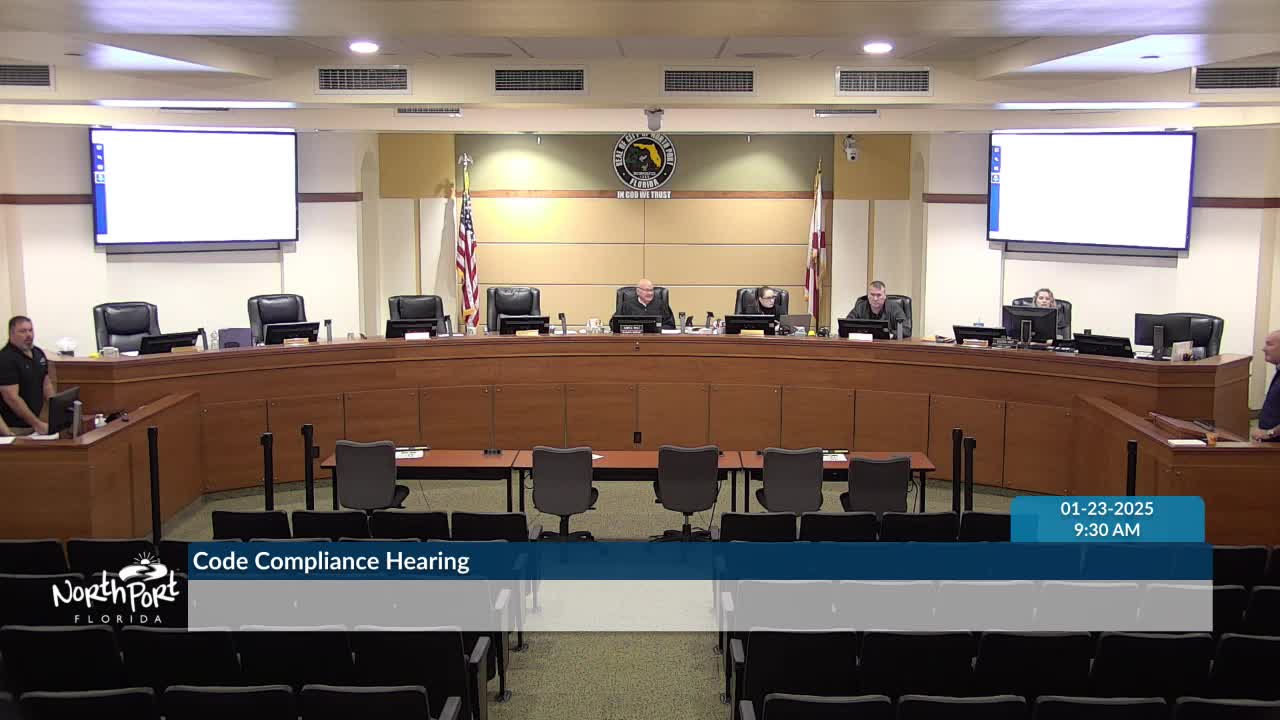
At the Jan. 23 City of North Port code enforcement hearing, the hearing officer found an Estero‑related development in violation of multiple codes for unfinished, exposed structures and set daily fines that would begin Feb. 18, 2025, if the violations are not corrected by Feb. 17.
The case involved properties tied to Estero Development Partners (referred to in the record and represented by a company representative identified as Readsweiser) and an associated developer inventory of partially completed homes. Code Enforcement Inspector Gavin O’Neil and others presented photographs and inspection histories showing exposed roof components, missing screens and an expired building permit.
Nut graf: The hearing officer determined the site posed both a building‑code violation and a public‑safety risk and imposed a tiered set of penalties: $25 per day for missing silk screens (max $2,000), $50 per day for the expired permit (max $5,000), and $250 per day with no maximum for the unsafe structure violation. Assistant City Attorney Caitlin Coghlan told the panel the city’s principal concern was liability tied to people accessing or inhabiting unsafe unfinished structures.
During the hearing, the developer’s representative said the company was negotiating a sale of a block of inventory to another builder and estimated a possible timetable of 30–60 days for sale negotiations and 4–6 months for construction to resume. The hearing officer said that, given repeated inspections and neighbor complaints, he was reluctant to extend an open‑ended timetable and would set a short compliance window so the city could move to enforce if the work did not occur.
“At least you have a lien that is, you know, hopefully…that helps you,” the hearing officer said, explaining that assessed fines become liens that can be used by the city to fund abatement. Assistant City Attorney Caitlin Coghlan emphasized liability concerns to the hearing officer: “The biggest issue for the city is the liability,” she said, pointing to the risk of collapse or unauthorized occupation.
The developer said it was seeking to sell the properties “to consummate a sale of, I don’t know, it’s like 15 to 18 of these,” and estimated that construction could begin in “as quickly as 4 months as long as 6.” The hearing officer noted that such timelines were uncertain and that a short compliance date — Feb. 17, 2025 — would give the city clarity on whether the site had been secured or transferred to a new owner who might ask for relief.
The hearing officer’s order: For the property in this matter (case 243798), the hearing officer found violations of municipal code and the Florida Building Code as presented and ordered: missing silk screens — $25/day (max $2,000), expired permit — $50/day (max $5,000), unsafe structure — $250/day (no maximum). All three penalties were scheduled to commence Feb. 18, 2025, if the property had not been brought into compliance by Feb. 17, 2025.
Why it matters: The uncapped daily fine for unsafe structures creates a strong financial incentive for either the current developer or any buyer to secure or correct the property quickly. The city attorney’s liability concerns mean the city could seek to board openings, abate hazards or pursue liens if the owner does not act.
Next steps: Code enforcement asked the developer to board up openings where feasible and to provide documentation of any buyer or remediation plan when the matter returns to the docket. The hearing officer said the case could return at the next hearing cycle for further review or to consider a buyer’s plea for relief once any sale was completed.
Ending: The hearing officer said he preferred a short compliance window to avoid indefinite delays and told the parties that, if a new owner appeared and sought relief, the hearing or the city commission could consider that later. The matter remains active and will be revisited in the court of the hearing officer if compliance is not demonstrated by mid‑February.