Get Full Government Meeting Transcripts, Videos, & Alerts Forever!
Get email alerts on the Debanking topic
No spam. Unsubscribe anytime.
Senate Banking Committee hears testimony on ‘‘debanking’’ of legal businesses and consumers
Summary
Witnesses, bank lawyers and policy experts told the Senate Banking, Housing, and Urban Affairs Committee that banks and regulators have contributed to widespread account closures of lawful customers — from crypto firms to charities and individuals — and called for clearer rules, more transparency and better staffing of examiners.
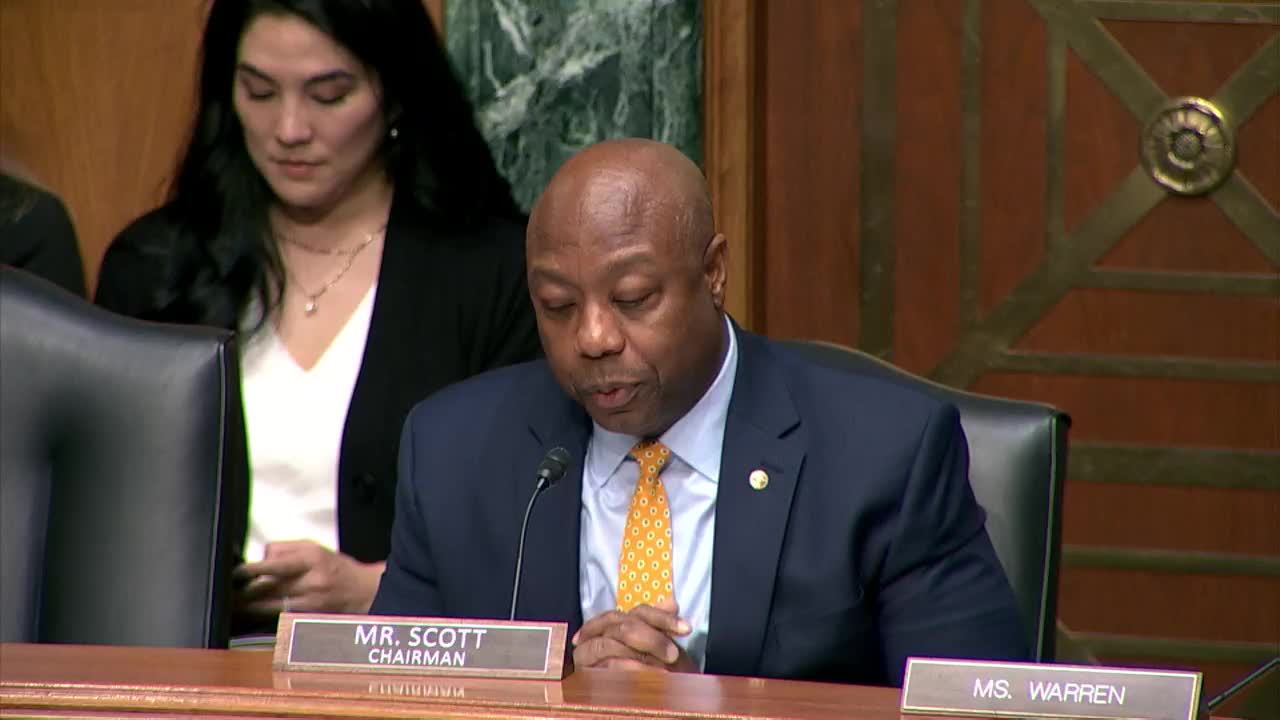
The Senate Banking, Housing, and Urban Affairs Committee held a full-committee hearing on Feb. 5 examining the phenomenon commonly called “debanking,” with witnesses from the crypto industry, banking law and policy experts describing how legal firms and individuals have lost access to bank services.
The hearing, chaired by Senator Tim Scott, focused on accounts being closed or denied without apparent explanation and on whether regulators and large banks had pressured or otherwise shut out lawful customers. Senator Elizabeth Warren, the committee’s ranking member, said the volume of complaints indicated a real problem: “Debanking is a real problem, and it’s something that I hope we can work on together,” she said, noting her staff’s review of 11,955 Consumer Financial Protection Bureau complaints in the past three years.
Nathan McCauley, chief executive officer and co‑founder of Anchorage Digital, told the committee that Anchorage — which holds an OCC conditional bank charter and custodial relationships for institutional crypto clients — was told by a partner bank in June 2023 that its account would be closed in 30 days. “They told us they were closing our account in 30 days because they were not comfortable with our crypto clients and their transactions,” McCauley said. He described repeated rejections by roughly 40 other banks and said the disruption forced Anchorage to lay off about 70 employees — roughly 20% of U.S. staff — and impaired the firm’s ability to offer routine banking services such as wire transfers.
Steven Gannon, a partner at Davis Wright Tremaine who previously served as a senior legal executive for banks, argued that regulators’ broad discretion enables debanking. “They depend on broad, vague, and malleable terms, always subject to reinterpretation by supervisors,” Gannon said, describing how terms like reputational risk and management can be applied so broadly they effectively give examiners near‑unlimited discretion.
Mike Ring, president and CEO of Old Glory Bank, described launching a community bank in Elmore City, Oklahoma, as a market response to account closures. Ring said Old Glory built alternative products — from a payments app to cash‑deposit partnerships — to give customers options after being denied by larger banks. “We are a community bank that does do character loans,” Ring said, adding that Old Glory grew to more than $170 million in deposits and more than 50,000 customers across all 50 states in under two years.
Aaron Klein, senior fellow at the Brookings Institution, described the consumer consequences of lacking bank access and outlined policy options, including wider adoption of low‑cost “Bank On” style accounts, overdraft reform, payments modernization and changes to anti‑money‑laundering reporting thresholds. “Ten percent of American households are currently unbanked or were unbanked at some point within the last year,” Klein said, and he argued that modernizing payments and reducing surprise fees would reduce the economic pressure that drives people out of mainstream banking.
Senators on both sides said a mix of factors appeared to be involved: regulatory guidance and supervisory letters that discouraged banks from certain activities; large banks’ internal policies and reputational‑risk committees; third‑party “do not bank” lists; and the economics of anti‑money‑laundering (AML) compliance. Members pressed witnesses about how to preserve safety and soundness while preventing arbitrary exclusion from the financial system.
Witnesses and senators discussed several specific regulatory documents and agency actions cited by witnesses and in the record: an interagency January 2023 joint statement by the Federal Reserve Board, the FDIC and the OCC warning about crypto‑related risks; FDIC financial institution letters such as FIL‑16‑22; SEC Staff Accounting Bulletin SAB 121; FDIC supervisory pause letters disclosed by the agency’s Inspector General; and recent FDIC supervisory documents the acting FDIC chair released publicly during the hearing. Senator Scott said the committee would review newly released FDIC material in detail.
Committee members raised policy options ranging from statutory fixes and better notice and process for supervisory guidance to market‑driven solutions such as easier chartering and more community banks. Several senators urged stronger staffing for bank examiners; witnesses and senators noted that understaffed supervisory agencies complicate clear, consistent examinations and guidance.
The hearing record will remain open for written questions; Chairman Scott announced senators may submit questions for the record and witnesses have 45 days to respond. Several senators promised follow‑up oversight; others said legislation — including proposals to require more transparency or to bar categorical denials of lawful industries — merited further study.
While witnesses described differing diagnoses and remedies, the hearing underscored bipartisan concern that lawful consumers and businesses should not be shut out of the banking system without an accessible, transparent process to challenge decisions.
Less urgent items discussed in the hearing included proposals to speed payments and to reform AML reporting thresholds; witnesses argued those changes would reduce the number of marginal customers who are cost‑prohibitive for banks to serve.