
Senate panel presses Pentagon to overhaul acquisition and expand U.S. manufacturing
Get AI-powered insights, summaries, and transcripts
Sign Up Free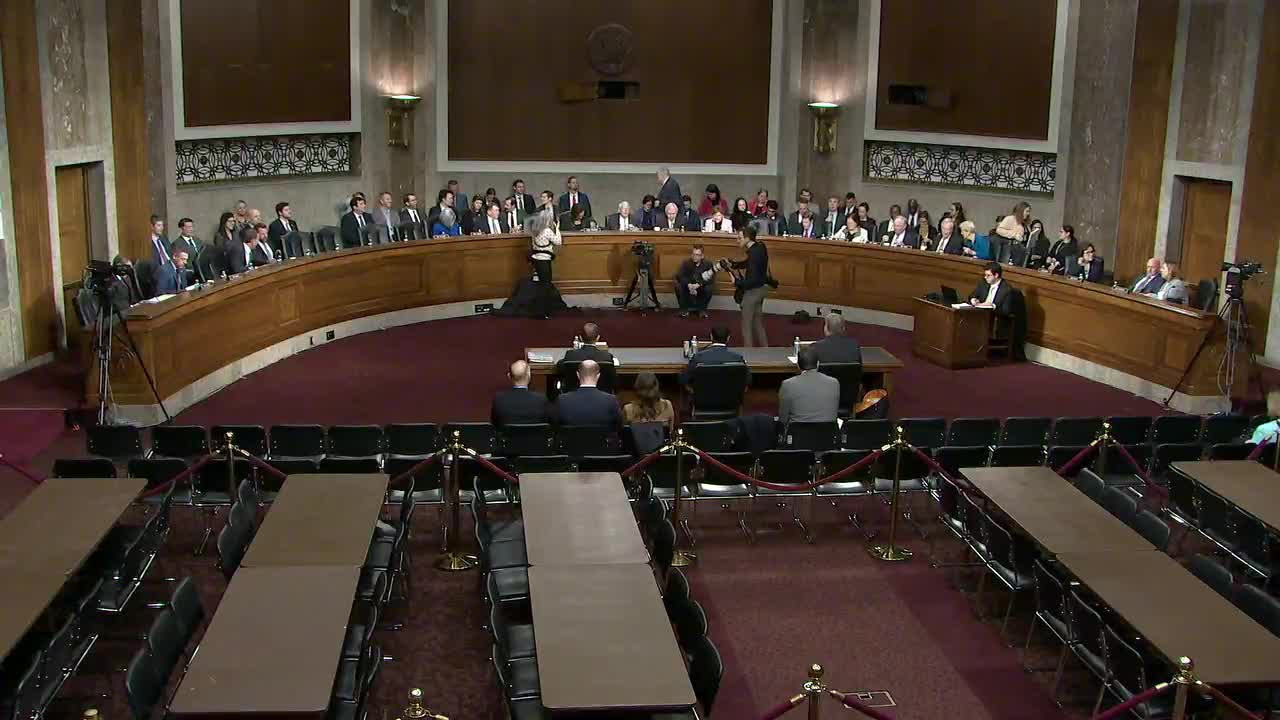
Summary
The Senate Armed Services Committee convened Oct. 12 to examine barriers to defense innovation and ways the Department of Defense can speed the transition of commercial technologies into military use.
The Senate Armed Services Committee convened Oct. 12 to examine barriers to defense innovation and ways the Department of Defense can speed the transition of commercial technologies into military use.
Chairman Wicker opened the hearing by saying, “We must change the way the Pentagon does business,” and framed the discussion around his FORGE proposals and a white paper urging budgeting and acquisition reforms to reduce regulatory burdens and accelerate procurement.
The hearing brought three witnesses: Shyam Sankar, chief technology officer at Palantir; Nate Diller, chief executive officer of Divergent Technologies; and James Gertz, a former acquisition executive who led procurement efforts for U.S. Special Operations Command and the Navy. Each described overlapping problems and potential fixes for what they called a risk‑averse, slow acquisition system that often cannot absorb commercial innovation quickly enough.
Shyam Sankar said, “defense innovation and procurement are broken at precisely the moment we need them to deter and defeat our adversaries,” and urged removing barriers that prevent commercial firms from competing. He and other witnesses pointed to the growth of detailed acquisition rules over decades, noting that aspects of the DOD 5000-series and other contracting guidance have expanded substantially since the Cold War and now deter many nontraditional entrants.
Nate Diller argued the industrial base must be retooled so factories themselves become strategic capacity. He described Divergent’s factory processes that can shift between commercial production and defense parts and said, “the factory is the weapon,” urging policies that would scale digital manufacturing and create a civil‑reserve manufacturing network to provide surge capacity.
James Gertz urged giving program managers clearer authority and accountability so they can adopt new technologies quickly: “You can empower the program manager and hold them accountable,” he said, noting program managers today answer to many reviewers and often lack the practical ability to reprogram funds or pick new suppliers rapidly.
Committee members raised a range of practical concerns. Senators questioned whether existing acquisition authorities—such as other transaction authorities (OTAs), middle‑tier acquisition and rapid authorities used by entities like the Defense Innovation Unit (DIU) and AFWERX—are being implemented at scale and whether the acquisition workforce is trained to use them. Witnesses generally said authorities exist but implementation, training and trust are limiting factors.
Lawmakers also pressed witnesses on specific topics: the Small Business Innovation Research (SBIR) program, which several senators defended as a source of early‑stage innovation but also criticized where a small group of firms have captured a large share of awards; acquisition protests and bid challenges that can delay programs; and the workforce shortfalls and review‑heavy culture that have slowed fielding.
Multiple speakers warned about a recent White House/Office of Management and Budget action referenced in the hearing that paused some federal financial assistance and grant processing. Witnesses and senators said an abrupt freeze on funding or payments could damage industry trust and harm small companies and readiness, though witnesses had limited visibility into the memo at the time of the hearing.
Quantitative figures and clarifications aired in the hearing included a committee assertion that contracting and financial regulations span thousands of pages, a witness note that some acquisition series expanded from a handful of pages in the 1970s to many hundreds or thousands today, a Defense Department report cited that more than 20,000 suppliers have left the Navy shipbuilding industrial base in the past 20 years, and discussion of a roughly $220 million appropriation added to DIU fielding efforts in recent legislation.
Senators repeatedly returned to two related themes: 1) the need to accelerate adoption (not just invention) by streamlining approvals, giving operational buyers stronger demand signals, and holding program managers accountable; and 2) rebuilding a resilient industrial network that blends commercial manufacturing and defense production so the U.S. can produce and sustain munitions, ships and other high‑end systems at scale. Witnesses presented examples—digital engineering, 3‑D printing, vertically integrated factories—as proof of concept and urged broader pilots and scaling authority.
The hearing concluded with committee members urging further work, including hearings on the acquisition workforce, workforce training, and follow‑up questions for the witnesses. No formal votes or committee actions were taken at the hearing.