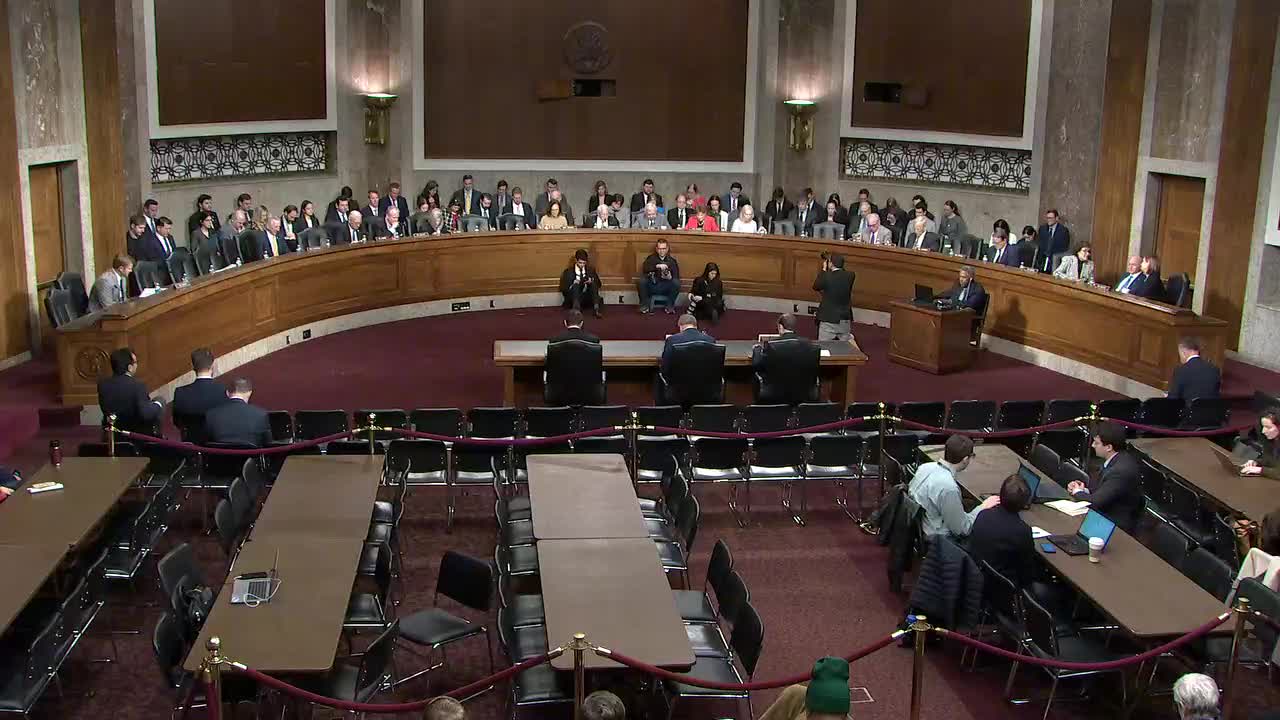
Senate Armed Services hears from Dan Driscoll as nominee for Secretary of the Army
Get AI-powered insights, summaries, and transcripts
SubscribeSummary
Dan Driscoll, a former Army cavalry scout and Yale-trained lawyer, answered senators' questions on recruiting, modernization, munitions stockpiles, acquisition reform, counter-drone efforts and infrastructure during his nomination hearing before the Senate Armed Services Committee.
Dan Driscoll, President Trump’s nominee to be Secretary of the Army, testified before the Senate Armed Services Committee, outlining his priorities and answering a range of questions about recruiting shortfalls, modernization, munitions readiness and installations.
The hearing, convened by Chairman Roger Wicker, opened with a moment of silence for the victims of a helicopter crash near Reagan National Airport and then turned to the nominee’s record and plans. "The committee on armed services has convened this hearing to consider the pending nomination of Mister Dan Driscoll to be the 26th Secretary of the Army," Wicker said. Senators from both parties commended Driscoll’s Army service and family history of service, and several asked for commitments on specific policy issues.
Why it matters: If confirmed, Driscoll would oversee manning, training and equipping the largest U.S. land force at a time the service is addressing recruiting shortfalls, a multibillion-dollar facilities backlog and a push to modernize against near-peer threats. Ranking Member Jack Reed emphasized those priorities and asked how Driscoll would protect readiness if the Army is asked to take on missions that pull soldiers away from training.
Driscoll described his approach as "the soldier's secretary of the Army," saying his first priorities would be to ensure soldiers have training, equipment and leadership. He pledged to work with the committee on recruiting, to review Army acquisition and readiness practices, and to examine the causes and possible remedies for infrastructure decline. On a range of modernization topics — from unmanned systems to directed-energy countermeasures — Driscoll said the Army must accelerate innovation and build a resilient industrial base.
Senators pressed him for specifics. Chairman Wicker pressed Driscoll on expanding Army Junior Reserve Officer Training Corps (JROTC) units and noted about 300 schools remain on a waiting list. Senator Jack Reed asked how Driscoll would protect long-term readiness if active-duty forces are assigned to homeland tasks such as border support. Senators Maggie Hassan and Jeanne Shaheen focused on aviation safety, munitions stockpiles and industrial-base replenishment. Senators Elizabeth Warren and others raised acquisition issues including data rights and the ability of the Army to repair and 3D-print needed parts quickly.
Driscoll pledged to take early, in-depth briefings if confirmed and to work with this committee on acquisition reform, industrial-base stabilization and recruiting strategies such as scaling preparatory training programs. He also committed to addressing counter-small-UAS coordination and to filling key cyber leadership positions quickly.
The hearing produced no committee vote. Senators will submit written questions for the record and follow-up hearings and briefings were discussed. The committee recessed after asking staff to provide the nominee any routine forms and to ask Driscoll to provide timely responses to questions for the record.
Looking ahead: The committee’s questions and the responses Driscoll provided outline the principal policy areas members intend to monitor closely during any confirmation process: recruiting pipelines and JROTC expansion, munitions and industrial-base replenishment, acquisition and data-rights reform, counter-UAS and cyber/AI implementation, and the Army’s facilities backlog and MilCon processes.