Get Full Government Meeting Transcripts, Videos, & Alerts Forever!
Get email alerts on the Inland Port Sustainability topic
No spam. Unsubscribe anytime.
Utah Inland Port panel addresses air quality, wetlands and rail funding as growth accelerates
Summary
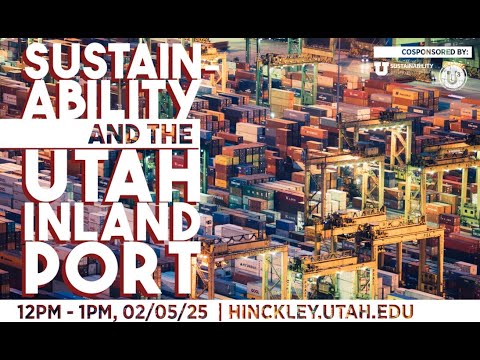
At a Hinckley Institute forum at the University of Utah, officials from the Utah Inland Port Authority, Salt Lake City and academic and rail experts discussed air quality, wetlands protection and the authority's role in funding and convening projects across multiple Utah project areas.
At a Hinckley Institute forum at the University of Utah, Ben Hart, executive director of the Utah Inland Port Authority, joined city officials, academics and rail advocates to discuss how the inland port can balance economic growth with air quality and Great Salt Lake protection.
The panel focused on three connected challenges: local air pollution and winter inversions, long-term threats to the Great Salt Lake and wetlands, and the need for coordinated rail and freight investments to reduce truck traffic. Speakers emphasized the port's limited regulatory authority but highlighted financial tools and recent federal grants as levers for change.
Ben Hart, executive director of the Utah Inland Port Authority, said the authority was created in 2018 “born out of significant controversy” and is currently the target of constitutional lawsuits. He described the port’s twin charter goals as strengthening regional economies and improving logistics to reduce road dependence and truck miles.
Mona Smith, environmental and sustainability director for the Utah Inland Port Authority, described federal funding the port helped secure and the authority’s project-area approach. “Last year we worked directly with the division of air quality as well as Union Pacific … and we were able to win just over $112,000,000,” Smith said, referring to an EPA award the panel said is intended for climate and air-quality planning and zero-emission deployments at a major intermodal terminal.
Salt Lake City sustainability director Debbie Lyons said the city did not initially support the port and has sued over its creation, but now is following state law while trying to influence development. Lyons noted the city uses an inland port overlay zone and conditional-use permitting to require extra analysis and public input for new industrial activity in sensitive areas.
“Those are some good policy levers,” Lyons said, describing vouchers and incentive programs the city uses to reduce emissions at the household level and investments in indoor-air-quality devices tied to research with university partners.
Dr. Carrie Kelly, professor of chemical engineering at the University of Utah and chief science officer at TELUS Network Sensor Solutions, outlined air-quality drivers in the Salt Lake Valley: a constrained airshed, winter inversions that raise particulate matter, increasing wind-driven dust events and rising summer ozone. “The only thing we can really control are our emissions,” Kelly said, adding that older diesel equipment moving from regulated ports into places with fewer rules is a known risk.
Mike Christiansen, Salt Lake City planning commissioner and executive director of the Utah Rail Passengers Association, presented a quantitative critique of Utah’s rail funding uptake under the bipartisan Infrastructure Investment and Jobs Act. Christiansen said he compiled Federal Railroad Administration award data and found Utah received roughly $12.5 million out of about $28 billion awarded at the point he checked, placing Utah near the lower third of states in absolute and per-capita rail awards.
Panelists said shifting freight from trucks to rail and electrifying equipment are primary ways to reduce emissions over time. Hart and Smith argued the inland port’s project-area model — which concentrates logistics infrastructure like airports and rail spurs in designated zones — can make coordinated upgrades and grant applications easier than a fragmented patchwork of local rules.
The panel identified several concrete commitments and tools. Hart said the port has used its financial tools to prohibit use of its incentives for wetland destruction in some project areas and that the port directs 3% of project-area revenues to wetland protection. The authority also said it is exploring zero-emission technologies, hydrogen pilots and incentives to recruit higher-value businesses rather than low-wage warehouse uses.
Panelists and audience members urged public engagement. Lyons and others noted land-use entitlements can limit a city's ability to downzone without compensation; Mike Christiansen described how prior zoning choices can pre-commit future land uses and stressed the importance of public participation in planning and conditional-use processes.
Students asked about Great Salt Lake restoration and dust risks from exposed lakebed. Panelists and the port said the principal technical solution is returning more water to the lake and that restoration needs coordinated funding and better wetland characterization. Smith said the port is working with the National Audubon Society, the Utah Geological Survey and the Great Salt Lake Enhancement Trust on data gaps and targeting funds to the most critical wetland complexes.
Acreage figures discussed at the forum: the airport-area project is about 16,000 acres, Juab County project area 36,000 acres and the port’s total project-area footprint across Utah is roughly 110,000–120,000 acres, according to Hart. The port’s officials said project-area sizes vary widely and that individual local governments retain land-use authority.
The forum closed with panelists encouraging students and residents to engage with legislators, planning commissions and community outreach on renewable energy, water conservation and conditional-use hearings. Panelists said federal planning dollars and coordinated grant applications are critical near-term steps for managing growth while protecting air quality and wetlands.