Get Full Government Meeting Transcripts, Videos, & Alerts Forever!
Get email alerts on the Usda Nomination Brooke Rollins topic
No spam. Unsubscribe anytime.
Senate Agriculture Committee questions nominee Brooke Rollins on farm bill, trade, animal disease and nutrition
Summary
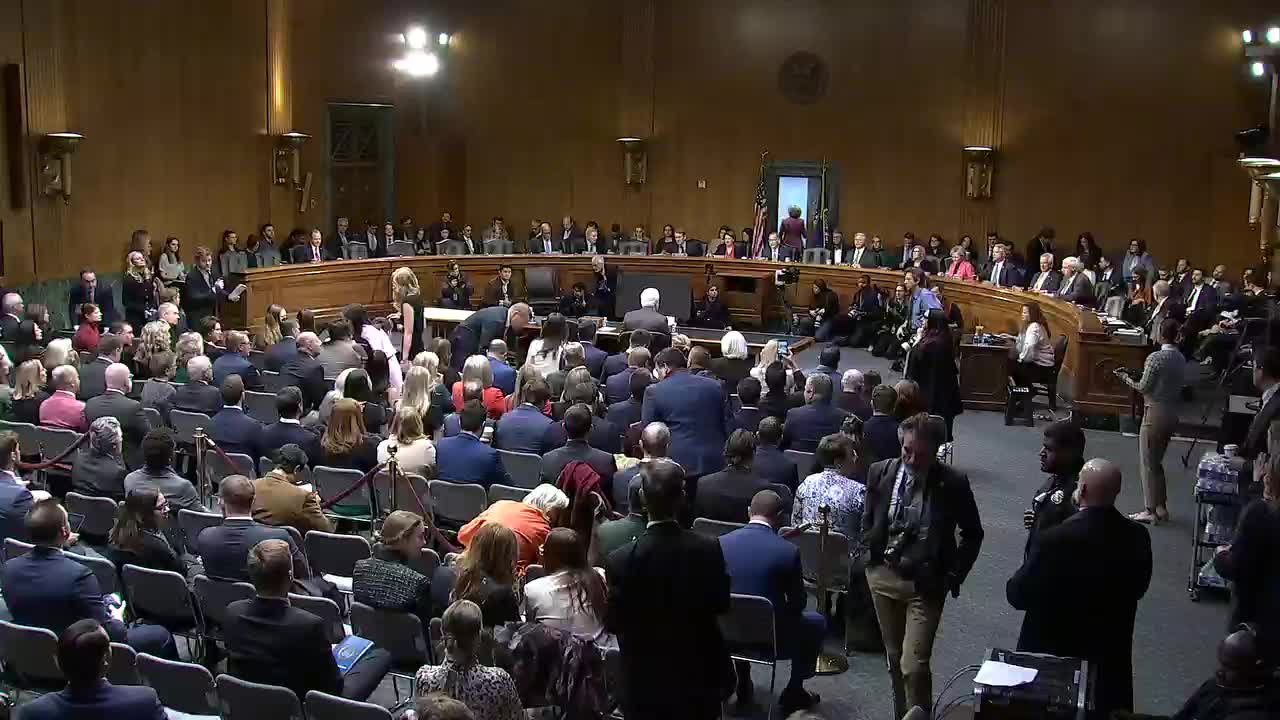
Chairman Bozeman convened the Senate Committee on Agriculture, Nutrition, and Forestry hearing that introduced Brooke Lehi Rollins as the nominee for secretary of agriculture and allowed senators to question her on the department's immediate and longer-term priorities.
Chairman Bozeman convened the Senate Committee on Agriculture, Nutrition, and Forestry hearing that introduced Brooke Lehi Rollins as the nominee for secretary of agriculture and allowed senators to question her on the department's immediate and longer-term priorities.
Rollins told the committee that if confirmed she would prioritize distributing disaster and economic assistance quickly, responding to animal disease outbreaks, modernizing USDA operations, and supporting rural communities. "If confirmed, I will do everything in my ability to make sure our farmers, ranchers and rural communities thrive," Rollins said in her opening remarks.
The hearing focused on several recurring themes: the need for an updated farm bill and quick delivery of supplemental aid; how trade and tariff policy would affect farm exports; responses to ongoing animal disease outbreaks including highly pathogenic avian influenza; the future of biofuels and renewable-fuel policy; SNAP and other nutrition programs; workforce and telework expectations at USDA; and forest and wildfire management.
Why it matters
The secretary of agriculture oversees a broad portfolio that includes commodity programs, the nation’s nutrition safety net, and agencies that manage plant and animal health and research. Committee members emphasized that the next USDA leader will influence farm income, trade access for exporters, nutrition program rules affecting millions of Americans, and responses to animal-disease and wildfire emergencies.
What Rollins said she would do
Rollins, who described her background in state policy, think-tank leadership and as a senior White House domestic policy official, told senators her immediate tasks would be to ensure disaster and economic-assistance authorized by Congress reached producers quickly; to assemble teams to address animal-disease outbreaks; and to begin a broad effort to "modernize, realign, rethink" USDA to better serve producers and rural communities. She said she would work with governors, ag commissioners and stakeholders and bring the White House interagency process experience she gained in the prior administration to those discussions. "The first 100 days, if I am so fortunate to be confirmed, will be a fast and furious effort to ensure that we move that economic aid out," Rollins said.
Trade and market access
Several senators pressed Rollins on trade. Rollins cited a recently mentioned roughly $45 billion agricultural trade deficit and called expanding market access a high priority. She acknowledged the administration's stated willingness to use tariffs as a tool but said USDA must work to minimize harm to producers and that she would use her access in the White House and interagency process to advocate for agriculture. "My role is to defend, to honor, to elevate our entire agriculture community in the Veil Office, around the table, through the interagency process," she said.
Animal disease and plant/food-safety programs
Lawmakers repeatedly raised the recent H5N1 avian-influenza outbreaks, infections in dairy herds, and human and animal health risks. Rollins said animal disease response would be among her top priorities and that she would assemble and coordinate the appropriate USDA teams, working with state partners. Senators emphasized veterinarian staffing needs at APHIS and the need to improve laboratory and inspection capacity at FSIS and ARS for both disease response and export access.
Nutrition programs and SNAP
Senator Amy Klobuchar and others pressed Rollins on the future of SNAP and related nutrition programs. Rollins said she believes in the importance of work and responsibility in public programs but also emphasized the need for data and research before making detailed changes. She said nutrition programs must be effective, efficient and reach intended recipients while being fiscally responsible. Committee members asked whether she would oppose cuts to SNAP; Rollins said she needed more time to review specifics and would work with senators on policy design.
Biofuels, renewable-fuel credits and energy policy
Biofuels were a frequent topic. Senators from ethanol-producing states asked how Rollins would support year-round E15 access, Renewable Volume Obligations, and coordination with EPA and Treasury on production credits such as section 45Z. Rollins said she would defend all American agriculture and work across agencies to provide the data and coordination needed.
Workforce, telework and USDA operations
Several senators raised GAO findings on low headquarters space utilization and asked whether USDA employees would be required to return to offices. Rollins indicated she supported stronger in-office presence and described an intent to assemble a team to improve headquarters operations and readiness. She also pledged to prioritize recruiting and retaining USDA veterinarians and other technical staff.
Forests, wildfires and land management
Senators from Western states urged action on forest management, prevention and the Forest Service workforce. Rollins said she would make wildfire response and forest stewardship priorities and work quickly to confirm qualified undersecretary leadership to address those risks.
Immigration, farm labor and H-2A
Committee members raised concerns about the administration’s stated immigration enforcement priorities and potential impacts on the farm labor force, including dairy and specialty-crop harvests. Rollins said she supported the administration’s border and enforcement agenda but pledged to work with the Departments of Labor and Homeland Security and Congress to address labor needs, including possible H-2A program reforms, to avoid destabilizing production in agriculture.
Facilities, research and rural development
Senators pressed Rollins on Agricultural Research Service (ARS) labs and National Institute of Food and Agriculture (NIFA) relocations and construction delays, citing a $65 million ARS lab allocation in Kentucky and other research investments. Rollins pledged to dig into regulatory or administrative tripwires that had slowed projects and to work with members to move facilities and research projects forward. Senators also sought commitments to protect and strengthen rural development programs tied to housing, childcare and broadband.
Ethics and conflicts
Rollins was asked about her family’s financial interests in oil and gas. She responded that she has not made decisions based on family financial interest and pledged to adhere to ethics rules.
What the committee will do next
Chairman Bozeman said senators would enter letters and materials into the hearing record and will send written questions for the record. Rollins received broad questioning from Republicans and Democrats on many programmatic fronts; multiple senators requested follow-up on specifics including SNAP calculations, disaster-payment distribution methods, confirmation of undersecretary nominees and implementation details for animal-disease response.
Ending
The committee concluded the initial round of questions without a vote. Rollins’s confirmation will require further committee action; members signaled continued oversight on the farm bill, trade policy, animal disease, nutrition programs and USDA operations in the days ahead.