Get Full Government Meeting Transcripts, Videos, & Alerts Forever!
Get email alerts on the Parks Recreation topic
No spam. Unsubscribe anytime.
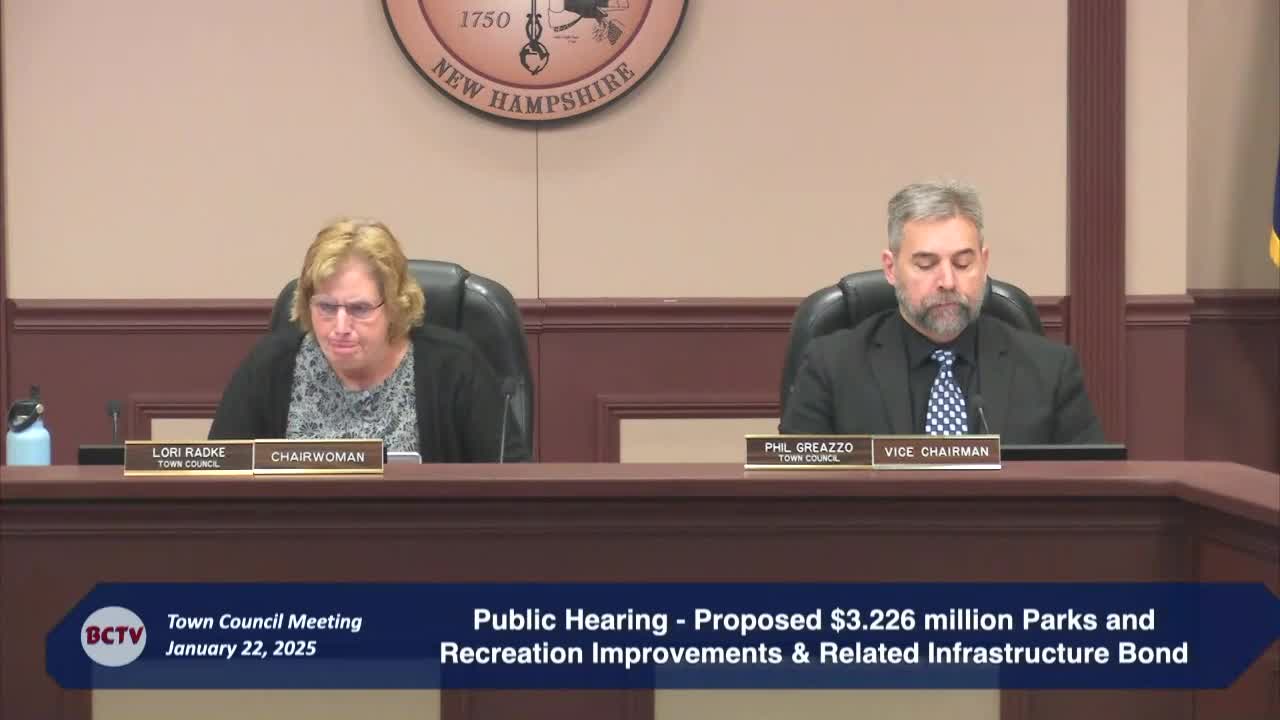
Council sends $3.226M parks and recreation bond to deliberative session amid debate over skate park and concession funding
Summary
After a public hearing on a parks and recreation bond that would reconfigure youth ball fields and rebuild a skatepark, the council moved the article to the deliberative session; the council did not recommend the full article, voting 3–4 against recommending it.
The Bedford Town Council held a public hearing on Jan. 22 for an article authorizing up to $3,226,000 in bonds to fund field relocations, lighting and the replacement of the skateboard park, and then voted to place the article on the town’s deliberative session. The council’s motion to move the article passed unanimously; its recommendation vote recorded a 3–4 split, meaning the council does not recommend the article as presented.
The proposal would move the Little League complex from the Nashua Road site (built on a former landfill) to the Swenson Field location, add lighting to ball fields at Swenson and elsewhere, construct restroom/concession facilities, and replace the skateboard park at Earl Legacy Park with a poured‑in‑place concrete facility. The warrant language authorizes the council to issue and negotiate bonds under the Municipal Finance Act and accepts donations or other outside aid to reduce the amount to be bonded.
Representatives of Bedford Little League told the council the league rosters “around 650 players” across spring, summer and fall seasons and said limited playable fields and the inability to excavate Nashua Road (a former landfill) make relocation necessary. Daniel Fisher, speaking for the league, said the “overwhelming majority” of players are Bedford residents, and that without the relocation the league could be forced to turn players away.
Members of the Rebuild Bedford Skatepark Committee described the current prefabricated concrete ramps as deteriorating and presented the $800,000 line item for a poured‑in‑place skate facility as an investment in longevity, noting comparable parks in the region cost more. Committee members and other residents said they are fundraising and intend to seek donations to reduce the amount the town would bond; staff confirmed that donations received before bond sale could reduce the amount to be issued.
Several residents asked about lighting, hours of use and parking. League representatives said typical youth games and practices would not run late; one Little League spokesperson said spring games typically finish by about 7:15 p.m. and that lights would primarily provide practice time and fall‑season play. Town staff said the planning board would review details such as light specifications and that newer LED systems can be controlled to reduce glare and light pollution.
Council discussion repeatedly returned to the concession/restroom building, which opponents called an expensive inclusion; supporters said the facility is necessary for tournaments and accessibility, including a free Challenger program for players with disabilities. Councilors debated whether the snack/concession building (the presentation identified a roughly $700,000 portion of the total) should remain in the warrant or be funded separately through further fundraising.
The council moved the article to the Feb. 3 deliberative session so residents can debate amendments and decide at the polling place in March. In the subsequent roll-call recommendation vote the council recorded three votes in favor and four against recommending the article in its current form; the council noted residents may propose changes at the deliberative session and the council could revisit its recommendation afterward.