Get Full Government Meeting Transcripts, Videos, & Alerts Forever!
Get email alerts on the Employee Pay topic
No spam. Unsubscribe anytime.
Committee advances pay plan: most police and fire to get 7%, other city employees 3%
Summary
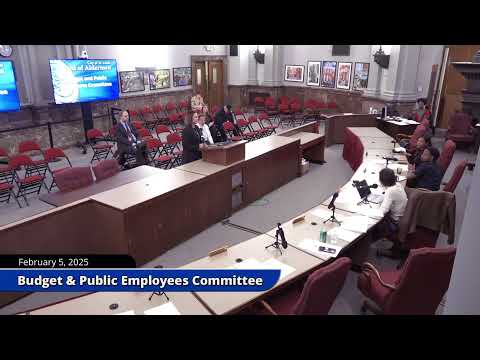
The St. Louis Board of Aldermen Budget & Public Employees Committee on Feb. 12 voted to advance Board Bill 173, a pay plan that would give most commissioned police and fire personnel a 7% increase and a 3% raise for other city employees, while collapsing the police salary matrix from 30 steps to 20.
The St. Louis Board of Aldermen Budget & Public Employees Committee on Feb. 12 voted to advance Board Bill 173, a pay plan that would give most commissioned police and fire personnel a 7% increase and a 3% raise for other city employees, while collapsing the police salary matrix from 30 steps to 20.
The bill matters because it immediately affects city payroll and will add recurring costs to next year’s budget. Committee members pressed budget staff about how the increases would be funded and union representatives criticized the speed and process of the negotiations.
John Understell, deputy director of personnel, told the committee that the police and fire increases are centered on the changes to the pay matrix. "For most police commission police and fire employees, the increase will be 7%," Understell said, adding that collapsing the matrix means some employees at the highest existing steps will receive less than 7% because steps 21–30 will compress into the new range. "I don't want to mislead by saying 7% across the board. That will range from 2 to about 5% for those (on the highest steps) just from the conversion process to the smaller step matrix."
Paul Payne, the budget director, presented a fiscal note showing the near‑term and annual costs. Payne said the partial fiscal‑year cost for the remainder of FY25 is about $6.3 million across general, special grant and enterprise funds, including roughly $5.3 million to the general fund. He said the annualized recurring cost for FY26 would be approximately $23.1 million across all funds (about $18.8 million to the general fund). "So that basically lays out the cost impact," Payne said, noting the city faces revenue uncertainty tied to earnings tax refunds and that next year’s budget will be "tighter."
Union representatives testified during public comment that the negotiation process was rushed and that many members were dissatisfied with the package. Jason Speakerman, who identified himself as a Ward 5 resident and a union representative, said he agreed to the terms "under protest" because members had been without a new contract for months. "Three percent is garbage," Speakerman said. "Our workers are understaffed, undervalued, overworked." Dan Clark, president of Firefighters Local 73, said the raises were presented to firefighters without adequate time for bargaining and cited Administrative Regulation 174, which he said outlines collective bargaining expectations. "This was jammed down our throat," Clark said.
Committee members and staff also discussed operational tradeoffs. Payne and other staff noted the city currently carries roughly 22% vacancies and that departments typically budget salary savings for vacancies; the committee discussed whether some authorized positions should be removed from the budget if they are not realistically expected to be filled. Alderman Aldrich asked whether other departments would experience cuts in positions to pay for the raises; Payne said that as the FY26 budget is prepared, departments will have to scrutinize positions and allocations to absorb recurring costs.
The committee moved Board Bill 173 with a "due pass" recommendation. The committee did not enter a recorded roll‑call vote in the transcript; the clerk later announced that Board Bill 173 had passed with a due pass recommendation.
The committee was told a citywide pay study remains incomplete; Understell said the study — which includes classifications and a benefits component — is expected to deliver additional findings within approximately a month and could inform future pay decisions. Payne said revenue uncertainties tied to earnings tax refunds remain and estimated recurring revenue loss from refunds could be "somewhere in the teens" of millions of dollars, which must be incorporated into future budgets.
Why it matters: The bill would raise recurring personnel costs materially and is timed before the committee and city finalize FY26 budgets. Committee members acknowledged that the increases aim to help recruit and retain staff amid high vacancy rates, while also flagging potential tradeoffs in staffing and spending in the next budget year.
Ending: The committee forwarded Board Bill 173 with a due‑pass recommendation to the full Board of Aldermen. Members said they expect follow‑up as the pay study and final fiscal numbers land during the upcoming budget process.