Get Full Government Meeting Transcripts, Videos, & Alerts Forever!
Get email alerts on the State Legislation topic
No spam. Unsubscribe anytime.
Ways and Means Committee advances election, school and absentee-ballot bills; transgender sports ban fails
Summary
At its Feb. 6, 2025, first voting session the Ways and Means Committee voted favorably on several departmental and education-related bills, defeated a proposal restricting transgender girls from women's sports and approved requests to withdraw multiple bills.
ANNAPOLIS, Md. — On Feb. 6, 2025, the Ways and Means Committee held its first voting session of the 2025 session and voted on a series of bills affecting election procedures, student records and school health curriculum. The committee approved several bills favorably, rejected House Bill 156 (a bill that would have restricted transgender girls from competing in girls’ sports), and granted requests to withdraw multiple bills.
The measures advance or clarify administrative election procedures, change the voter-registration eligibility age, set statewide requirements for local health-education curricula and bar withholding student transcripts for unpaid debts at certain private schools. The session also included a motion to withdraw six bills by unanimous consent and a subcommittee scheduling announcement.
House Bill 41, a departmental proposal from the State Board of Elections, moved favorably. The bill changes the deadline for filing petitions to form a new political party from the first Monday in August to the first Monday in July and prohibits resubmitting signatures from a rejected petition. The committee approved the bill by voice vote.
House Bill 153, which would lower the voter-registration age from 16 years to 15 years and 9 months to align initial registration with the timing for applying for a learner’s permit, passed favorably on a roll-call vote.
House Bill 156, a proposal addressing athletic-team designation in public and nonpublic high schools, was the meeting’s most contested item. Under the bill’s language, teams would be designated based on “biologic” sex and students defined as male would be prohibited from participating in girls’ sports. The committee voted on a motion for an unfavorable report; that motion passed and the bill failed.
During debate on House Bill 156, Delegate Fair said the committee had heard testimony from the sponsor and referenced two studies: “I want to assure the committee there's been exactly 2 major studies done on this specific issue,” citing a 2021 Canadian Centre for Ethics in Sport report and a 2024 British Journal of Sports Medicine paper. Delegate Buckle, opposing the unfavorable motion, said he and other Republican members would vote against an unfavorable report and stressed concerns about fairness in athletic opportunities. Delegate Miller said she viewed the matter as a fairness-for-girls issue and cited a recent executive order concerning Title IX enforcement.
House Bill 161, which codifies current practice for how county boards of education establish health curricula, passed favorably. The bill requires the State Department of Education and the Maryland Department of Health to adopt a state framework for health education and directs counties to form local committees of educators, community members and health experts to develop age-appropriate curricula. The bill explicitly allows parents to opt out of the Family Life and Human Sexuality portion of the curriculum but not from HIV and AIDS prevention instruction, according to committee remarks.
House Bill 184, a bill that prohibits nonpublic schools that participate in state-funded education programs from refusing to issue a transcript to a student who owes a debt, passed favorably on roll-call.
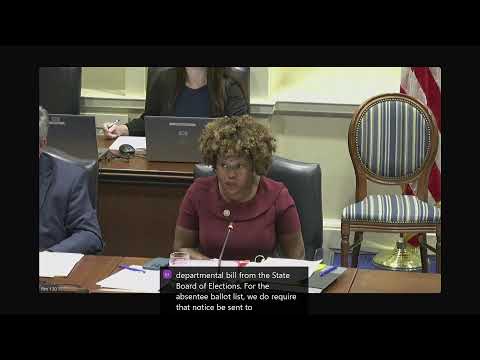
House Bill 199, another departmental bill from the State Board of Elections, clarifies the timeline for notifying permanent absentee voters about address confirmation and ballot-delivery preference; the notice window is set to the period beginning 120 days to 90 days before an election. The bill passed favorably; the chair noted explicit opposition from Delegates Long, Miller and Hartman during the voice vote.
The committee accepted, by consent, requests to withdraw House Bills 47, 3707, 404, 4604, 5306 and 8603.
Before adjourning, the chair announced a Local Revenues subcommittee meeting scheduled for the next day via Zoom at 1:30 p.m. and noted the committee’s next meeting Monday at 11 a.m.
Votes at a glance — selected items House Bill 41 — Election law: petition deadline and signature resubmission prohibition. Motion: favorable (mover recorded on the floor). Outcome: passed favorably (voice vote). House Bill 153 — Lowers voter-registration age to 15 years, 9 months (align with learner’s permit). Motion: favorable (mover: Delegate Fair). Outcome: passed favorably (roll call). House Bill 156 — Requires sports teams to be designated by biologic sex and bars male-designated students from girls’ teams. Motion: unfavorable (motion to recommend unfavorable report). Outcome: unfavorable motion passed; bill fails. Noted debate and study citations during discussion. House Bill 161 — State framework for health education; county-level curriculum committees; parental opt-out for Family Life and Human Sexuality. Motion: favorable. Outcome: passed favorably (roll call). House Bill 184 — Private school transcripts: prohibits withholding for debt when school participates in state-funded programs. Motion: favorable. Outcome: passed favorably (roll call). House Bill 199 — Absentee voter notices: clarifies 120-to-90-day notice window. Motion: favorable. Outcome: passed favorably (voice vote; several named delegates opposed).
The committee’s formal actions advance the listed bills to subsequent steps in the legislative process or conclude consideration where bills were withdrawn or failed. The transcript records motions and roll-call responses for multiple items; roll-call details are on the committee's official minutes and the clerk’s record.