Get Full Government Meeting Transcripts, Videos, & Alerts Forever!
Get email alerts on the Child Testimony topic
No spam. Unsubscribe anytime.
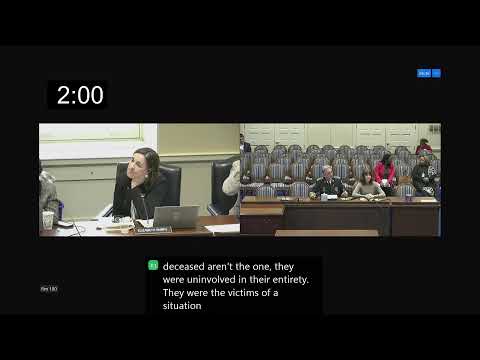
Committee hears bill to let children testify outside sight of alleged abuser; public defenders urge caution
Summary
The House Judiciary Committee heard testimony on House Bill 293 on Thursday about steps to let child victims testify outside the line of sight of the accused.
The House Judiciary Committee heard testimony on House Bill 293 on Thursday about steps to let child victims testify outside the line of sight of the accused.
Delegate Jesse Pippe, sponsor of HB 293, told the committee the bill would ‘‘clean up’’ existing language that requires a child to be ‘‘reasonably able to communicate’’ before their out‑of‑court testimony can be used. Pippe said the change would apply to children age 16 and under and would also require that ‘‘the defendant’s attorney shall be present if the child victim is testifying outside of court.’’
The bill’s proponents — including parents of survivors, prosecutors, and advocates — described the courtroom experience as retraumatizing for young victims. Lauren Cream, the mother of an eight‑year‑old abuse survivor, described preparing her daughter to ‘‘sit on a witness stand directly in front of her abuser’’ during a criminal trial and said the child continues to have nightmares. Cheryl Grady, president of the Friends of the Child Advocacy Center in Frederick County, recounted that her son had to sit within ‘‘mere feet’’ of the defendant when he testified at 11 and later required months of therapy.
Erica Lamon, advocacy director for Children’s Rights at Maryland Legal Aid, urged a favorable report and said removing the ‘‘reasonably able to communicate’’ requirement would not undermine courtroom accuracy because judicial safeguards and modern practices already protect defendants’ rights. Joyce King of the Maryland State’s Attorneys Association said similar procedures are in use across the country and cited Maryland v. Craig, a U.S. Supreme Court decision that upheld televised child testimony in some circumstances.
Tamara Stofa, district public defender for the Upper Eastern Shore, asked the committee for an unfavorable report. Stofa said the current statute gives judges a concrete safeguard to determine if a child is unable to ‘‘reasonably communicate’’ because of emotional distress; she warned that removing the phrase risks eroding the defendant’s confrontation rights and noted that the statute already allows the defendant’s attorney to be present during such testimony.
No committee vote was recorded during the hearing. Supporters told the committee they hope the House will again move a favorable report after prior unanimous House action last year; Pippe said the bill had a bipartisan Senate cross file on the Joint Committee on Pensions and Retirement this year.
The panel concluded the HB 293 testimony after two hours of witnesses and questions from committee members.
— Ending: The committee did not take a formal vote on HB 293 at the hearing; proponents asked for a favorable report and opponents urged retaining the current judicial safeguard that asks whether a child can reasonably communicate.