Get Full Government Meeting Transcripts, Videos, & Alerts Forever!
Get email alerts on the Downtown Parking topic
No spam. Unsubscribe anytime.
Council hears draft downtown access, mobility and parking plan that favors pricing, shared private parking and mobility hubs
Summary
City staff and consultants presented a draft Downtown Access, Mobility and Parking Plan that emphasizes demand-based pricing, seven‑day enforcement, shared use of private parking and investments in mobility options such as a circulator and micro‑mobility hubs.
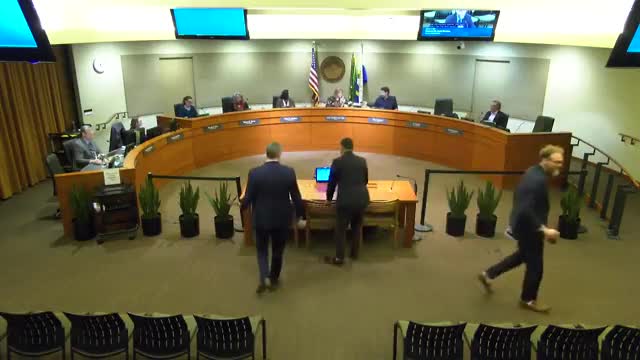
City staff and a consultant team on Monday presented a draft Downtown Access, Mobility and Parking Plan that focuses on managing demand through pricing, unlocking privately owned parking for public use, expanding enforcement to seven days a week and investing in non‑driving mobility options.
Patrick Quintin, director of economic prosperity and housing, said the plan is meant to support substantial downtown growth without adding new public parking supply, by relying on development-associated parking and shared private parking agreements. “The downtown access mobility and parking plan is really not about parking. It's really about downtown,” Quintin said, noting the plan’s role in managing growth anticipated over the next 20 years.
Consultant Ben Weber (Walker Consultants) outlined three pillars of recommended actions: adopt new pricing practices; expand public supply through shared parking agreements; and enhance downtown mobility options. Specific proposals included charging for public parking seven days a week (adding weekend enforcement), designating high‑ and low‑demand pricing zones, researching tiered pricing for multi‑hour stays, improving payment and automated enforcement options (including license‑plate enforcement), sunsetting unlimited permit programs while preserving discounts for low‑wage downtown employees, and targeted expansion and upgrades to accessible parking.
Why it matters: Vancouver’s downtown is projected to add substantial housing and jobs; the plan aims to manage parking demand, reduce circling and congestion, better utilize a large privately owned parking inventory (roughly 9,500 spaces across ~220 lots), and invest in alternatives such as a circulator shuttle, micro‑mobility, loading‑zone management and mobility hubs.
Key data and technical details
- On‑street public parking inventory: approximately 2,504 spaces across roughly 20 miles of curb. - Private off‑street parking inventory (consultant estimate): roughly 9,500 spaces in about 220 lots (approximately four times the on‑street supply). - On‑street occupancy (continuously collected for ~18 months): average occupancy reported ~62% on Wednesdays, ~61% on Saturdays, ~51% on Sundays, with waterfront hotspot often exceeding 80%. - Private lot occupancy (snapshot counts April dates): varied between roughly 25–54% depending on day and time. - ADA/accessibility: staff identified two additional waterfront ADA spaces added and four potential conversions flagged for further work; deeper curb/ramp work and PROWAG considerations will be needed to meet best‑practice accessibility.
Major recommendations
Pillar 1 — Pricing and public parking management
- Require payment and enforce public parking seven days a week, adding weekend enforcement that is currently free in some areas. - Create a geographic, demand‑based pricing system that designates high‑ and low‑demand areas and adjusts prices to manage turnover. - Preserve a discounted program for low‑wage downtown employees while phasing out “unlimited” permit programs that encourage driving. - Improve payment methods and enforcement integration, including exploring license‑plate recognition to automate enforcement. - Evaluate and add accessible parking where needed and examine curb use to create or convert ADA spaces more quickly in high‑demand areas such as the waterfront.
Pillar 2 — Shared private supply and wayfinding
- Pursue shared parking agreements with private lot owners (durable or event‑based) to increase publicly available supply, including use of underutilized private lots for events or park‑and‑ride near proposed transit stations. - Revisit and remove parking minimums from development code to allow market decisions on parking supply and free space for housing and other uses. - Invest in improved wayfinding and signage and partner with private owners to make available parking easier to find.
Pillar 3 — Mobility, curb management and hubs
- Invest in non‑driving options (walking, rolling, transit) and mobility programs such as a downtown circulator shuttle, micro‑mobility or bike‑share, and mobility hubs integrating multiple modes. - Develop a curb management strategy to consider time‑based loading zones, flexible curb uses (e.g., loading during off‑peak hours), and reallocation of right‑of‑way to people‑serving uses where appropriate. - Study loading zone needs and maintain coordination with waste/recycling and delivery operations to avoid operational conflicts.
Council feedback and follow-up
- ADA access: Councilor Fox and others urged faster action on waterfront ADA parking; staff said two spaces were added and four more locations identified for conversion, and that some improvements could begin immediately while full compliance would take longer.
- Timeline and code changes: Staff said enforcement and pricing changes will require code changes and internal coordination (signage, streets work) and anticipated implementation could begin as early as January 2026 if internal partners permit; no firm date was set.
- Shared parking and permits: Councilors supported pursuing shared agreements and revisiting on‑street permit zones and parking minimums; staff noted the plan includes evaluating permit programs and buffer zones that balance residential and commercial needs.
- Costs and operations: Council requested maintenance and operations cost estimates for seven‑day enforcement, technology upgrades, and mobility investments before adoption; staff agreed to return cost estimates and an implementation/prioritization plan.
- Next steps: Staff said the plan would be returned next month in final form for adoption as city policy and that the Parking Advisory Committee and CCRA were scheduled to vote to recommend the document; staff noted a date shown in the presentation was incorrect and will provide the correct schedule.
Quotes
- Patrick Quintin, Director of Economic Prosperity and Housing: “The downtown access mobility and parking plan is really not about parking. It's really about downtown.”
- Ben Weber, Walker Consultants: “The city will begin by requiring payment for public parking and will enforce that parking 7 days a week, adding Saturdays and Sundays.”
Clarifying details
- On‑street spaces: ~2,504 public curb spaces across ~20 miles of curb. - Private supply: ~9,500 spaces across ~220 private lots; many private lots show low utilization on certain days. - ADA additions identified: 2 added at waterfront and 4 additional potential conversions (staff noted more work required for ramps/PROWAG compliance). - Potential implementation start target for some measures: January 2026 (staff caveated this depends on internal coordination and code changes).
Speakers (as identified in the meeting record)
- Patrick Quintin — Director, Economic Prosperity and Housing, City of Vancouver - Gabe Montez — Parking District Manager, City of Vancouver - Ben Weber — Consultant, Walker Consultants - Councilor Fox — Vancouver City Council member - Councilor Perez — Vancouver City Council member - Councilor Paulson — Vancouver City Council member - Councilor Hanson — Vancouver City Council member - Councilor Henson — Vancouver City Council member
Authorities
- other: Draft Downtown Access, Mobility and Parking Plan (city staff/consultant document) — referenced_by: ["presented recommendations across three pillars"] - other: PROWAG (Public Rights-of-Way Accessibility Guidelines) — referenced_by: ["accessibility standards and ramp/curb considerations"]
Actions
- {"kind":"referral","identifiers":{"agenda_item_id":"downtown-parking-plan-draft"},"motion":"Return the draft Downtown Access, Mobility and Parking Plan to council next month in final form for adoption as city policy; staff to provide cost and implementation details before adoption.","mover":"not specified","second":"not specified","vote_record":[],"tally":{"yes":0,"no":0,"abstain":0,"absent":0,"recused":0},"legal_threshold":{"required":"simple_majority","met":false,"notes":"No formal vote recorded at this meeting; staff to return plan for formal action."},"effective_dates":{"effective_on":"not specified","sunset_on":"not specified"},"outcome":"postponed","notes":"Parking Advisory Committee and CCRA to vote to recommend; staff to correct presentation date and present final plan with costs and implementation timeline.","implementation":{"assignee_dept":"Economic Prosperity and Housing; Transportation; Parking Operations","follow_up_tasks":[{"task":"Provide maintenance and operations cost estimates and implementation/prioritization plan","due_date":"2025-02-10","status":"planned"},{"task":"Coordinate internal code changes and signage updates required for seven-day enforcement","due_date":"2025-06-30","status":"planned"}],"reporting_requirements":"Return final plan with recommended code changes and cost estimates for council adoption."}}
Discussion_decision
- discussion_points:["Seven‑day enforcement and demand‑based pricing zones","Shared parking agreements with private owners and utilization of existing private supply","Accessibility/ADA parking shortfalls and near‑term conversions","Curb management, loading zones and waste/recycling coordination","Mobility options including a downtown circulator, micro‑mobility and mobility hubs","Revisiting parking minimums and permit programs"], - directions:["Staff to return the final plan next month with cost estimates and an implementation/prioritization plan; staff to provide corrected schedule for adoption.","Staff to begin immediate, targeted ADA access conversions at the waterfront where feasible and report progress."], - decisions:["No adoption or voting recorded; councilors generally supported the plan's direction and asked staff for follow-up details before formal action."]
Clarifying_details
- {"category":"on-street inventory","detail":"Public on-street parking spaces","value":2504,"units":"spaces","approximate":true,"source_speaker":"Gabe Montez"},{"category":"private-inventory","detail":"Privately owned off-street parking spaces","value":9500,"units":"spaces","approximate":true,"source_speaker":"Gabe Montez"},{"category":"occupancy","detail":"On-street average occupancy (18 months of data)","value":"Weds ~62%, Sat ~61%, Sun ~51% (waterfront often exceeds 80%)","units":"percent","approximate":true,"source_speaker":"Gabe Montez"},{"category":"ADA-parking","detail":"Immediate ADA additions and potential conversions at waterfront","value":"2 added, 4 potential conversions","units":"spaces","approximate":true,"source_speaker":"Gabe Montez"},{"category":"implementation_target","detail":"Possible earliest implementation for some measures","value":"January 2026 (staff stated this is an internal target if partners permit)","units":"date","approximate":true,"source_speaker":"Gabe Montez"}],