Get Full Government Meeting Transcripts, Videos, & Alerts Forever!
Get email alerts on the Transportation Traffic Signals topic
No spam. Unsubscribe anytime.
Council approves RTC signal‑timing pilot to test congestion and carbon reductions
Summary
The council approved a voluntary participation agreement with the Regional Transportation Council to pilot signal‑timing changes on key corridors using a carbon reduction grant; staff said the city will monitor performance and can revert changes if they cause adverse impacts.
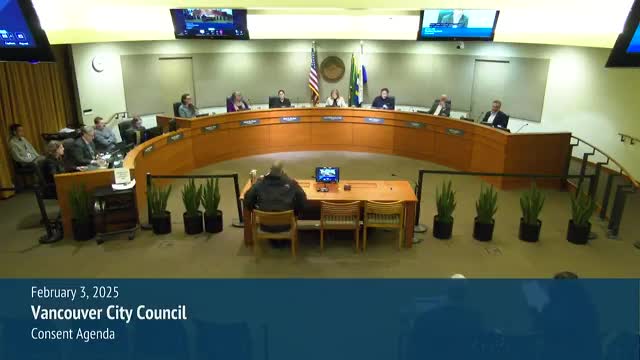
Vancouver City Council on Feb. 3 approved a voluntary participation agreement that allows the Regional Transportation Council (RTC) to test modified traffic signal timing on several corridors as part of a carbon‑reduction grant pilot.
Ryan La Poste, transportation manager for the city, described the agreement as an opportunity to “experiment” with signal timing on a handful of significant corridors to try to reduce congestion and vehicle carbon emissions. He cautioned council that “anytime you start playing with the timing of signals, you may have unintended consequences,” and described the city’s ability to closely monitor signals and roll back changes if they produce negative effects.
Councilor Stober asked about a passage in the draft agreement that referred to “efficient system operations and user fee strategies,” expressing concern that “user fee strategies” sounded like tolling. Judith Perez Canastone, representing the Regional Transportation Council, said, “we're not intending to collect the new user fees. All we're doing is this pilot study to try to improve the flow of traffic in our most congested corridors in the county.”
Council took a motion to approve the participation agreement; the motion was seconded by Councilor Paulson and passed by voice vote. Staff said the city will closely monitor corridor performance during the pilot and will adjust or revert changes if monitoring indicates negative impacts.