Get Full Government Meeting Transcripts, Videos, & Alerts Forever!
Get email alerts on the Homelessness topic
No spam. Unsubscribe anytime.
Residents and businesses press council for stronger response to homelessness as city cites progress
Summary
Business owners and residents described repeated drug use, violence and sanitation problems around encampments; council and city manager said outreach has moved nearly 250 people into permanent housing and promised targeted outreach and follow-up.
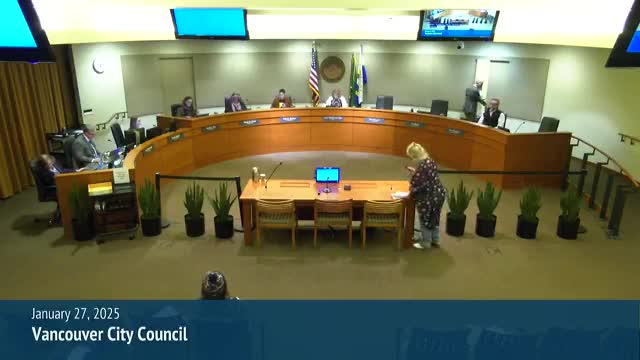
Business owners and nearby residents urged the Vancouver City Council on Jan. 27 to escalate response to local unsheltered homelessness, citing public drug use, discarded needles, assaults and repeated disturbances near shelters and the sound wall. Council and city staff said the city is expanding shelter capacity and outreach and will follow up with targeted contacts.
Several residents and a property owner described repeated public-safety and sanitation problems they attributed to people living outdoors near retail and residential properties. Kimberly Goheen Alban, who identified herself as a long-time Clark County resident, said large sums have gone to homelessness services in recent years and questioned whether those expenditures have produced adequate results. "Millions and millions of hard earned tax dollars through this last 4 years have gone to homeless," she said.
Josh Arden, who said he owns property at 9430 Vancouver Mall Drive, told the council his landscaping contractor is charging nearly $1,000 a month and has stopped routine trash pickup because crews encounter needles and human waste on the property. "Why should I have to clean up after you? Stop doing this," Arden said, and he asked for help. Mayor McInerney Ogel said the city's HEART team would contact Arden; the mayor added that the city itself "does not hand out needles," and identified needle distribution as a separate harm-reduction provider service.
Resident Shannon Stamp said outreach conversations had felt productive but disputed claims that most people want shelter. Referring to counts discussed earlier by staff, she said: "Jamie gave really small numbers, but she said they have 9 people out of the 52 that want shelter, 6 that don't and 2 that don't qualify." Stamp said violent incidents near the sound wall have woken neighbors and contributed to a pattern of nuisance activity.
Resident Matthew Trego said personal encounters with overdoses and assaults had left him skeptical that the planned 50‑bed bridge shelter will substantially reduce public disorder. "When the bridge shelter does open, that 50 beds ... is only gonna be such a small portion of the population that we already have," he said. He urged larger, longer-term options and referenced House Bill 1255, which he said proposed a 500-foot setback for high-occupancy shelters; he told the council he preferred a 1,000‑foot standard for certain shelter types.
City Manager (unnamed) and other staff framed the issue as a long-term housing shortage and described the city's recent outreach results. The city manager said the city has moved "almost 250 people off of the streets into permanent housing of one type or another" since programs began, and noted the cost pressures of emergency responses: "The average cost of a fire response ... is almost $1,600 every time they go out," and roughly 21% of police spending is directed toward responses that include unsheltered homelessness. The manager said the bridge shelter is a "key piece" of the city's strategy and that the city will continue outreach while building more long-term housing.
No formal council action was taken on the public comments. Mayor McInerney Ogel and staff directed outreach teams to follow up with residents and property owners who raised site-specific concerns, including having the HEART team contact Arden. The council also acknowledged continued community unease even as staff urged patience with a multi-year effort to increase housing supply.
Residents and business owners who testified asked for faster results, clearer metrics of program effectiveness and more coordination with police and outreach services. City staff promised written follow-ups and continued reporting on shelter and housing outcomes.