Get Full Government Meeting Transcripts, Videos, & Alerts Forever!
State officials outline tax credits, special valuation and grants as tools for Gig Harbor preservation; Places conference coming in October
Summary
City of Gig Harbor preservation commissioners heard a detailed briefing on financial incentives for rehabilitating historic buildings from the Washington State Department of Archaeology and Historic Preservation on Jan. 28.
City of Gig Harbor preservation commissioners heard a detailed briefing on financial incentives for rehabilitating historic buildings from the Washington State Department of Archaeology and Historic Preservation on Jan. 28.
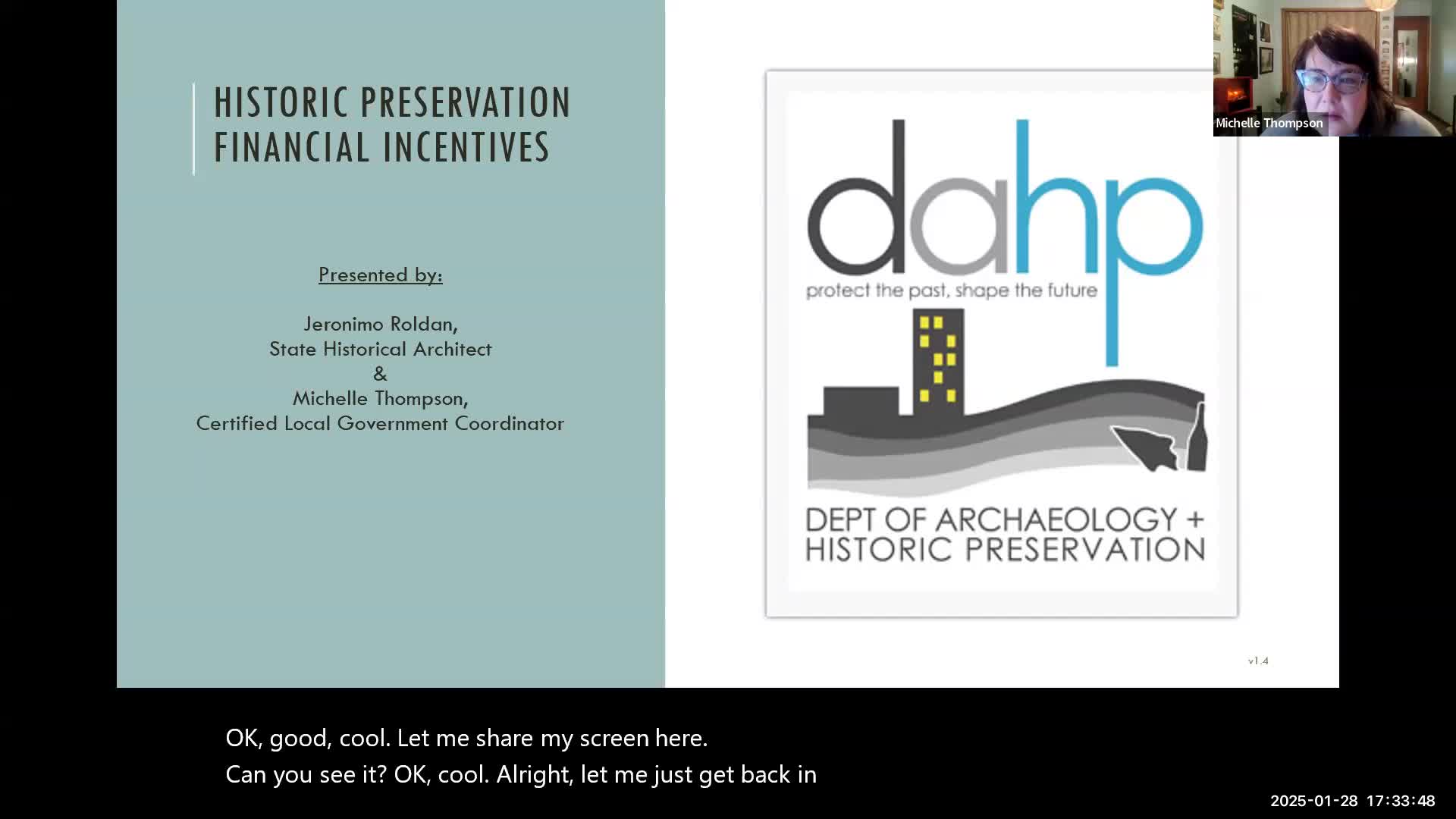
Michelle Thompson, certified local government coordinator at the Washington State Department of Archaeology and Historic Preservation (DAP), and Jeronimo (Geronimo) Roldan, the state historical architect, described federal tax credits, the state's special tax valuation, certified local government (CLG) grants and smaller facade-improvement programs and answered commissioners' questions about eligibility and outreach.
Thompson said many incentives require a building to be listed on a register (local, state or national) and noted the Places conference will be hosted in Gig Harbor Oct. 8—Oct. 10. "We've been working in the past few years to push the conference a little bit preservation end of it," she said, inviting the commission to participate in mobile tours and panels.
Roldan explained the Federal Historic Tax Credit program and how it works in practice. "Basically, in the simplest terms, it's 20% of your project budget that you get back over 5 years, on your general business taxes," he said, using a $1,000,000 rehab (a $200,000 credit taken over five years) as an example. He said projects must be eligible for the National Register (either individually listed or contributing to a district), must be income-producing (commercial, rental or similar), must meet a minimum threshold of substantial rehabilitation (discussed…
Already have an account? Log in
Subscribe to keep reading
Unlock the rest of this article — and every article on Citizen Portal.
- Unlimited articles
- AI-powered breakdowns of topics, speakers, decisions, and budgets
- Instant alerts when your location has a new meeting
- Follow topics and more locations
- 1,000 AI Insights / month, plus AI Chat