Get Full Government Meeting Transcripts, Videos, & Alerts Forever!
Get email alerts on the Utility Rates topic
No spam. Unsubscribe anytime.
Chehalis council revisits utility rate plan; public hearing continued to Feb. 10
Summary
Consultant presented a 2025–29 multiyear rate plan and updated capital facility charges for water, wastewater and stormwater. Council and staff discussed moving to monthly billing, proposed water-rights purchases and annexation impacts; council continued the public hearing and tabled formal ordinances to Feb. 10.
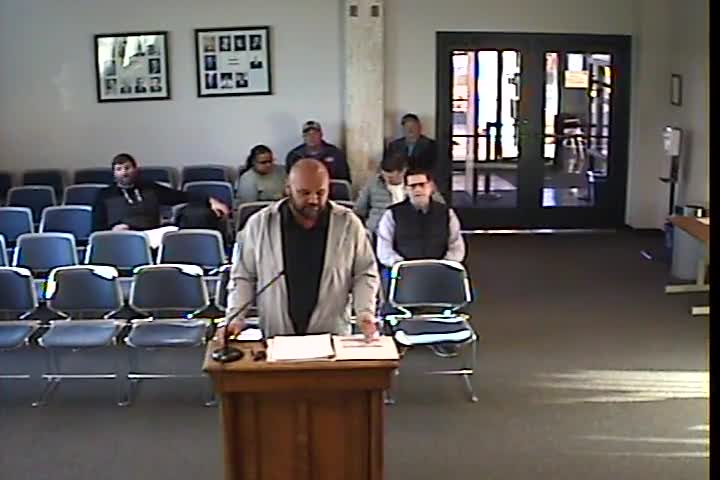
Chehalis City Council members heard a consultant presentation and staff briefing on Jan. 27 on proposed utility rate increases and updated capital facility charges for water, wastewater and stormwater, then agreed to continue the public hearing to Feb. 10 for further review.
The consultant, Chris Gonzales of FCS Group, told the council the multiyear financial plan is intended to avoid sudden, large increases by phasing revenue needs tied to capital projects and debt service. “Our goal in setting rates is to cover to have the rate increases be as moderate and stable over time as possible,” Gonzales said during his presentation.
The rate study lays out a five‑year plan (2025–2029) to fund operating costs, capital projects and likely borrowing. The consultant described a roughly $36 million water capital program through 2029, including distribution system work, source investments and a water‑rights acquisition. Gonzales said projected grants and cash resources would cover about a quarter of water capital needs, with the remainder funded by loans and debt service that would add roughly $1.9 million per year in debt service by 2029.
Under the recommended schedule, monthly residential bills would change as follows (selected figures presented at the meeting): wastewater current $98.50, increasing by $2.93 (2025) and roughly similar smaller annual steps thereafter; stormwater current $9.45, increasing by about $1.51 in 2025; water current $36.54, increasing by $7.68 in 2025 with larger increases in 2026–27 as capital spending ramps up. The combined current monthly bill for water, wastewater and stormwater was shown as $144.49; the plan shows combined increases of about $12.12 in 2025, $14.11 in 2026 and a larger 2027 increase before moderating in later years.
Gonzales also presented updated capital facility charges (CFCs) intended to recover a proportionate share of system capacity costs from new connections. The consultant’s draft recommended raising the maximum justifiable CFCs to roughly $4,093 per ERU for water (from $2,071), $5,103 per ERU for wastewater (from $3,003), and $1,342 per ERU for stormwater (from $489). Staff noted the council could adopt lower charges as a policy choice but that reduced CFC recovery shifts costs onto existing ratepayers.
Council members pressed staff and the consultant on a set of policy and implementation issues: the timing of increases, how debt service and large one‑time purchases affect short‑term spikes, and the effect of annexing the urban growth area (UGA). Staff reported 929 existing UGA connections and estimated a net revenue loss to the city of roughly $250,000 per year if the entire UGA were annexed under current rates because UGA customers are charged higher service fees now. Councilors asked staff to model scenarios under different annexation and growth assumptions before final action.
The council and staff also discussed converting the city’s customer billing from bimonthly to monthly. Staff said the city can implement monthly billing relatively quickly with an estimated incremental postal/shipping cost of about $1,200 per month and proposed a 60‑day customer notice; staff recommended offering an electronic‑billing opt‑in to offset the expense. Staff confirmed the city currently accepts credit‑card payments and that the billing change would not force customers to accept electronic bills; paper billing would remain an option.
Council members asked for more detail about the specific capital projects that underlie the five‑year spending forecast. Staff said a draft capital improvement plan is in preparation and committed to providing councilors the draft project list and to return periodically with project status updates so elected officials can match spending to the plan.
Council discussion also covered a potential purchase of TransAlta water rights, which staff placed in a range with a current working estimate of roughly $5.5 million though staff said the final acquisition cost could be higher depending on transaction terms and legal fees.
Votes at a glance: the council recessed consideration of the three proposed ordinances that would adopt the new rates and CFCs (Ordinance Nos. 1107‑B, 1108‑B and 1109‑B) and continued the public hearing to Feb. 10 to allow more review and to ensure the ordinances consistently reference the updated capital facility charges. The council approved the consent calendar earlier in the meeting and later approved a separate voucher to pay medical evaluations for new volunteer firefighters (action recorded among regular business).
Why it matters: the plan funds large water and wastewater capital projects and associated debt service that the consultant said are the main drivers of near‑term increases. The council deferred final ordinance votes to allow review of the draft capital improvement plan, the annexation modeling and ordinance language that explicitly incorporates the updated CFCs.
The public hearing on the utility rate study was continued to Feb. 10. Staff said they will provide the draft capital improvement plan, CFC detail and updated ordinance language to councilors before the next hearing.