Get Full Government Meeting Transcripts, Videos, & Alerts Forever!
Get email alerts on the Firearms Liability topic
No spam. Unsubscribe anytime.
House passes bill granting civil immunity for voluntary firearm-hold agreements
Summary
The Arkansas House passed House Bill 1067, which grants civil immunity to federal firearms licensees who agree to hold a firearm for an individual under a voluntary private agreement; the measure passed 96-2.
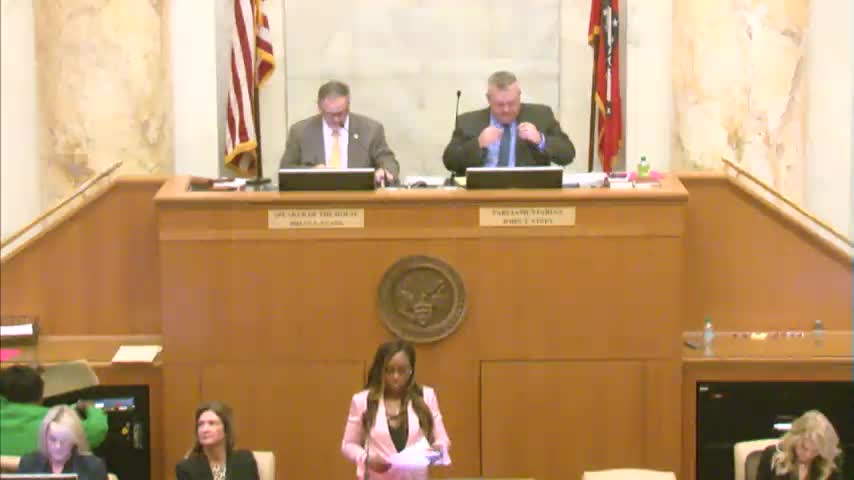
The Arkansas House of Representatives on Feb. 3 passed House Bill 1067, a measure that grants civil immunity to federal firearms licensees (FFLs) who voluntarily agree to hold a firearm for an individual, by a vote of 96 yeas and 2 nays.
Supporters said the bill is intended to give gun owners — including veterans experiencing mental-health crises — a temporary, private option to remove firearms from their homes while they seek help. Representative Grammich, who presented the bill, said the proposal is aimed at reducing suicide risk by allowing FFLs to store weapons without fear of civil liability. He told colleagues that "this is totally voluntary. The government is in no way involved."
The bill was read into the record by the clerk before Representative Grammich explained its purpose and answered a question about what entities can hold a federal firearms license. Representative Lademan asked for an example of an FFL; Grammich said examples include gun stores and private individuals who hold an FFL, and cited a local business that operates as a "pharmacy gun store."
House members debated no formal amendments on the floor and the chair called the question. The clerk reported the final tally as 96 yays, 2 nays and 0 present; the bill was announced as passed.
The measure creates a limited civil-immunity framework for private agreements between FFLs and individuals. Proponents repeatedly described the arrangement as voluntary and as a private contract between an FFL and an individual seeking temporary storage. The text read on the floor and the sponsor—xplanation did not specify implementation details such as recordkeeping, retention periods, or insurance-treatment rules; those details were not specified during the session.
The House adjourned until 1:30 p.m. the next day after completing scheduled business.