Get Full Government Meeting Transcripts, Videos, & Alerts Forever!
Get email alerts on the Community Service Program topic
No spam. Unsubscribe anytime.
Yakima municipal court outlines community service program as alternative to jail
Summary
At the Jan. 21 Yakima City Council meeting, Municipal Court Judge Masters described how community service hours are used in diversion, juvenile and sentencing contexts, and councilmembers discussed barriers and possible city-run work crews or partnerships to expand supervised options.
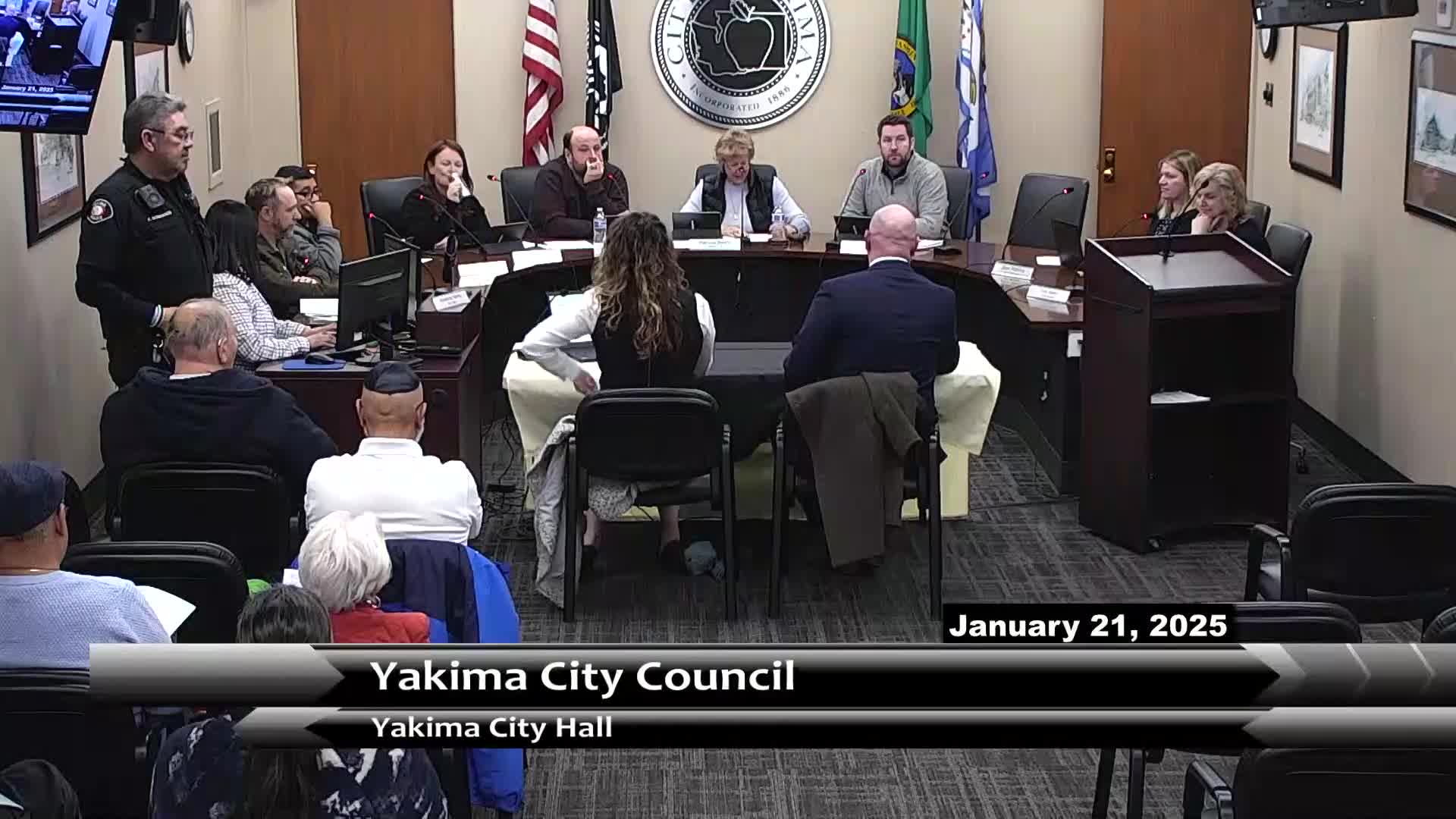
At its Jan. 21 meeting, the Yakima City Council heard a presentation from Municipal Court Judge Masters about how Yakima Municipal Court uses community service hours as an alternative to jail, a requirement in a new community diversion court contract and as part of juvenile infractions handling.
Judge Masters said the court assigns community service for three main purposes: as part of the community diversion program (soon to be the community diversion court), as a sentencing alternative to short jail time for certain nonviolent offenses such as driving with a suspended license, and as an option for some juvenile infractions. “We use community service hours for a variety of reasons,” Judge Masters said, noting the court requires nonprofit placement within the Yakima city limits and proof of completion on official letterhead with a supervisor signature.
The program typically starts at eight hours and can range higher depending on charges and circumstances; Judge Masters said diversion participants must complete at least eight hours. She told the council that year-to-date participants in the diversion program have completed more than 400 community service hours and that, for an infraction calendar of about 30 dockets, “I might have one juvenile who might take advantage of community service.”
Councilmembers raised questions about using city parks or a city-managed work crew to provide supervised placements and reduce screening and liability barriers. Judge Masters said such options had been explored previously but were found cost-prohibitive when supervision and screening requirements were included. “There has to be a supervision. There would have to be some sort of screening process for defendants, and there could be liability issues,” she said, adding that People for People handles screening for the diversion program and makes placement recommendations.
Judge Masters and council members discussed practical barriers that limit placements, including nonprofit organizations’ internal screening policies, the need for identification documents among low-income defendants, and the administrative cost of monitoring completion. She suggested the court could host a public list of community providers on its website and noted the court already maintains a nonexhaustive list of agencies used in the past.
Deputy Mayor Brown asked whether the court tracks how many people receive community service orders. Judge Masters replied, “We don't have a specific number...so when I'm doing my infraction calendar...I might have one juvenile,” and reiterated that community diversion participants typically complete at least eight hours.
Councilmembers and the judge said community service could be packaged with treatment, housing assistance and other supports inside the community diversion court to help stabilize participants and reduce recidivism. No formal council action was taken; the presentation was informational and council members invited further discussion about partnerships, potential pilot work crews, and posting vetted providers on the court website.