Get Full Government Meeting Transcripts, Videos, & Alerts Forever!
Get email alerts on the Judicial Appeals Court Oral Arguments topic
No spam. Unsubscribe anytime.
Appeals court hears dispute over sufficiency of evidence in alleged romance‑scam money‑laundering case
Summary
At the Feb. 6 sitting the Massachusetts Appeals Court heard argument in Commonwealth v. Adabo Wale over whether the Commonwealth presented sufficient evidence that the defendant knowingly handled proceeds of a fraudulent scheme and whether a jury reasonably could infer he opened and controlled the key bank account.
Commonwealth v. Adabo Wale returned to the Massachusetts Appeals Court on Feb. 6 for argument over whether evidence at trial was sufficient to sustain money‑laundering and related convictions.
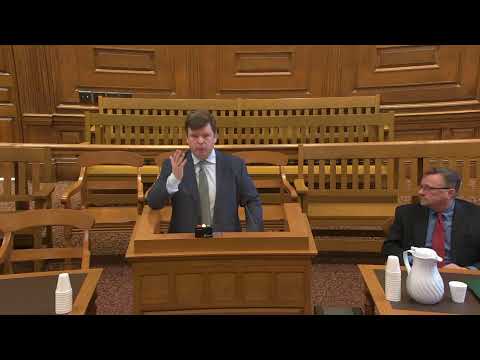
The defendant, represented by Attorney Thomas Gleeson, challenged both a pretrial McCarthy probable‑cause ruling and, primarily, the trial court’s denial of a directed‑verdict motion. Gleeson told the panel the evidence did not prove Wale had the knowledge or intent required under the state money‑laundering statute and that key inferences the Commonwealth asked a jury to draw were unsupported.
The Commonwealth, represented by Assistant District Attorney Kristen Jang, asked the panel to view the record “in the light most favorable to the Commonwealth” and argued the evidence permitted a jury to infer the defendant’s knowledge and participation. Jang pointed to a check from another alleged victim made payable to “John Richards,” addressed to the defendant’s listed residence, and deposited the same day into the corporate account used in the scheme. She also highlighted dozens of cash withdrawals from multiple ATMs over an approximately 45‑day span and the timing of account setup and withdrawals as circumstantial proof of joint participation in a fraudulent funneling operation.
Why that circumstantial pattern was or was not legally sufficient occupied most of the argument. Defense counsel emphasized gaps: the corporate account documentation listed a different named incorporator, there was no direct evidence tying Wale to the person who negotiated the original fraud, and most of the large dollar movement in the account occurred via wires that the defense said were not shown to be conducted by Wale. Gleeson argued the jury was left with competing reasonable inferences and that the inference of innocence should prevail when the evidence admitted multiple plausible explanations.
The court asked about specific legal elements of the Commonwealth’s money‑laundering theory, including which subsection the Commonwealth relied on and why concealment is not required under the state statute the parties cited. The prosecutor acknowledged she had corrected an earlier drafting error in her brief and reiterated that the Commonwealth relied on the statutory language that requires proof the funds were “known to be derived from criminal activity or which a reasonable person would believe to be derived from criminal activity.”
Both sides agreed the key questions are whether a jury reasonably could infer that (1) Wale opened or caused the Jairobi corporate account to be opened, (2) he received funds traceable to the scheme at his residence and deposited them into that corporate account, and (3) his repeated cash withdrawals—at different branches and in varying small increments—were consistent with participating in a money‑funneling enterprise rather than purely personal withdrawals. The court pressed counsel on the line between reasonable inference and speculation.
Argument concluded with the court noting the case had been “very interesting” and taking the matter under advisement; counsel rested on briefs and the case was submitted for decision.
The record remains under advisement; the panel did not announce a ruling from the bench at argument.