Get Full Government Meeting Transcripts, Videos, & Alerts Forever!
Get email alerts on the Parks Operations topic
No spam. Unsubscribe anytime.
Bothell staff outline parks operations, staffing and maintenance priorities for 2025
Summary
Parks operations manager Scott Perfogle briefed the Parks and Recreation Board on staffing, equipment purchases, maintenance zones and daily procedures; staff described safety and training steps and how operations will support upcoming projects including The Landing and golf course master planning.
Scott Perfogle, park operations manager for the City of Bothell, told the Parks and Recreation Board on Jan. 8 that the city’s parks crew is expanding and focusing this year on maintenance consistency, safety and support for major projects.
“We're a 7‑day‑a‑week operation,” Perfogle said, summarizing the department’s workload as he reviewed parks, ballfields, playgrounds, historic cemeteries and trails under city care.
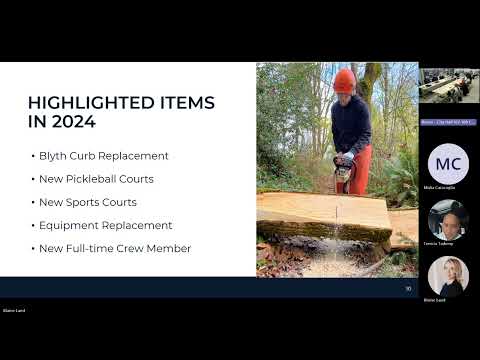
The presentation outlined the department’s assets and personnel: 26 parks, multiple ball fields and playgrounds, two historic cemeteries (Pioneer Cemetery behind UW Bothell and Swedish Cemetery behind QFC), and about 3.6 miles of public trails. Perfogle said the operations crew currently includes 10 full‑time employees and six seasonal staff; the city plans to increase full‑time staffing to 12 this year. Seasonal staff generally work May through September and several have returned year to year, he said.
Why it matters: The staff brief gave the board a picture of capacity to maintain existing park assets while taking on new projects such as The Landing and the forthcoming golf‑course master plan. Staffing and equipment choices carry direct consequences for service levels, event support and ongoing maintenance costs.
Most important details
- Zones and priorities: Parks maintenance is organized into four geographic zones with A/B/C priority levels; A‑level sites receive daily visits and multiple weekly mows, B‑level sites receive multiple weekly visits and one mow every 7–10 days, and C‑level sites receive weekly visits and one to two mows per month. Perfogle said the city intends to add a maintenance worker to the busiest zone this year.
- Equipment and efficiency: The department recently added three walk‑behind blowers that avoid backpack strain and purchased an additional wing‑deck mower and flatbed trailer to improve field mowing efficiency. Perfogle said that having a second wing‑deck and extra mower lets crews better cover large fields and open turf areas.
- Cemeteries and interments: Perfogle said Pioneer Cemetery (active) and Swedish Cemetery (inactive) remain under city care; he noted Swedish Cemetery has about six visible headstones but the city has records suggesting roughly 40 burials there. The city uses a contractor for grave digging and averages six to eight funerals per year at Pioneer, he said.
- Trainings and safety: The operations team described an emphasis on employee safety that includes a daily 20‑minute pre‑shift stretching routine, periodic training on lifting and hazardous tasks, and equipment choices meant to reduce repetitive‑motion injuries. Perfogle said injury reports prompted the department to change equipment and procedures; he reported fewer work‑related injuries since adopting the new practices.
- Tree care, graffiti and volunteer events: The city uses in‑house arborists for many tree issues and contracts for large removals; graffiti incidents occur periodically with a cluster of tags at North Creek Forest. Parks staff coordinate roughly 10–12 volunteer work parties annually and assist city events and rentals.
- Leaf management and composting: Staff described a park‑by‑park approach to leaf litter, balancing ecological benefits of leaving leaves in beds with event and safety needs. Leaves collected by crews go to the city’s shop and then to municipal composting/processing; staff noted a recurring heavy workload in fall and coordination with street sweepers.
Board action and next steps
Staff identified maintenance and staffing as continuing priorities while supporting upcoming capital projects (The Landing and the golf‑course master plan). Perfogle suggested arranging a meet‑and‑greet between board members and maintenance staff so board members can become familiar with crew roles and operational constraints.
Ending
Perfogle and other staff said they will continue bringing detailed updates as capital projects move into design and as staffing changes take effect this year.