Get Full Government Meeting Transcripts, Videos, & Alerts Forever!
Get email alerts on the Currency Policy topic
No spam. Unsubscribe anytime.
Senate passes bill defining central bank digital currency and barring it from UCC money/deposit status
Summary
Senate Bill 133 defines central bank digital currency (CBDC) in state law and clarifies that a CBDC is neither "money" nor a deposit account under the Uniform Commercial Code, a step sponsors described as a state-level 'speed bump' against federal CBDC action; the Senate passed the bill 31-0-4.
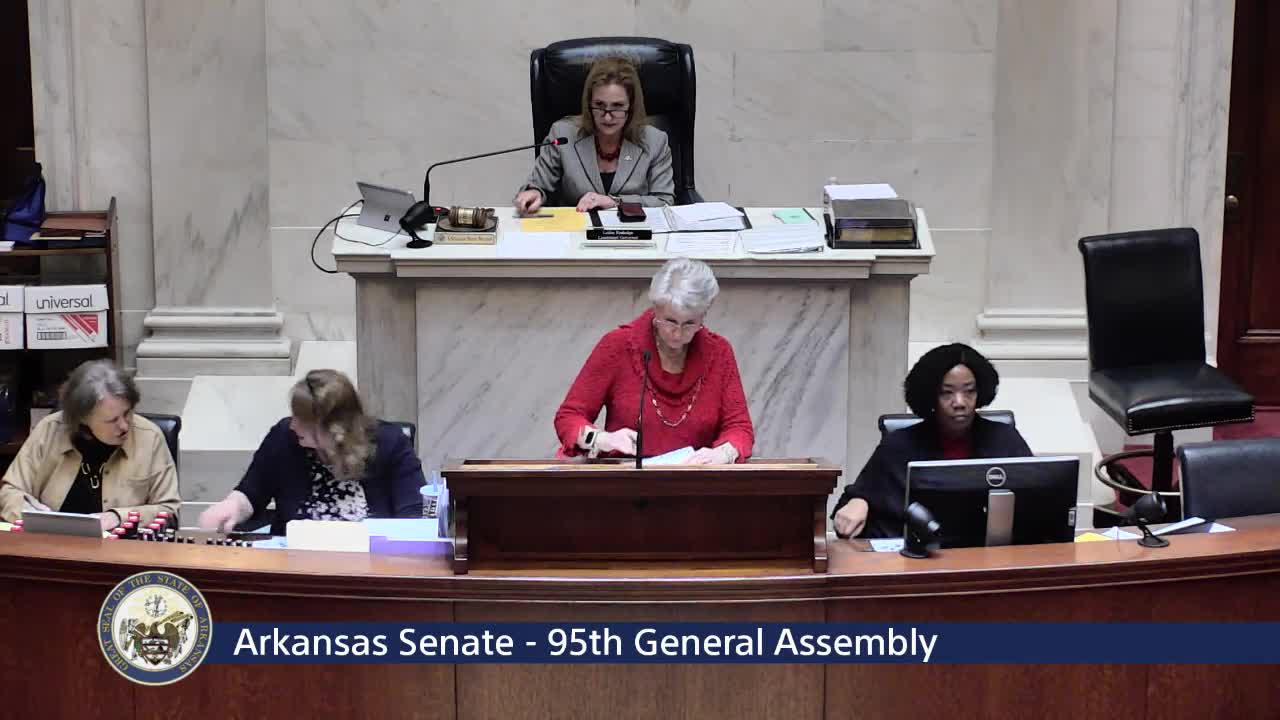
The Arkansas Senate on Feb. 3 passed Senate Bill 133, a measure to define central bank digital currency (CBDC) in the Uniform Commercial Code and to specify that CBDC is not "money" or a deposit account under Arkansas law.
Sponsor Senator Boyd said the bill is intended to create a state‑level obstacle to implementation of a federally issued CBDC. “By clarifying a central bank digital currency is not money in Arkansas and the uniform commercial code, it places a constitutionally sound speed bump in the way of our federal government implementing a central bank digital currency,” Boyd said on the floor, adding that the bill is similar to legislation adopted in Florida.
Boyd emphasized that the measure is not about cryptocurrency and said it is distinct from proposed 2022 UCC amendments he said would have smoothed a federal transition. He told colleagues the banking association had supported the bill in committee and that the banking department had not expressed concerns.
Senators asked technical questions on ties to the Federal Reserve and on the bill’s mechanics. Senator Mark Johnson asked whether the bill’s effect was to “slow down” a CBDC process; Boyd agreed. Senator Stubblefield asked whether other states that acted had pending litigation; the sponsor responded that the bill’s purpose was to oppose a system that would let a central bank “know where every unit of money we have is and fundamentally change our banking system.”
Senate roll call recorded 31 yeas, 0 nays and 4 present; by that tally SB133 passed and will be transmitted to the House.
Next steps: SB133 will be transmitted to the House. The sponsor characterized the bill as a preemptive state‑level defense against federal CBDC implementation; the bill’s legal effect and any potential challenges would depend on subsequent judicial or federal actions if a CBDC were advanced.