Get Full Government Meeting Transcripts, Videos, & Alerts Forever!
Get email alerts on the Judicial Election topic
No spam. Unsubscribe anytime.
Saint Croix County Branch 2 candidates debate judicial philosophy, bail, diversion and courthouse operations at New Richmond forum
Summary
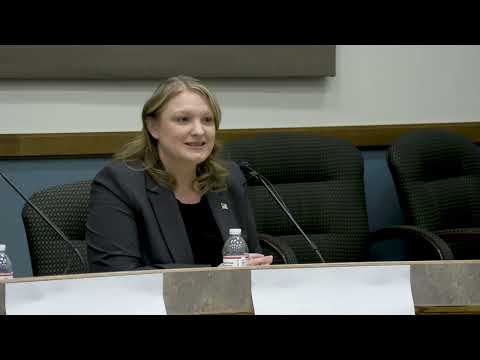
Three candidates for Saint Croix County Circuit Court Branch 2 — Heather Enos, James “Jamie” Johnson and Brian Smithstead — discussed judicial philosophy, pretrial release, mental health and diversion programs, courtroom order and case backlog at a candidate forum hosted by Friday Memorial Library in New Richmond.
A candidate forum at Friday Memorial Library in New Richmond gathered three contenders for Saint Croix County Circuit Court Branch 2 to describe their qualifications and to debate judicial philosophy, pretrial bail, mental-health and substance-use diversion programs, courtroom conduct and case backlog.
Moderator Monica Lavold opened the event and explained the format; candidates gave three-minute opening statements, answered a roster of questions and offered closing remarks.
The three candidates framed much of the evening around a shared theme: judges should apply the law neutrally and not use the bench to make policy. Brian Smithstead, deputy district attorney for Saint Croix County, said, "The first and most important thing is the judges should not be changing the law," and added judges must "follow the law as it's written." James "Jamie" Johnson, a longtime attorney and former school board president, described his approach as neither activist nor purely restraint: "I would say that I am neither an activist nor a total restraint," he said, adding he would "judge every case on its own merits." Heather Enos, who said she has served as the county's corporation counsel, echoed those points and said candidates and judges should be nonpartisan: "Being nonpartisan is the primary way that the judges should rule," Enos said.
Qualifications and backgrounds
Each candidate emphasized different career experience. Enos described 22 years in county government, including work on mental-health commitments, guardianships, contracts and ordinances; she said her public-sector experience helps her understand what county services are available to people who appear in court. Johnson highlighted more than 37 years as an attorney, judicial clerkships and volunteer mediation work and cited long-term community service, including four elected three-year terms on the Hudson School District board and 11 years as its president. Smithstead described 27 years of practice, 22 years living in Saint Croix County and his current role prosecuting major and violent cases as a deputy district attorney; he also noted prior work in the public defender's office and private practice.
Pretrial release and bail
Candidates discussed recent statutory changes and the balance between public safety and wealth-based disparities in cash bail. Enos and Smithstead noted a 2023 change that allows judges to consider prior convictions and the seriousness of charges when setting bail; the candidates said that change gives judges more tools to account for public-safety risks. Enos said judges should use Chapter 969 standards (as discussed at the forum) and make individualized determinations rather than apply blanket rules. Several candidates described Justice Support Services pretrial monitoring, GPS and sporadic testing as alternatives to cash for supervising defendants released before trial.
Mental health, treatment courts and diversion
All three candidates said Saint Croix County needs more local mental-health treatment capacity and more diversion options. Smithstead and Johnson described existing treatment court and other diversion programs, and both supported expanding access and resources. Smithstead and others highlighted the county's logistical problem when people require emergency commitments under Chapter 51: those patients are often transported hours away, using law enforcement resources. Johnson said he would support a family treatment court if elected and noted a three-year grant application seeking $125,000 per year to pilot that work; he said family treatment court could help parents meet treatment goals and reduce foster-care costs. Candidates also discussed the county's difficulty of using closer Minnesota treatment facilities, which they said could be more practical than sending people to Madison or Winnebago, though they did not identify a specific statutory barrier.
Courtroom conduct, community engagement and backlog
Candidates described expectations for courtroom decorum—timeliness, appropriate dress, silence of electronic devices and respectful address to the bench—and said judges should be prepared and evenhanded. Enos said she would explain proceedings in lay terms when unrepresented people appear. Johnson and Smithstead said judges should tolerate community-engagement activities (school visits, educational talks) while avoiding partisan or fundraising activity. On case backlog, candidates cited multiple causes: missed appearances, witness availability, evidence processing and limited courtroom space since COVID. They discussed Zoom appearances as a flexibility tool to reduce no-shows and recommended clear scheduling orders and stricter enforcement of timelines for attorneys where appropriate. Smithstead and others also stressed public-defense capacity and attorney availability as contributors to delays.
Where candidates differ
Differences appeared mostly in emphasis and experience. Johnson stressed mediation, school-board service and community ties. Enos emphasized her long public-sector legal work and familiarity with county services and procedures. Smithstead highlighted having worked as a private attorney, a public defender and a prosecutor and said those combined roles give him experience on both sides of criminal cases.
What was not decided
No formal actions, endorsements or votes took place at the forum. Candidates described policy preferences and priorities; any legal or funding changes they discussed—such as building a local mental-health facility or establishing new diversion or family-treatment programs—would require legislative action, county funding or interagency agreements and were discussed only as proposals.
Ending
The forum concluded with three-minute closing statements and encouragement to voters to participate in the county's judicial election process. The event was organized by Friday Memorial Library and supported by the League of Women Voters and local media partners.