Get Full Government Meeting Transcripts, Videos, & Alerts Forever!
Get email alerts on the Education Budget topic
No spam. Unsubscribe anytime.
Ohio education chief outlines executive budget: literacy, workforce training and bus safety among priorities
Summary
Director Stephen Dacken told the House Finance Committee the governor's executive budget continues Read Ohio funding, adds a $10 million principal apprenticeship, and seeks changes to career-technical access and the school funding guarantee. Committee members pressed the department on formula inputs, vouchers, DPIA and transportation logistics.
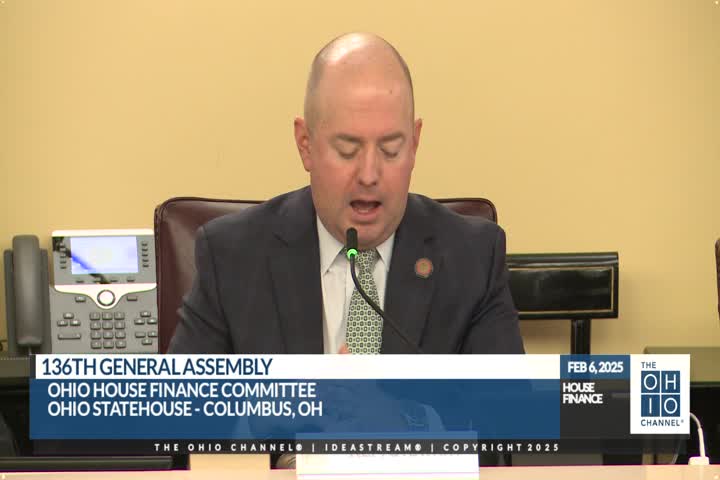
Columbus — Stephen Dacken, director of the Ohio Department of Education and Workforce, told the Ohio House Finance Committee on Thursday that the governor’s executive budget maintains and expands investments in literacy, career-technical education and student wellness while asking the Legislature to consider changes to the school funding formula.
Dacken said the budget builds on last session’s Read Ohio investments and would continue funding literacy coaches, ask districts to use some foundation funds for science-of-reading implementation, and direct larger portions of state support to districts with the lowest literacy rates. "We must accelerate our shared goal of reading proficiency for all students," he said.
The department highlighted several specific proposals to the committee: continued support for the Read Ohio initiative (including 84 literacy coaches serving 125 schools), a $10 million principal apprenticeship program, elimination of middle-school waivers so seventh-graders can access career-technical education beginning in the 2026–27 school year, up to $7 million per year to reimagine regional tech-prep centers, $30 million for a school bus safety grant program and $4 million for expanded driver training. The executive budget also recommends increasing facility funding for community schools from $1,000 to $1,500 per pupil and expanding an equity supplement to eight independent STEM schools.
Committee members focused much of their questioning on the funding formula. Dacken confirmed the governor’s recommendation would fund the final two years of the current phase-in without updating the inputs, and that the administration had proposed modest adjustments to the guarantee (phasing funding floors to 95% in fiscal year 2026 and 90% in fiscal year 2027). "The guarantee ... is somewhat nuanced," Aaron Rausch, the department funding expert, told the committee, explaining that changes in property values, local income and historical formula choices can put growing districts on the guarantee in unexpected ways.
Ranking Member Sweeney asked why the executive budget does not adjust state inputs for inflation. "Why are we not accounting for inflation?" Sweeney asked, saying districts across the state will feel the effect of rising property valuations and costs. Dacken said the governor’s proposal is a starting point and that the department is ready to work with the General Assembly on broader formula changes.
On vouchers and school choice, members raised concerns about tuition increases at private and charter schools using vouchers and about whether universal vouchers are expanding access to new students or simply shifting public dollars to students already served. Dacken said the department will provide data and work with lawmakers: "We fund students where they are," he said, describing the department’s role under current law.
The department told the committee it contracted the American Institutes for Research to study the cost of educating economically disadvantaged students; that study was not complete at the time of the hearing. The department also proposed targeted uses of DPIA (disadvantaged pupil impact aid) money in literacy: districts on a reading achievement plan would be asked to spend at least 50% of DPIA funds on literacy, and other districts would be asked to spend 25% on literacy interventions.
Several representatives pressed Dacken on career-technical education implementation and facility constraints. Dacken noted prior investments in CTE facilities and equipment — including a prior biennial allocation of $200 million for facilities and $100 million for equipment grants — and said the department wants districts and career centers to coordinate to avoid duplication and waiting lists. He promised to follow up on operational constraints raised by members related to the Ohio Facilities Construction Commission.
Transportation and school-bus logistics drew repeated attention. Members described cases where transporting a small number of students to distant charter schools would require additional buses and drivers, reducing service for hundreds of other students. Dacken called the current system a "quagmire" and said the department will explore alternatives and improvements, noting that logistics and driver shortages are causing missed and late student arrivals in some districts.
On student wellness, Dacken described the department’s programs for mental and physical health, school-based health centers and before/after-school programming and urged districts to build community partnerships to expand access to services. He noted some districts are using federal COVID-relief funds and existing balances to support interventions such as high-dosage tutoring, and he emphasized that tutoring is most effective during the school day.
The committee recessed for lunch and planned additional witnesses later in the day. Members and department officials agreed to continue technical discussions on formula inputs, DPIA calculations, transportation logistics and implementation details for the budget proposals.