Get Full Government Meeting Transcripts, Videos, & Alerts Forever!
Get email alerts on the School Levies And Funding topic
No spam. Unsubscribe anytime.
Bill would change levy cap and local effort assistance; sponsors and critics warn of equity tradeoffs
Summary
Senate Bill 5,593 would set a new maximum enrichment levy amount at 30% of state allocations and change local effort assistance (LEA) eligibility and formulas; sponsors called it a tool to help districts raise local funds while some district and equity advocates warned the changes could widen disparities without parallel investments in basic ed.
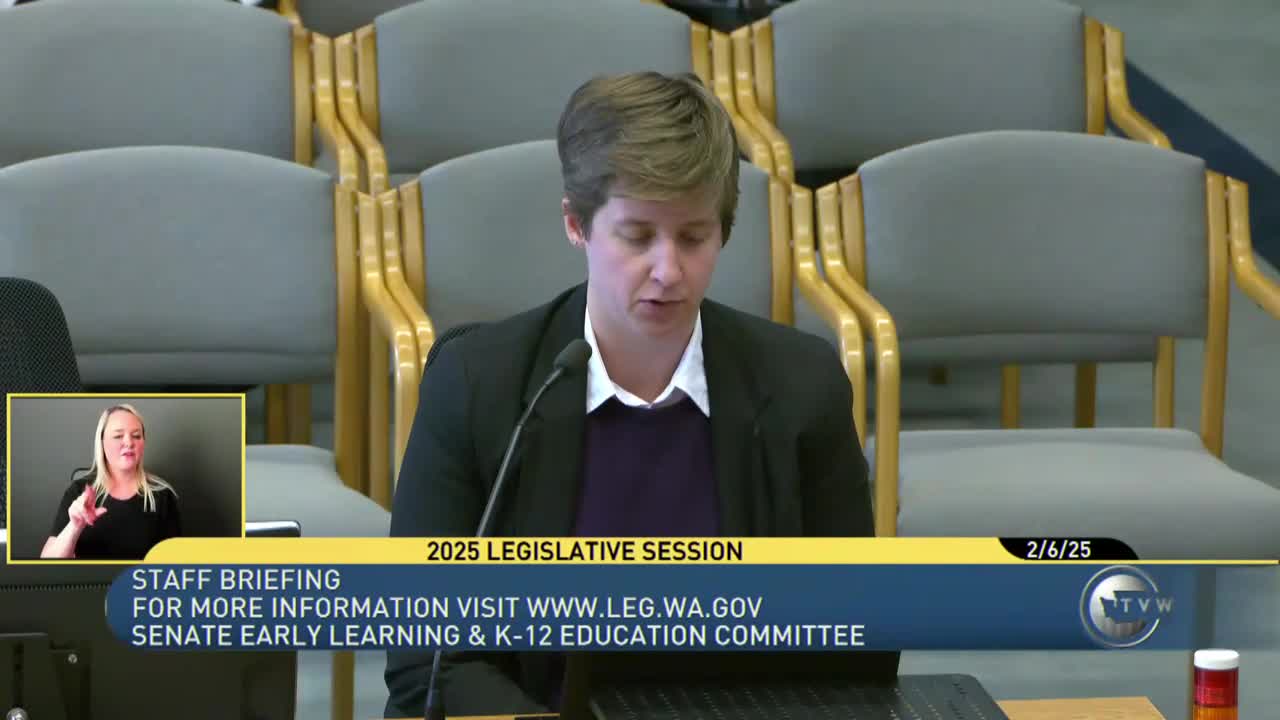
The Early Learning & K–12 Education Committee heard Senate Bill 5,593, a proposal that would change how school enrichment levy limits are calculated and would revise local effort assistance (LEA) formulas intended to help property‑poor districts. Alex Fair Fortune, staff to the committee, and several witnesses described both the mechanics and the potential fiscal and equity effects.
Fortune summarized the bill: under current law the levy cap is based on a maximum levy rate or a per‑pupil cap; the bill would instead set the maximum enrichment levy amount equal to 30% of state allocations provided to the district (basic education allocations, categorical programs, and food service allocations). It would also alter LEA eligibility so a district is eligible if it must levy above the statewide average to collect revenues equivalent to 18% of its state allocation; the bill provides formulas for calculating LEA amounts. A fiscal note had been requested but was not yet available.
Supporters including district lobbyists and the superintendent's office described the bill as an additional tool to help districts cope with tight budgets. Clifford Draceman, a lobbyist representing several large districts, said the change "could benefit Highline as much as $20,000,000 a year, Bellevue as much as $12,000,000 a year, Seattle 25 or more million a year, North Shore 20 Million a year." Tyler Munch of OSPI said the bill "provides districts more flexibility" and emphasized the need for LEA funding to be adjusted regularly for inflation.
Opponents and cautious commenters — including taxpayer groups and some district finance officials — warned the bill's mechanics are complex and could exacerbate inequities. Jeff Pack of Washington Citizens Against Unfair Taxes described the proposal as "horribly complex, incomprehensible." District CFOs and superintendents said the bill should not distract from the "big 3" funding priorities—special education, transportation and MSOC (materials, supplies and operating costs)—and some witnesses urged parallel LEA adjustments to prevent widening the funding gap between property‑rich and property‑poor districts.
Several witnesses asked for more modeling to show how the bill would affect individual districts. Panelists also noted that levies are voter‑approved local taxes and capacity to pass levies varies by community.
Ending: The committee concluded the hearing after extensive testimony. Witnesses and staff said further modeling and discussion would be needed to resolve equity concerns and to understand district‑level impacts before the Legislature considers substantive changes.