Get Full Government Meeting Transcripts, Videos, & Alerts Forever!
Get email alerts on the Turnpike Finances Operations topic
No spam. Unsubscribe anytime.
Ohio Turnpike Commission outlines $463.8 million 2025 operating budget, $2 billion debt and $319 million capital plan
Summary
Chief engineer and deputy executive director said the turnpike is almost entirely self-funded by tolls, maintains high bond ratings, launched a modern tolling system in April 2024, and plans more than $2 billion in capital investment over the next decade.
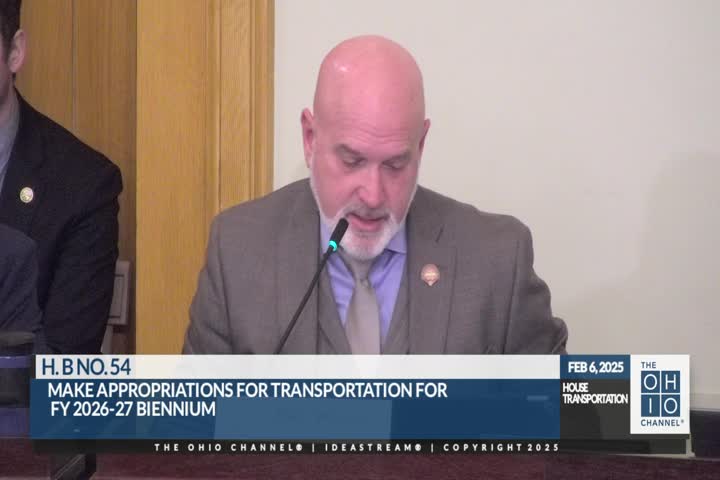
Chris Motta, chief engineer and deputy executive director of the Ohio Turnpike and Infrastructure Commission, told the House Transportation Committee the commission’s 2025 operating budget is about $463.8 million, funded primarily by toll revenue, and that the commission carries roughly $2.0 billion in outstanding senior and junior lien debt.
Motta said approximately $414.0 million of the 2025 operating budget is expected from tolls, with $17.1 million from concessions, $19.2 million from investment income, $10.7 million from miscellaneous sources such as transponder fees and advertising, and about $2.1 million from state motor fuel tax receipts tied to sales at service plazas. He told the committee the commission approved a $319 million capital budget for 2025 focused on pavement, bridges and safety projects and said the commission plans to invest more than $2.0 billion in capital improvements over the next ten years.
Motta described the Turnpike as a self-funded state-owned toll system whose revenue flow and debt service are governed by senior- and junior-lien master trust agreements. He said debt service will require about 28% of the commission’s 2025 budget, leaving roughly 37% for capital projects in that plan. He told members the turnpike is highly rated by the major credit rating agencies and that recent ratings place the turnpike among the highest-rated major toll agencies in the United States.
On operations and customers, Motta said the Ohio Turnpike carries on average about 150,000 vehicles per day and that travelers drove more than 3 billion miles on the system last year. He said the commission employs about 810 full- and part-time staff and that service plazas generated substantial economic activity and tax revenue for host counties. He said 8 of the system’s 14 service plazas currently offer electric vehicle charging and the commission aims to expand EV charging to all plazas using a public–private model.
Motta summarized changes to toll collection made operational in April 2024: open-road tolling allows E-ZPass customers to pass without stopping in left lanes while cash and credit customers still use right-side lanes. He described the unpaid-toll collection process: license-plate images generate bills that are mailed at about 15, 30 and 75 days after travel; customers can request an administrative hearing; and the commission works with the Ohio Attorney General’s Office and the Bureau of Motor Vehicles to pursue unpaid invoices and registration holds where permitted.
Committee members asked about operational savings from the new tolling system, the accuracy of transponder reads at highway speeds, camera coverage at service plazas, and reserve levels. Motta said the commission is closing out contracts for the new system and expects long-term operational savings; he estimated, from strategic planning figures, potential lifecycle savings in the low hundreds of millions but offered to provide detailed contract close-out figures to the committee. The commission’s chief financial officer told the committee the commission’s cash reserves are approximately $157,000,000.
Motta also highlighted the turnpike’s market role: 14 service plazas operate on a public–private concessions model and the commission reported national recognition for several plazas and services. He closed by saying the turnpike’s high bond ratings and ongoing capital program allow it to fund maintenance and upgrades while maintaining credit quality.