Get Full Government Meeting Transcripts, Videos, & Alerts Forever!
Get email alerts on the Early Learning & K 12 Education topic
No spam. Unsubscribe anytime.
Committee hears bill to require tribal sovereignty curriculum, OSPI to support local consultation
Summary
Senate Bill 5570 would require school districts to incorporate curriculum about federally recognized tribes by Sept. 1, 2026, direct OSPI to help identify tribes for consultation, and add reporting and compensation review; tribal leaders and educators testified in support.
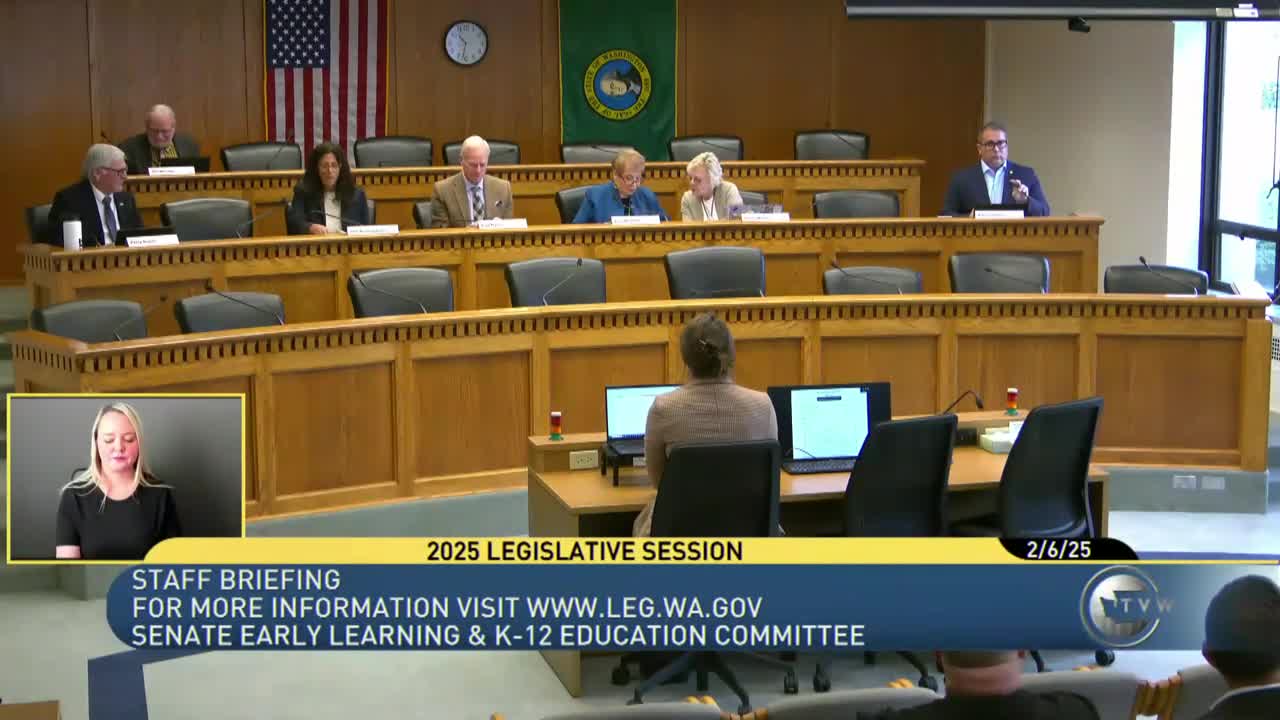
A Senate committee heard testimony on Senate Bill 5,570, which would require Washington public school districts to incorporate curriculum about federally recognized tribes into social studies courses no later than Sept. 1, 2026, and to "consult and collaborate with federally recognized tribes" during that process. Elena Becker, committee staff, presented the bill to the Early Learning & K–12 Education Committee.
Becker told the committee: "This bill is Senate Bill 55 70 relating to supporting public school instruction in tribal sovereignty and federally recognized Indian tribes." She summarized that districts already have a statutory duty dating from 2015 to incorporate tribal history and that the state-maintained John McCoy "Since Time Immemorial" curriculum is the statutory resource districts are directed to use.
The bill would add the word "consult" to the collaboration directive, require the Office of the Superintendent of Public Instruction (OSPI) through its Office of Native Education to assist districts in identifying tribes that meet consultation requirements, and add three reporting requirements: (1) the State Board of Education must monitor district compliance and report to the Legislature; (2) OSPI must report by Sept. 1, 2026, on compensation for tribal expertise and recommended metrics for evaluating consultation and curricular implementation; and (3) the Office of Native Education's annual report must include information about consultations, tribal perspectives on implementation, and recommendations to promote consultation efforts. Becker also noted a fiscal note estimating operating costs of $549,000 in the 2025–27 biennium.
Tribal leaders, educators and local school staff spoke in favor. Monica Tonaskett, a council member of the Spokane Tribe of Indians, said, "I am in favor of Senate Bill 5,570. It is time to include and expand the teaching of the history of tribes and the current state of tribal nations and the unique status the tribes hold as sovereign nations." Charlene Taliquot, of the Yakama Nation Tribal Council, told the committee that roughly 95% of Yakama students attend public schools and that "it is time to address this lack of education and to once again direct public schools to work with the neighboring tribal governments together."
Educators and tribal curriculum developers described local work and needs. Elise Washines, who identified herself as a former curriculum writer and current school board member, said the state curriculum is available on OSPI's website and that she has created tribe-specific subsections. Bernard Koontz, executive director for instruction in Highline Public Schools, supported sections of the bill that would place implementation reporting into the state's accountability structures and would provide compensation for tribal partners, saying it recognizes the "huge ask" the work places on tribal contributors.
Senator Claudia Kauffman, the bill's prime sponsor, described the proposal as a continuation of nearly two decades of work to make tribal history and indigenous knowledge part of public-school instruction across Washington and said the bill adds timelines and reporting to improve implementation.
Supporters urged stronger accountability and reimbursement for tribal time and expertise. Karen Hahn, vice chair for the Confederated Tribes, urged the committee to support the bill's section calling for OSPI recommendations regarding reimbursement for tribal development of resources, noting tribes have invested substantial human and financial resources in language modules and other materials.
The committee did not take a final vote on the bill during the hearing. Proponents said the bill matters for tribal students and for all students' civic education; some witnesses urged careful roll-out and adequate resources for districts and tribes to consult and localize materials.
Ending: The hearing transitioned to other bills after witnesses finished their testimonies; the committee recorded the testimony and fiscal estimates for further consideration.