Get Full Government Meeting Transcripts, Videos, & Alerts Forever!
Get email alerts on the Housing Affordability topic
No spam. Unsubscribe anytime.
Simsbury holds extended public hearing on housing "toolkit"; vote deferred until full commission can attend
Summary
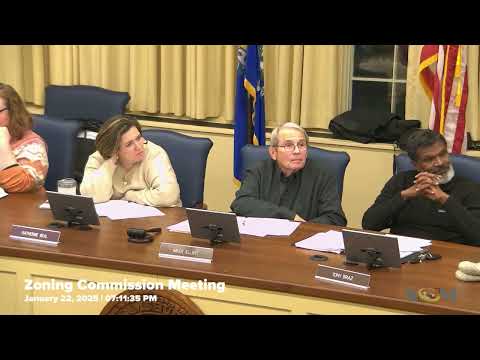
The Simsbury Zoning Commission held a resumed public hearing on ZC24‑06, a four‑part zoning text amendment package aimed at expanding housing options; after extensive public comment the commission closed public comment and deferred any vote until a missing commissioner can participate.
The Simsbury Zoning Commission held a resumed public hearing on ZC24‑06, a zoning text amendment package the staff described as a “housing strategies” or “housing toolkit.” The package contains four distinct changes: (1) revisions to the town’s accessory dwelling unit (ADU) review process, (2) an inclusionary housing set‑aside requirement for residential developments, (3) creation of an R‑8 small‑lot residential zone, and (4) revisions to the workforce housing overlay zone.
George (town planning staff) summarized the proposals for the commission and the public, saying the draft seeks to remove barriers to accessory dwelling units by allowing attached and detached ADUs as a matter‑of‑right under an administrative review, to require a portion of new residential units (draft: 15% for developments over 10 units) be deed‑restricted for 40 years at 60% and 80% area median income tiers, to create an R‑8 zone with an 8,000‑square‑foot minimum lot size to allow smaller and typically less‑expensive homes, and to simplify the workforce housing overlay by removing a 750‑foot adjacency limit and the overlay’s existing 20% affordable requirement in favor of applying any adopted inclusionary requirement.
More than two dozen residents and several community representatives spoke during the resumed hearing. Supporters said the toolkit is a measured effort to expand housing options for seniors, young families and local workers. Mario Chiappatti, who said he served on the town’s DEI housing subcommittee, told the commission: “I am in support of the 4 suggested changes to our existing zoning regulations. I believe they will help Simsbury in its efforts to develop more affordable housing.” Bert Halfant, a longtime resident, urged the commission to rely on staff to administer ADU rules without adding an extra public‑hearing step.
Opponents urged caution and more detail. Several speakers said the four tools are complex and should be separated and considered individually rather than bundled. Bob Clark asked why four distinct and complex items were presented as a single package and asked that the commission split the measures so residents could vote on or review each independently. Others expressed concerns about the removal of public hearings for detached ADUs, oversight of deed‑restricted units, impacts to neighborhoods and town services and the long‑term enforceability of affordability restrictions.
Speakers requested additional detail and oversight language on multiple subjects: how affordability will be verified and enforced, what oversight agency (town staff or an outside administrator) will monitor deed‑restricted units, how deed‑restriction time limits will be handled at the end of a 40‑year term, and what incentives the town could offer developers (parking reductions, density bonuses) to make inclusionary requirements practicable. Town staff said certain incentives (parking reductions, density bonuses) are available in the zoning code and that tax abatements are not within the Zoning Commission’s authority.
Commissioners and staff also noted procedural limits. Chairman Bruce Elliott said one commissioner, Tucker Salls, was on temporary active duty in Washington, D.C., and had asked that any final vote be delayed until he could return and participate. After hearing public comment from four prior meetings, the commission voted to close the public hearing portion of ZC24‑06. Commissioners also agreed to defer substantive deliberation and any vote until the next regular meeting so the absent commissioner can participate.
The formal public record for ZC24‑06 will remain open for the administrative record as required; staff provided three memoranda addressing frequently raised questions, including options on inclusionary percentages and oversight approaches. Commissioners said they may vote on individual pieces separately rather than approving or rejecting the entire four‑part package as a block.