Get Full Government Meeting Transcripts, Videos, & Alerts Forever!
Get email alerts on the Charter Governance topic
No spam. Unsubscribe anytime.
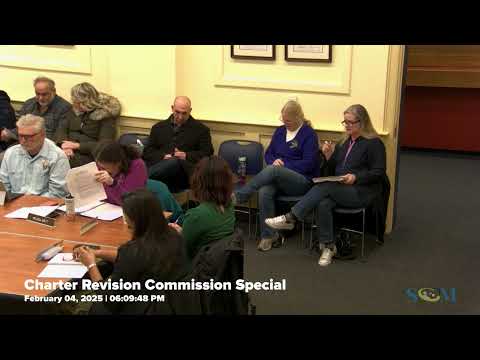
Simsbury commission reopens charter debate on first selectman, town manager roles and board powers
Summary
At a March 2025 Charter Revision Commission meeting, town leaders and committee chairs urged clearer lines between the elected first selectman and the hired town manager, recommended charter language to protect access to information and suggested changes to terms and board-creation authority to increase transparency and continuity.
First Selectman Wendy urged the Charter Revision Commission on March 4 to clarify the town’s governance roles and the scope of boards and commissions, saying “First Selectman is not an easy role.” The discussion ranged from whether the town’s chief elected official should be separately elected or chosen by the council, to whether selectmen should keep power to create temporary committees, and whether terms for key offices should be lengthened to four years.
The commission is reviewing proposed revisions to the town charter intended to tighten rules on boards and commissions, improve transparency and reduce administrative ambiguity. Commission members, the first selectman, the town manager and liaisons from multiple elected boards all urged changes to make responsibilities and timelines explicit.
Why it matters: Simsbury’s current hybrid arrangement — an elected first selectman and an appointed town manager — has produced a working relationship in the present term, but speakers said the charter lacks clear “lanes” and that ambiguity can create inconsistent expectations when administration or elected officials change. Clarifying who directs staff, who declares emergencies, and how the town manager is reviewed could reduce turnover-related disruptions and improve public confidence.
At the meeting, participants proposed five near-term priorities: (1) codify clear division of responsibilities between the first selectman and the town manager; (2) set a consistent timetable and roles for creating or sunsetting boards and commissions; (3) consider moving key elected offices to four-year terms to improve continuity; (4) specify performance metrics and review processes for the town manager that align with charter duties; and (5) ensure any charter language preserves legally required election statutes.
"The town manager needs to be able to adapt to a new elected official every two years," the first selectman said, urging that the charter allow flexibility while setting guardrails. Several commissioners echoed the need for both clear responsibilities and protections that do not depend on the personalities holding the offices. One commission member suggested clarifying whether the first selectman should be designated the town’s chief executive officer while the town manager serve as chief administrative officer; the first selectman noted this would be an “option” worth discussing.
Commissioners and board chairs also discussed how temporary committees can be created and re-created under current charter language, and whether membership requirements (electors vs. non-residents) should be enforced in charter or ordinance. Lori Boyko urged the commission to require that new boards’ membership be limited to town electors and to add procedural rules that limit two‑year temporary committees from being repeatedly recycled.
On staffing and oversight, the commission asked the first selectman and the town manager to provide the commission with the town manager’s expected duties, the metrics used in the town manager’s performance review, and the contract language that frames authority. "There are 13 duties in the town manager section of the charter," the first selectman said, and the commission asked staff to compile those duties and any discrepancies between contract and charter.
The commission asked staff (Franklin) to return with a matrix showing which boards are active or dormant, liaison input on effectiveness, and an inventory of which commissions are created by charter versus ordinance — material commissioners said they need to weigh consolidation, appointment versus election, and equity of political representation.
Ending: Commissioners agreed to pursue more information from board liaisons, to review comparative town charters Franklin prepared, and to return draft language on clearer role delineation and board-creation rules at a future meeting.